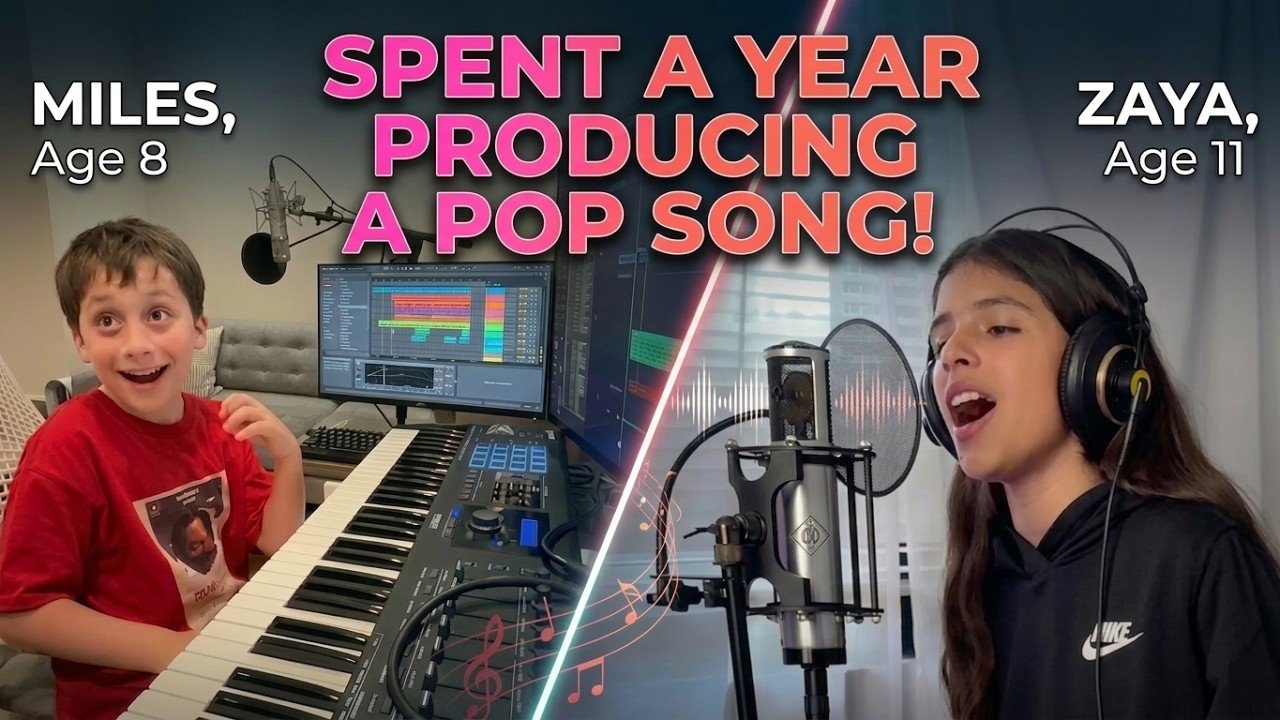
The first direction Miles gives is quietly decisive: ‘Can everybody be quiet? We’re recording.’ The door closes. A vocal take begins. Miles is eight years old.
What unfolds across the session is not a child playing at making music. Miles is producing a full original song – an EDM-leaning track built around the emotional arc of a relationship, structured with a pre-chorus, a building bridge, and layered vocal doubles – with 11-year-old Zaya singing lead. The two work through the material with the kind of focused repetition that usually happens in professional studios: line by line, energy note by energy note, take after take.
How Miles thinks about the song before Zaya sings a word
The track is built around a narrative Miles has already worked out in his head. A person who believed they were better alone realizes they were wrong and returns to someone they pushed away. Miles describes it as a story that unfolds slowly, with an EDM structure underneath. He has already mapped the emotional trajectory of each section before Zaya steps to the microphone, and his direction reflects that – he is not guessing at what he wants, he knows it.
For the opening line, he asks Zaya to soften the approach, then pivot into chest voice for the pre-chorus. When the bridge arrives – ‘And when you kiss me and I don’t feel right, how do I go?’ – Miles coaches her to build energy across three or four takes until the final version is nearly a shout. He cues her with the phrase ‘belly shout to the whole world,’ which turns out to be more effective than any technical instruction. Zaya nails it. Miles calls it immediately: ‘We got it.’
He also explains, mid-session, why a note works harmonically – pointing out that a tritone interval against the main melody would ‘sound awesome’ – before moving on without lingering on it. It is the kind of observation that passes without ceremony in a real session.
The mixing decisions that happen after Zaya goes home
Once the vocal takes are locked, Miles moves into the production layer of the work. He builds a sub bass by shaping an attack envelope until it becomes a wub. He runs a signal through a vocoder – specifically the Vocal Synth 2 from iZotope – in sidechain mode and adds an LFO to give movement to the low end so the beat develops rather than sits still. He replaces Logic stock plugins with tuned processing, adds a compressor and de-esser for warmth, and adjusts the flex tune and humanize settings to preserve the natural quality of Zaya’s voice while cleaning up intonation.
He also mentions a piano layer he painted in manually because the keyboard he was using was two octaves short. The piano, the LFO, the vocoder, and the building vocal arrangement are designed to work as a single rising system – each element contributing to the same emotional peak.
When a collaborator drops in to hear a playback, the reaction is immediate: ‘You got to send me that. I want to listen to it in my studio.’ Miles says he still has work to do at home.
A later session adds more vocals – head voice harmonies, a new lyric Zaya kept hearing in her head, doubled lines processed through Melodyne-style pitch and formant separation. Miles references the Beatles as an influence on one production choice, noting it gave a particular section a ‘Let It Be vibe.’ When he finds the triplet grid moment that fits the bridge, he lets out a quiet ‘fun’ and keeps moving.
After a final set of vocal runs and a round of high fives, the two celebrate with a chocolate chip muffin. Miles says he is so happy he could jump on the bed.
The moment Zaya stops and asks how he did that
After one playback, Zaya turns to Miles and asks him directly: ‘How did you do that? That sounds like Zen, bro.’ Miles walks her through it – the vocal sample, the autotune processing, the signal routed through the vocoder, the bass that results. Then he adds: ‘That’s actually sort of cool.’ He keeps building.
The mixing day is labeled ‘day one.’ Miles notes it is also the day he gets to drive a prop DeLorean parked outside the studio, just for the transitional scene. Some details in a session stay strictly professional. Others do not need to be.
Here is the completed masterpiece 🙂
This article was reported in June 2026.
OHN Editorial Note: This article is based on publicly available sources. If you spot an error or have updated information, contact us at editorial@onlyhappynews.com. We correct mistakes promptly.