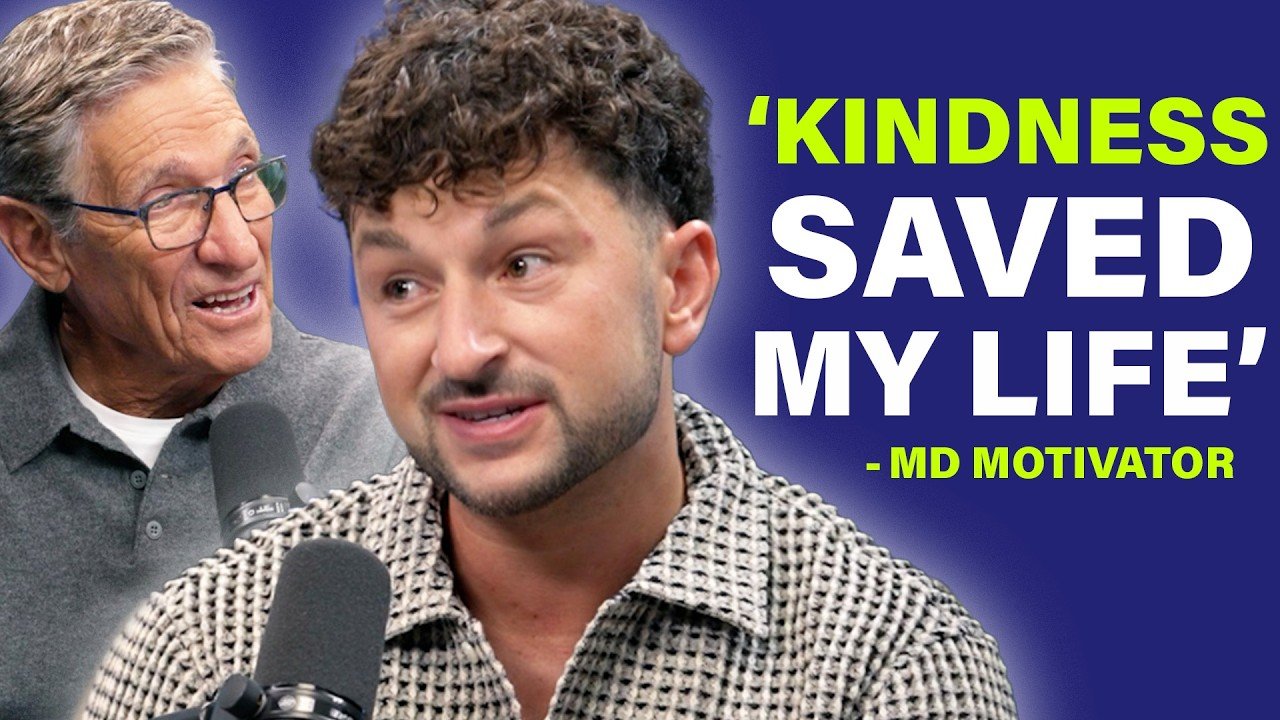
It was the middle of the night in Sydney, raining, and Zach was sitting alone on wet cement outside the Sydney Opera House when two women stopped and asked how he was doing. He said he was fine, the way everyone does. They asked again. Then they sat down beside him on the wet ground and listened to a stranger for 30 minutes. That moment, Zach told Maury Povich in a recent conversation, changed the entire direction of his life. What started as a medical school student in crisis quietly became one of the most watched kindness movements on the internet, with a community of more than 41 million followers and nearly $10 million given away in two years.
Zach grew up in Windsor, Ontario, just across the river from Detroit, and his plan was straightforward: become a doctor. He got into the University of Sydney’s medical school and moved there in January 2020. Then everything collapsed at once. The pandemic pushed classes online. A six-year relationship ended. A week later, he tore his ACL and needed surgery. He was isolated, hurting, and too afraid to tell anyone back home. The walk to the Opera House that rainy night was just to get out of his roommate’s apartment without being seen crying.
From a blindfold and a sign to a quarter million dollars
After those two women hugged him and listened, Zach went home, called his parents despite the time difference, and told them what he had been carrying. He felt heard for the first time in months. His response was to try to be that for someone else. He started blindfolding himself on street corners holding a sign that read: ‘If you suffer from mental health, if you feel alone, if you’re missing someone, if you’re feeling anything, just hug.’ His first TikTok hit 20 million views overnight, but he said plainly that the views were not the point. ‘It was just like this is resonating with people on a real level,’ he said. ‘That was what made me feel alive.’
At 27, he quit medical school and moved back into his parents’ basement in Windsor to make content full time. His parents had no idea what social media was, but they saw their son was unhappy, and they trusted him. The work evolved fast: hugs became flowers, flowers became coffee gift cards, gift cards became live-stream fundraisers, and fundraisers became his nonprofit, Kindness Is Cool.
The scale of what followed is hard to absorb. A single mom in his hometown gave him a strawberry because it was all she had. From that one act, the community raised her nearly $50,000, found her three full-time jobs, and bought her a new car. In Los Angeles, he spotted a father and his autistic son sitting outside a barber shop and discovered they were living out of the father’s trunk. He brought them to a Lakers game, got the son a meet-and-greet with the team, and returned five days later to surprise the family with a quarter of a million dollars, along with nine job offers for the dad and three years of covered medical care for the son.
The quarter that built a friendship worth more than the cash
One story sits at the center of everything Zach talks about. On 127th Street in Harlem, he found a 65-year-old man named Michael in a wheelchair, repeating ‘help me’ while pedestrians walked past him as if he were invisible. Michael was $195 short on rent due the next morning. Zach told him he did not need money, but if Michael gave him a quarter for the bus, he would come back. Michael gave him the quarter anyway, adding, ‘You don’t need it, but take it if you need it.’
Zach came back. The community raised $9,000 in 40 minutes, then eventually $100,000 for Michael. Seven strangers from the same block showed up the next morning to hand it over. But when the cameras stopped, Michael tapped Zach’s elbow. ‘I just want to say thank you for all the money you’ve raised,’ he said, ‘but I haven’t had a friend in seven years and now I have nine people I can call a friend.’ Michael now lives with his son in New Jersey and has met grandchildren he had never met before. Zach was heading to see him the morning after the conversation with Maury.
Michael’s quarter, sitting somewhere in a pocket
A single quarter, passed from a man in a wheelchair to a stranger with a GoPro, on 127th Street in Harlem.
Zach still has not found the two women who sat with him on the wet cement in Sydney. He never got their names. He said he might recognize them if he saw them again, and he is hoping to go back to Australia by the end of the year to look. They had no idea what they were doing that night. But because they stopped, a man who was supposed to become a doctor became something else entirely, and nearly $10 million found its way to people sitting outside barber shops, in wheelchairs on street corners, and in cars that had quietly become their only home.