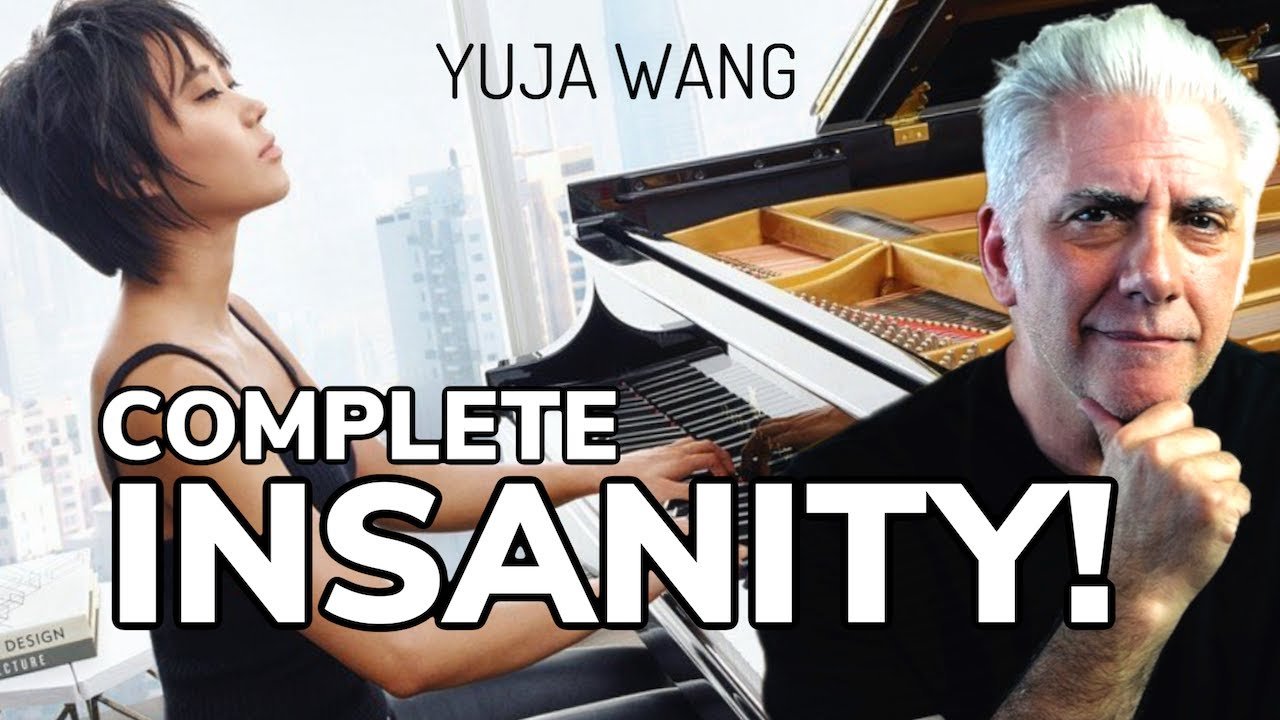
Yuja Wang walks onto the stage at the end of a full concert program, already having given everything to the music for hours, and then attacks an encore that most pianists would never attempt at the start of a fresh rehearsal. The Chinese pianist, born in 1987 and trained at the Curtis Institute, has spent years quietly humbling guitar players who thought they had seen real technical mastery. For anyone who has scrolled through social media watching musicians race through well-rehearsed runs, Wang offers a different kind of reckoning.
When the camera literally cannot keep up
The piece in question is an arrangement of Rimsky-Korsakov’s Flight of the Bumblebee, composed around 1899 to 1900, and the version Wang performs was arranged by Hungarian pianist Gyorgy Cziffra. The arrangement is not a simplified showcase. It features interlocking octaves that Cziffra himself described through his playing as near-impossible demands on any hand, and Wang dispatches them at a speed where the footage becomes a blur. One observer watching this performance put it plainly: ‘the camera can’t even catch up to what she’s doing.’ The one minute and fifty seconds of music she plays at concert’s end carries more physical intensity than most performances at their opening.
The Cziffra connection matters here. A 1962 recording of Cziffra improvising shows exactly where the ideas come from. He was not only a classical virtuoso but also a jazz improviser, and he folded stride piano elements and orchestral textures into his arrangements in ways that made them compositionally wild rather than just technically demanding. His arrangement of a Strauss piece called the Tritsch-Tratsch Polka ends with stride piano at a tempo that makes the left hand’s octaves and chord jumps feel structurally impossible, yet Wang handles those same devices with what looks, from the outside, like calm.
Why violin and piano kept the bar this high
The broader argument behind Wang’s presence in this conversation is not about instrument rivalry. It is about pedagogy. Piano and violin carry centuries of defined and redefined teaching traditions, each generation of virtuosos building on the last, which is why the ceiling for technical and emotional range on those instruments keeps rising in documented, teachable ways. Wang is not just a technical wizard, as those who have followed her work point out. She brings genuine emotional depth to concertos, chamber music, and solo repertoire, and an extensive catalog of those performances is available to anyone who searches her name.
The encore she played after a full program
At 35, Wang is already considered a legend in classical music circles. The fact that she chose Flight of the Bumblebee as an encore, after a complete concert, is its own statement about what is possible when a lifetime of technique meets real physical energy at the right moment.
The Cziffra recording from 1962 sits on its own, a separate artifact from a different era, showing a man building arrangements that would take decades to find a player capable of fully inhabiting them.
The Pianist Who Faked It Until She Made It (And Still Gets Nervous After 20 Years)
She chose the piano because you get to sit down. That was the original logic, a young girl steering away from her mother’s world of dance toward something that at least let her stay still. More than 20 years later, she walks onstage in high heels, plays at speeds that leave audiences asking questions she finds mildly irritating, and still feels the nerves every single time. The story of how a faked passion became a real one turns out to be a story about what music is actually for.
Faking it until the real thing arrived
Her mother was a dancer and had a clear vision for her daughter. The daughter had a different plan. She picked piano not out of love but out of strategy, found a way to sit down, and then, somewhere inside the hours of practice, something shifted. ‘I pretended I really love piano,’ she said, ‘and then I faked it until I made it and then I actually really loved piano.’ The mechanics of practice, she explains, are not really about playing the right notes. They are about making a fool of yourself, finding where you can push too far, and discovering what survives the exaggeration.
What she notices now, after two decades, is that the nervousness has not faded. She frames this not as a failure of confidence but as evidence that the variables keep multiplying. She is always changing. The world is changing. And the piano itself, she insists, is always changing too. Every performance is a live negotiation with all three.
Coming back to Chopin at 11
She is returning to a Chopin concerto she first learned at age 11, and she describes what Chopin’s music does to her in terms that have nothing to do with technical mastery. It lets her tell a story. It lets her create colors. She reached a point where she felt she knew Chopin as a person, someone alive in the room, and that feeling was confirmed, in its own strange way, by a Hugh Grant film she watched in which he played the composer. ‘That was basically my idea of Chopin,’ she said, ‘super dashing, handsome, and his music is so romantic.’ The little-girl fantasy and the concert pianist exist in the same person, and she makes no attempt to separate them.
The comparison she reaches for is landscape. Standing in the Swiss Alps, surrounded by mountains, a particular feeling rises in you from the environment. Chopin produces the same feeling, she argues, but it comes from a fellow human being who lived 200 years ago and apparently went through the same things. ‘I’m made of the same dust,’ she said. She also points out, with real pleasure, that the harmonies running through contemporary pop music trace directly back to him.
The pianist in high heels who would rather skip the process
She is candid about practice in a way that most musicians are not. She does not enjoy it. She wants the goal without the steps to get there, the Sisyphean loop of finishing one piece only to find the next one waiting. When people ask how she plays so fast, or how she pedals wearing high heels, she finds the question a little beside the point. When the body is fully focused, she says, it does automatically what the mind asks. The heels are not the issue.
What she does enjoy, and cannot separate from the rest, is the moment of performance itself. On stage, the first movement can go beautifully, and then the second can disappear in a second. You talk yourself back in. She contrasts this with painting, where once you create something it stays fixed on the canvas. Music is ephemeral. It happens and then it is gone, which is part of why it still costs her something every time.
A Chopin concerto she learned at 11, waiting on the program
The Chopin concerto sits on a future program, the same piece she first worked through as a child, returning to her now with everything she has accumulated between then and this moment.
Every day is a challenge, she said, the same sentence she used to open and the same one she used to close, not as a complaint but as the most precise description she could find for what it means to keep doing this after 20 years. The challenge is not a sign that something is wrong. It is what the love looks like from the inside.
Yuja Wang Played All Five Rachmaninoff Concertos in One Night. Scientists Tracked Her Heart the Whole Time.
Yuja Wang walked onto the Carnegie Hall stage in January 2023 knowing she would not leave it for more than four hours. What she had agreed to play that evening had never been attempted in the history of the piano: all four Rachmaninoff concertos plus the Rhapsody on a Theme of Paganini, back to back, with the Philadelphia Orchestra conducted by Yannick Nezet-Seguin. Researchers asked her to wear a biometric device and track every heartbeat. She said yes. So did Yannick, members of the orchestra, and some audience members. What the data revealed about one of the most physically and emotionally demanding performances ever staged was, in several places, the opposite of what everyone assumed.
The night that had never happened before
The program that evening amounted to two and a half hours of actual music, 621 pages of score, and over 97,000 piano notes. Yuja wore a different outfit for each of the five pieces. The sequence was deliberate: the beloved Second Concerto opened the night, followed by the First, the Fourth, the Rhapsody, and finally the Third, the piece widely regarded as the most psychologically punishing work in the repertoire. The New York Times called it a musical Everest. Yuja, characteristically, was less dramatic about it. When asked what Rachmaninoff himself might say if he were resurrected and heard about the concert, she did not hesitate: ‘Show off.’
Her relationship with the composer runs deep. Pressed to estimate how many times she has performed each concerto, she landed on roughly 70 performances of the Second, 35 of the Third, and around 20 of the Fourth, before admitting she had probably lost count. ‘Rock 2, I was bored,’ she said, which turned out to be one of the most data-relevant observations of the night.
What the heartbeat data actually showed
Yuja’s resting heart rate sat at 62 beats per minute. Her peak across the entire concert reached 149 BPM, 233 percent above that baseline, and it came not during the infamous Third Concerto but during the finale of the Fourth. Her second highest reading, 146 BPM, arrived at the finale of the Third. Her third highest, 139 BPM, came at the finale of the Second.
The early assumption was simple: more notes, faster tempo, louder volume would drive her heart rate up. The data only partly agreed. Loudness correlated clearly with elevated BPM, and during quiet piano-solo passages her heart rate dropped toward 90. But sheer physical note density told a different story. The so-called black page, a section in the third movement of the Third Concerto notorious for its density of thirty-second notes, produced the same heart rate as a slower, quieter passage just one minute later. Skilled pianists conserve energy through efficient movement, Yuja noted, describing her own technique as ‘extremely economical.’
The most striking finding was where her heart rate ran lowest. During the Third Concerto, the longest and most physically complex of the five pieces, her average BPM was the lowest of the entire concert. ‘Rock 3 is like a calming effect for me,’ she said. ‘Like a cool down.’ Conversely, her heart ran higher on average during the First and Fourth, the two works she has performed least. She prepares roughly an hour to an hour and a half before playing the Fourth; before the Third, around ten minutes.
Yannick’s heart told a parallel story from the podium. His highest rate of the night came four BPM above Yuja’s peak, during the finale of the Rhapsody. ‘I’m just there rushing around to make sure we keep up with her speed,’ he said. Most striking was what the data showed between the two of them: across the concert, their heartbeats tracked each other with a synchronicity that surprised both of them when they saw it. Yannick called it telepathy. ‘My entire life as a conductor is to bring people in sync,’ he said. ‘But I never thought it would be reflected in heartbeats like this.’
The audience’s readings added one more layer. During the extended solo Cadenza in the first movement of the Third Concerto, with the full orchestra at rest, the audience’s heart rates climbed alongside Yuja’s. No one was playing except her. Their hearts went up anyway.
The monitor that flipped mid-performance
At one point during the four-hour evening, Yuja’s wearable device screen began flashing. She flipped it upside down and kept playing.
When she finally read the full dataset afterward, Yuja said the numbers surprised her in ways the music itself had not. ‘A lot of it was unexpected,’ she said. ‘For music, for Rachmaninoff.’ Researchers have already suggested a follow-up: tracking her brain waves at the next marathon. Yuja has not said no.
 Wake up to Only Happy News!