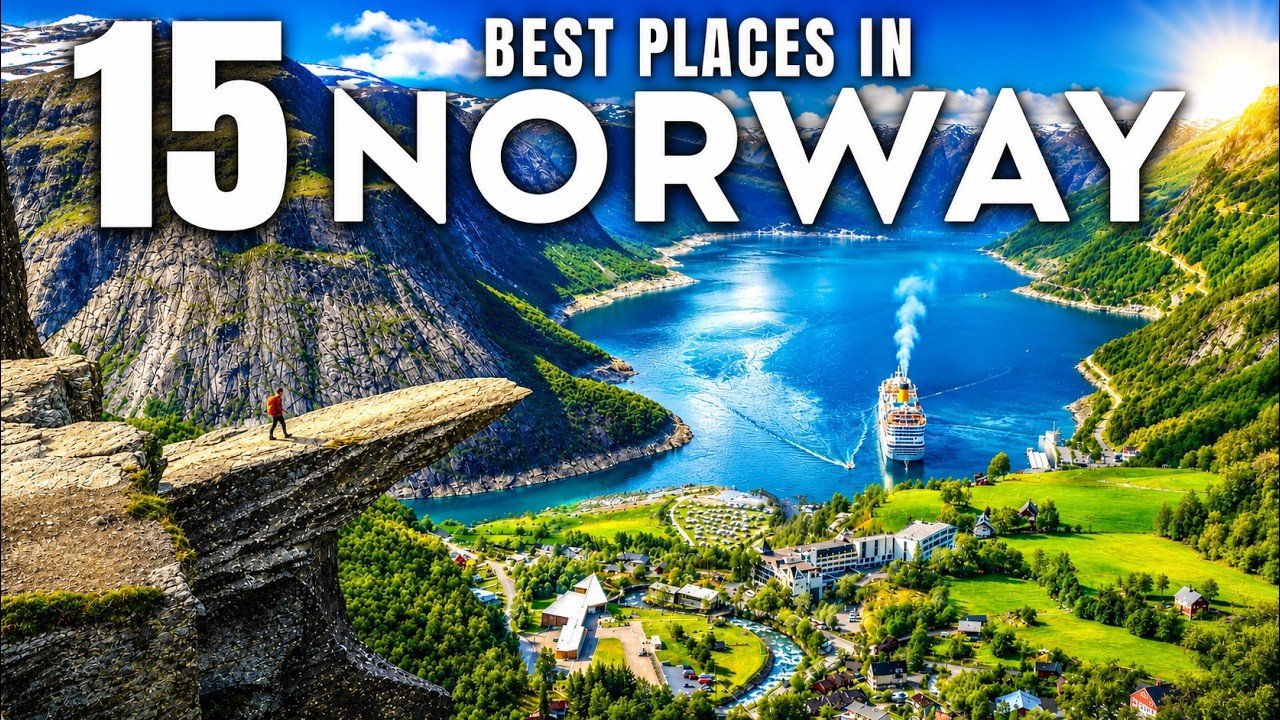
Bergen’s seven mountains ring the city like a natural fortress, and on a clear morning the colorful timber facades of its historic harbor reflect off the water below in a way that stops cruise passengers mid-stride. Norway rewards the traveler who is willing to get wet, get high on a clifftop, and drive roads that feel engineered by someone who had never heard the word ‘impossible.’ This countdown of the top 15 places to visit in the country starts on the southwestern coast and pushes all the way to the edge of the Arctic, covering fjords, island villages, cathedral cities, and one rock that juts over a valley like a troll’s outstretched tongue.
Bergen to Oslo and the fjords in between
Bergen opens the list as the gateway to the fjords and, unofficially, as one of Europe‘s rainiest cities. A raincoat is non-negotiable here regardless of the month. The settlement is more than a thousand years old and served as Norway’s capital for two centuries. Its open-air fish market and the Bryggen harbor district anchor daily life, while a funicular hauls visitors up the hillside for mountain views over a city of around 300,000 people. Coming in second are the Lofoten Islands, a scattering of sharp peaks, red fishing cabins, and beaches that trail into fjord water. The midnight sun runs from May to July, and the northern lights window opens from September to mid-April. The E10 road connects most of the islands and ranks among the world’s most scenic drives, though the guide advises saving it for summer unless ice driving is already second nature.
Oslo lands at number three as the country’s capital and largest city, home to more than a million people. Two days is the recommended stay, enough to reach the Viking Museum, walk the waterfront past the Opera House, and still have time to board the Oslo-Bergen railroad, which covers 308 miles in roughly 6.5 to 7 hours and is considered one of the world’s most scenic rail journeys. Three to five direct trains run daily depending on the season. A hop-on hop-off bus handles the city efficiently for first-time arrivals, though the guide notes Oslo can be compressed into 24 hours for travelers short on time.
Geiranger Fjord takes the fourth spot as a UNESCO World Heritage Site. The fjord runs about 15 km inland, framed by waterfalls including the Seven Sisters and Bridal Veil, and the tiny village of Geiranger sits at its end. Most cruise itineraries pass through here. The Atlantic Road follows at number five: 8.3 km of coastal highway connecting several towns across eight bridges, free to drive since 1999. The full drive takes 15 to 20 minutes, though most visitors spend considerably longer at the viewpoints.
Clifftops, cathedral cities, and the deep north
Pulpit Rock, known locally as Preikestalen, rises 604 meters above the fjord at number six. Glaciers carved it roughly 10,000 years ago during the ice age, and the edge has no fence or guardrail. The 8 km hike typically takes 4 to 5 hours. Tromsø arrives at seven, sitting 350 km north of the Arctic Circle with a population of 80,000 people. It holds the informal title of northern lights capital of the world, and in summer it pivots to midnight-sun experiences and whale watching, with orca and humpback sightings off the coast. The Arctic Cathedral, known for its stained glass windows, anchors the city.
Alesund at number eight was almost entirely destroyed by fire in 1904 and rebuilt within a few years in Art Nouveau style, making it one of Europe‘s most architecturally distinctive cities. Around 60,000 people live on this island city, and 418 steps lead up to the Aksla viewpoint. Flam slots in at nine: a village of just 350 residents that draws hundreds of thousands of tourists annually for its railroad, where 80 percent of the route runs at a gradient of 5.5 percent, making it one of the steepest adhesion railways on Earth. Twenty tunnels cut through the mountains, many of them carved by hand.
Stavanger, Norway’s oil and gas capital and fourth largest urban area at 150,000 people, takes the tenth position. Its old town is considered Europe’s best preserved collection of wooden buildings, and the waterfront pulls in visitors with seafood markets, colorful facades, and nearby beaches used for surfing and sunset walks. Naeroyfjord follows at eleven, another UNESCO World Heritage fjord and the longest and deepest in the country at 18 km. At its narrowest the fjord measures just 250 meters across while surrounding peaks rise more than 1,700 meters above the water. Trondheim lands at twelve as Norway’s first capital, founded in 997 AD and home to Scandinavia’s largest medieval church, Nidaros Cathedral. The city of around 220,000 people in the metro area also hosts the Norwegian University of Science and Technology, lending it a young, academic energy alongside its Viking-age history.
Reine, a village within the Lofoten Islands, earns its own separate entry at thirteen for scenery the guide describes as rivaling Alaska: red fishing houses against snow-dusted peaks reflected in still water. Senja Island comes in at fourteen, often called ‘Norway in miniature’ because it packs fjords, forests, mountains, beaches, and fishing villages onto a single landmass north of the Arctic Circle. Some of its beaches run a shade of blue that, as the guide put it, ‘look tropical like you would see in something in Fiji.’ Wildlife here includes moose, eagles, reindeer, and whales.
The countdown closes at number one with Trolltunga, a rock shelf formed by glaciers around 10,000 years ago that juts horizontally over a valley like, as locals say, a troll’s tongue. The hike covering 27 to 28 km typically takes 8 to 12 hours and is accessible from June through September.
The hiker who reached the edge
At Pulpit Rock, 604 meters above the fjord, the rock ends without ceremony. No fence, no railing, just open air and the water far below.
Norway stretches north to south like a sliver of a country, sparsely populated and overwhelmingly wild, and the two UNESCO fjords on this list represent only the beginning of what the landscape offers. Bergen started it all with a raincoat and a funicular, and Trolltunga ends it with a 12-hour hike and a view that took 10,000 years to form.
 Wake up to Only Happy News!