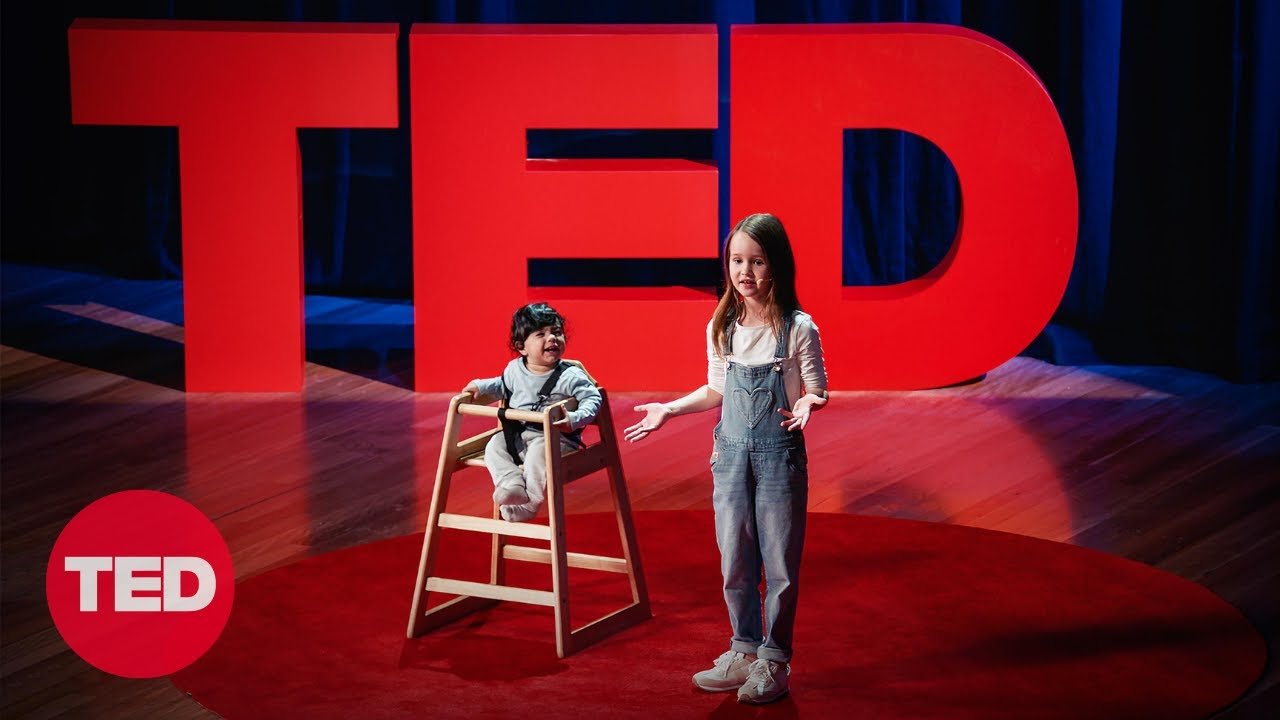
Molly Wright walked onto the stage carrying two bags, one blue and one red, and a baby named Ari on her arm. She was seven years old, and she had come to talk to a room full of adults about their brains, and about hers. What followed was one of the most disarming arguments for early childhood connection in recent memory, delivered not by a neuroscientist but by a second-grader who knew exactly what she was describing because she had lived it. The stakes, as Molly made clear from her first breath, could not be higher: the way adults respond to children in the earliest years of life shapes not just childhood, but every relationship, every skill, and every moment of calm or confusion that follows.
Two bags and a baby make the point
Molly held up the blue bag first. It represented the rough size and weight of a healthy baby’s brain at birth. Then came the red one, larger, heavier, representing a baby’s brain after just the first year of life. The brain nearly doubles in volume in that single year, she explained, and by age seven, it has already reached roughly 90 percent of an adult brain’s volume. In those early years, the brain can form up to one million neural connections every second. But it cannot do it alone.
Molly had brought her neighbor Amarjot and his baby Ari to make the science visible. She walked the audience through three types of simple interaction, copycat games that build imagination and empathy, naming games that build vocabulary and attention, and peekaboo, which she described as building memory and trust. Scientists call the broader pattern ‘serve and return,’ she noted, though she had her own translation: connect, talk, and play. Each time an adult responds to a baby’s reach, laugh, or sound, a neural pathway is reinforced. Each ignored signal is a missed opportunity at a moment when those windows are opening faster than they ever will again.
The thirty seconds that went quiet
The talk’s sharpest moment came when Molly asked Amarjot to stop responding to Ari. No anger, no raised voice, just absence. Ari reached toward his father’s face. He tried again. Within seconds, the baby was crying, confused by a silence he had no framework to interpret. Then Molly asked Amarjot to re-engage, and Ari laughed almost immediately. Molly stood still for a moment before speaking. ‘Now what if our whole childhood was like that last 30 seconds?’ she asked. How hard it would be, she said, for a child to feel calm, to feel safe, to learn to trust anyone, and the lifelong impact that would have. ‘That makes me feel sad,’ she added, without fuss.
Ari recovered quickly, she pointed out, specifically because the bond between him and his father was already so strong. That security is what allows children to try new things, to explore, to take the small risks that become the large competencies of adult life.
The girl who asked everyone to play more
Molly closed with a call that was precise rather than grand. The most critical window is the first five years, she said, starting from inside the womb. The single most impactful thing any adult can do during that time is serve and return, and when they do it matters as much as how: early, and often.
She looked out at the room and put it plainly: ‘To us, the children, it’s so much more than just a game. It’s our future.’
Ari laughed again as the applause came in.
The blue bag and the red bag were still sitting on the stage when she walked off.