On July 19, 2026, MetLife Stadium just outside New York City will host the most-watched sporting event on the planet. More than 5 billion people are expected to watch some part of the 2026 FIFA World Cup, and the 104 matches leading to that final represent the longest, most logistically complex tournament ever attempted. Three nations, 16 stadiums, four time zones, and a price tag for a final ticket that starts at $4,000 make this unlike any World Cup that came before it.
A tournament that outgrew its own blueprint
The 2026 edition expands from 32 to 48 teams, stretching across five and a half weeks and three countries: the United States, Canada, and Mexico. That transcontinental footprint means the distance between the northernmost and southernmost venues runs roughly 4,500 kilometers, from Vancouver to Miami. Fans who could hop between stadiums in a single day during Qatar 2022 now face serious cross-border logistics, and a U.S. transportation network built primarily around cars adds another layer of friction. Seven of the eleven U.S. stadiums have some access to a rail line, though some of those connections require more than a ten-minute walk.
The 16 host stadiums were all already standing, but most needed significant work. FIFA’s rules ban corporate branding, so nearly every venue is temporarily renamed for its city or region. And because almost all of them were built for American football, the most common modification is widening the pitch from the standard 48.8-meter NFL field to FIFA’s required 68-meter width, typically by pulling out fixed corner seating and rolling in retractable bleachers.
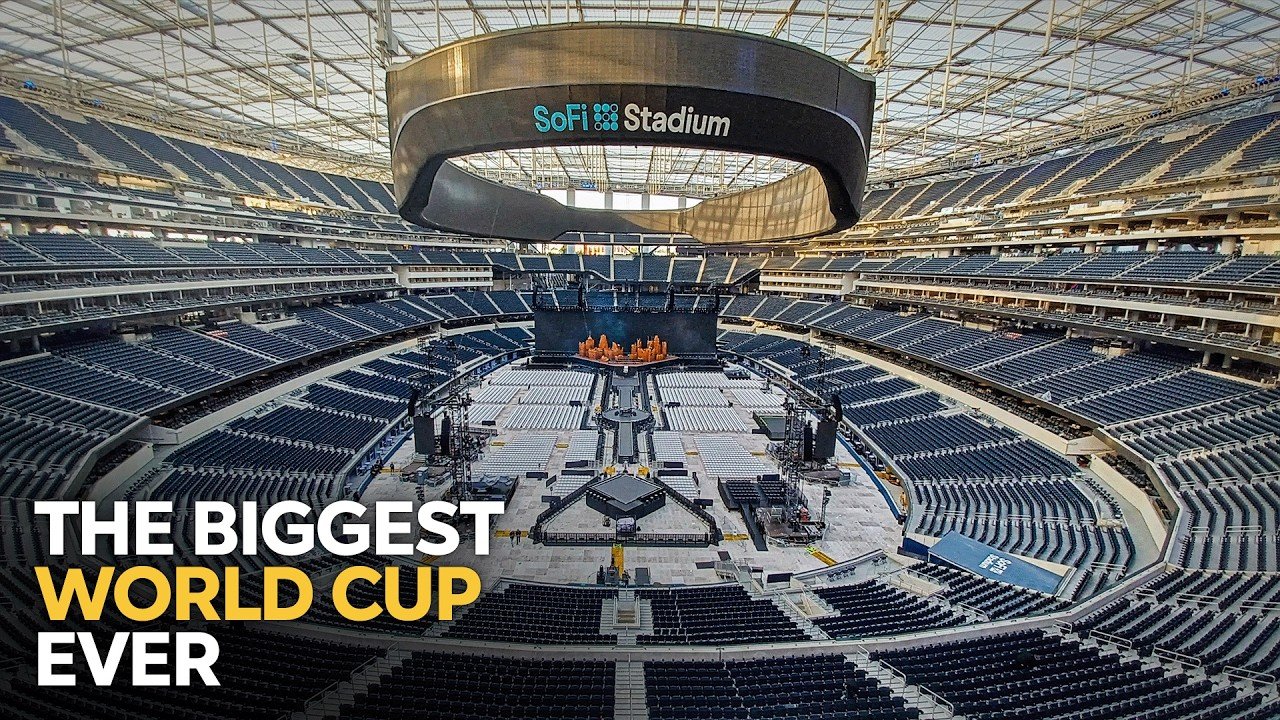
Starting on the west coast, SoFi Stadium in Los Angeles arrived at this tournament as the most expensive stadium ever built, with costs totaling $5.5 billion. Its ETFE canopy covers nearly 93,000 square meters and includes more than 300 separate panels embedded with LEDs, turning the entire roof into a display visible from the approach into LAX. Despite that roof, FIFA classified SoFi as open-air and prioritized fully air-conditioned venues for daytime matches, which cost it the final. It still won eight matches, including the U.S. team’s opener.
Up in Vancouver, BC Place carries a retractable roof installed during a $435 million renovation in 2011, making it the world’s largest cable-supported retractable roof structure at the time. For 2026, another $130 million went toward locker rooms, washrooms, elevators, and expanded VIP facilities. Just south of the border, Lumen Field in Seattle once held a Guinness World Record for crowd noise at more than 137 decibels, a record it later lost to Arrowhead Stadium in Kansas City, which now holds the mark at 142.2 decibels set in 2014.
Levi’s Stadium in Silicon Valley rounds out the west coast, featuring a 2,500 square meter green roof that doubles as a working farm growing 40 different crops, along with nearly 1,200 solar panels and 85 percent recycled water use. A $200 million upgrade ahead of the Cup and the 2026 Super Bowl refreshed the video boards and luxury suites.
History, altitude, and a volcano in the middle of the draw
The central region carries some of the tournament’s most distinctive venues. In Mexico City, Estadio Azteca becomes the first stadium ever to host three World Cups, having staged the 1970 and 1986 tournaments before 2026. It was inside this stadium that Diego Maradona scored both the Hand of God and the Goal of the Century in a single match in 1986. Its elevation of 2,200 meters above sea level thins the air enough to affect stamina and make the ball travel faster and farther than players are accustomed to, a factor that could matter when Mexico opens against South Africa on June 11. An $80 million renovation added a hybrid pitch with roughly five percent artificial grass stitched into the natural surface for durability, a standard now common in the Premier League.
Nearby in Guadalajara, Estadio Akron is built to evoke a dormant volcano, with grassy earth walls as the volcano itself, the seating bowl as the crater, and the roof canopy representing a cloud. In Monterrey, Estadio BBVA offers steep seating with minimal distance between fans and the field, with the mountain silhouette of Cerro de la Silla rising behind it.
In Dallas, AT&T Stadium’s 49-meter HD video board once held the record for largest HDTV screen in the world and has famously been struck by punts during NFL games. In Kansas City, Arrowhead’s 54 years make it the second-oldest venue in the tournament. Houston’s NRG Stadium was American football’s first retractable-roof stadium and is receiving a $55 million upgrade to ensure that roof is actually functional for the Cup, since it is almost never retracted under normal operation.
In the east, Mercedes-Benz Stadium in Atlanta became the first arena ever built with a roof that opens in a circular aperture pattern, like a camera iris, when it opened in 2017. Toronto’s BMO Field will host the June 12, 2026 match, the first Men’s World Cup game ever played on Canadian soil. A $146 million renovation is temporarily lifting capacity from 28,180 to 45,000 by erecting massive steel grandstands at the open north and south ends, which come down again after the six matches conclude.
Gillette Stadium in Massachusetts completed a $250 million renovation in 2023 that added a 22-story lighthouse with an observation deck and a curved video board spanning more than 2,000 square meters. Lincoln Financial Field in Philadelphia uses an asymmetric seating layout with steep upper levels and three open corners that give fans sightlines directly into downtown Philadelphia during matches.
The $4,000 question hanging over the whole thing
Ticket prices for the final jumped from $600 at Qatar 2022 to a minimum of $4,000, and FIFA’s dynamic pricing strategy has pushed costs higher across the board. Beyond cost, the question of who can physically enter the United States adds another dimension. FIFA introduced a FIFA Pass to reduce visa appointment wait times, but a ticket alone does not guarantee entry, leaving fans from some participating countries in genuine uncertainty about whether they will be able to show up and use what they purchased.
The creator put it plainly about the broader sustainability picture: ‘FIFA has talked a big game about sustainability in recent years. Their goal is to reach net zero by 2040. But to be honest the big picture for this Cup does not look eco-friendly.’
The aluminum fins waiting to go green
MetLife Stadium’s exterior is lined with thousands of aluminum louvers that shift between blue for New York Giants games and green for New York Jets games. On July 19, for one afternoon, neither team’s colors will matter.
SoFi’s roof panels will glow over Los Angeles for the group stage while, 4,500 kilometers away, Estadio Azteca’s hybrid pitch absorbs the altitude and the weight of its own history, hosting a third World Cup 56 years after it held its first.
 Wake up to Only Happy News!