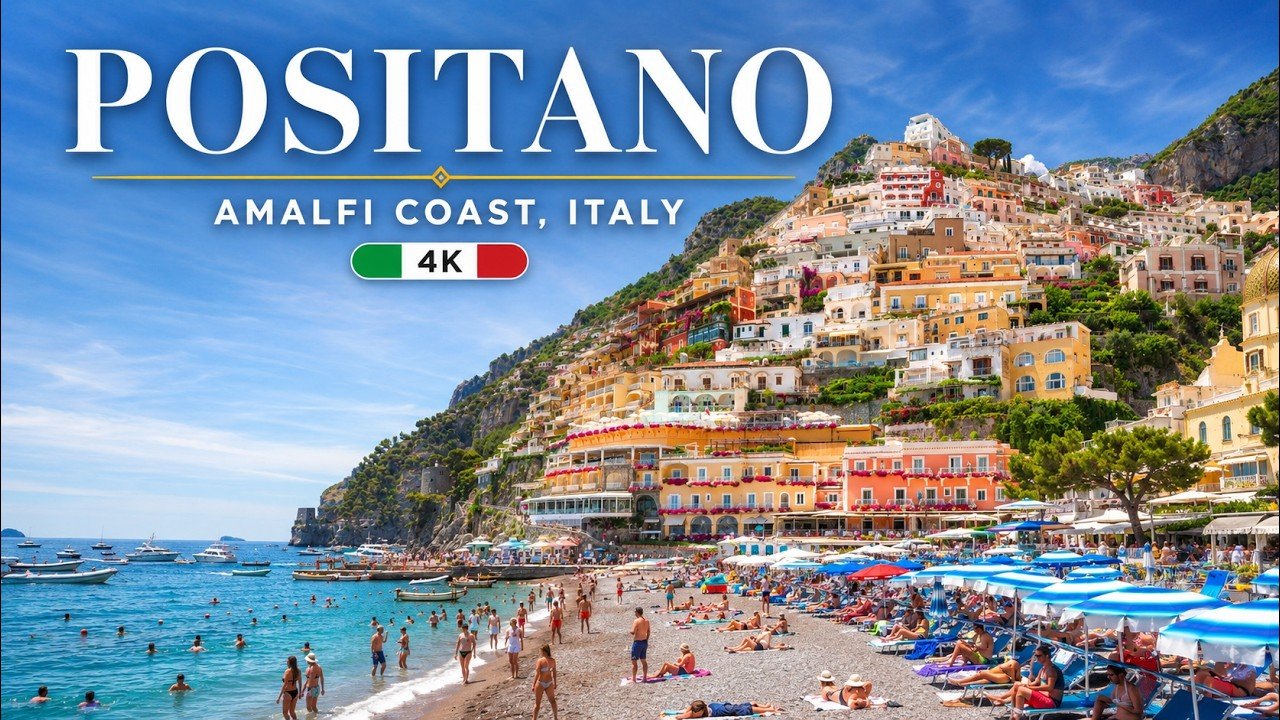
At 1:47 on a June afternoon, the Spiaggia Grande was doing what it always does in summer: filling every square meter of its 300-meter shoreline with sunbathers, rental loungers, and wooden fishing boats pulled up on the dark pebble sand. Positano climbs nearly 400 meters from that waterline to the ridgeline above, and for anyone standing on the beach looking up at the pastel stack of houses the locals call the Positano Pyramid, the question is always the same: how do you actually get around a town built this steep? The answer, it turns out, is staircases, patience, and a willingness to earn every view.
The walk covering Positano’s beaches and cliffside streets started the way most visitors do, at the piazzetta behind the main beach. Half the Spiaggia Grande is free sand; the other half is lined with rental loungers running roughly 25 to 35 euros a day, with front-row seats costing a little more. The pedestrian promenade behind the beach, Via del Brigantino, takes its name from the brigantine, a two-masted sailing ship, and threads past pine-shaded restaurants, boutique windows full of breezy linen, and stands selling granita and cold drinks all afternoon.
The cliffside path that earns its ten minutes
From the ferry dock at the eastern end of the promenade, a cliffside walkway called Via Positanesi d’America connects Positano’s two beaches. The name is not decorative: in the hard years of the 1800s, more than half of Positano emigrated, most of them to the United States, and the marble plaques along the path wall remember those families by name. Out beyond the anchored boats, the Li Galli islets sit on the horizon. According to legend they are the home of Homer’s Sirens, and the islands are still called Le Sirenuse; in more recent times they belonged to the ballet dancers Leonide Massine and then Rudolf Nureyev.
Ten minutes along the path delivers you to Spiaggia del Fornillo, quieter and wilder than the main beach, guarded at each end by watchtowers built in the 1500s when Ottoman and Saracen raiders made fire-and-smoke warning chains a practical necessity. Torre Trasita, the square tower at the eastern end, can now be rented as a vacation home. The Pupetto beach club marks its territory with orange loungers, and the beach clubs store their gear in natural caves at the base of the cliff. Prices at Fornillo run noticeably cheaper than on the Spiaggia Grande, which is one reason locals prefer it. At the western end the beach turns to open pebbles and boulders, and a watchtower called Torre Clavel holds the point: a century ago it was carved into habitable rooms by Gilbert Clavel, an eccentric Swiss writer who apparently wanted a home no one could accidentally stumble into.
Coming down from the top
The real twist of the day was structural. Filming had actually begun at 12:08 at the top of town, at Piazza Chiesa Nuova, one of Positano’s two SITA bus stops. Arriving by bus and getting off here means the entire town is downhill from your first step. The upper streets are where Positano lives rather than performs: covered alleys built narrow for shade, laundry lines, tiny alimentari, and a basketball court with a view that would embarrass most five-star hotels. Viale Pasitea, the main road that corkscrews down through the center, carries the name of the sea nymph Pasitea, for whom legend says Poseidon founded the town. Garage parking along this road runs roughly 8 to 10 euros an hour, which, as the walk noted, is one more argument for the bus or the ferry.
At Piazza dei Mulini, the crossroads of the lower town named for the flour mills that once ran on the stream flowing beneath the paving stones, Via dei Mulini drops toward the church and the beach. The famous ceramic garden at a delicatessen along Via Cristoforo Colombo stops nearly everyone: the owner admits visitors a few at a time, closing the gate behind each group, and the terrace holds life-size hand-painted ceramic figures overlooking the valley. As the walk put it plainly: ‘I should have taken my time out here.’
The descent ends at the Chiesa Madre di Santa Maria Assunta and its majolica-tiled dome of green and yellow. The church was closed on arrival, so the visit stopped at the vestibule, but the legend was told from the doorstep: pirates fleeing with a stolen Byzantine icon of the Madonna were caught in a dead calm off this coast, a voice from the painting cried ‘Posa, posa!’ meaning lay me down, the sailors brought the icon ashore, and the winds returned. The Black Madonna still hangs above the altar. Beneath the church, a Roman villa buried by Vesuvius in 79 AD has been excavated into the MAR museum, its frescoed rooms accessible by guided group visits booked in advance.
One detail left standing
The permanent nativity scene built directly into a rock face along the upper road, a little Christmas set into the cliff all year round, with no explanation offered and none required.
By the time the route looped back to the piazzetta where it began, the 4.5-mile walk had covered two beaches, one cliffside path, a cliff-top road, a handful of staircase alleys, and a church legend. The Spiaggia Grande was quieter now, the rental loungers mostly empty, and the pastel stack of the Positano Pyramid had shifted from afternoon gold to the softer light that comes just before the hillside becomes, in the words of the walk, a wall of lights.
 Wake up to Only Happy News!