On July 12, 1895, a child named Buckminster Fuller came into the world in Milton, Massachusetts. He would go on to publish 30 books, coin entirely new words for the English language, and design a structural form – the geodesic dome – that still stands across the planet today. This piece covers Fuller’s core inventions, his most recognized structure, and why his obsession with efficiency still echoes through modern design.
How the Geodesic Dome Went From Concept to the Montreal Biosphere
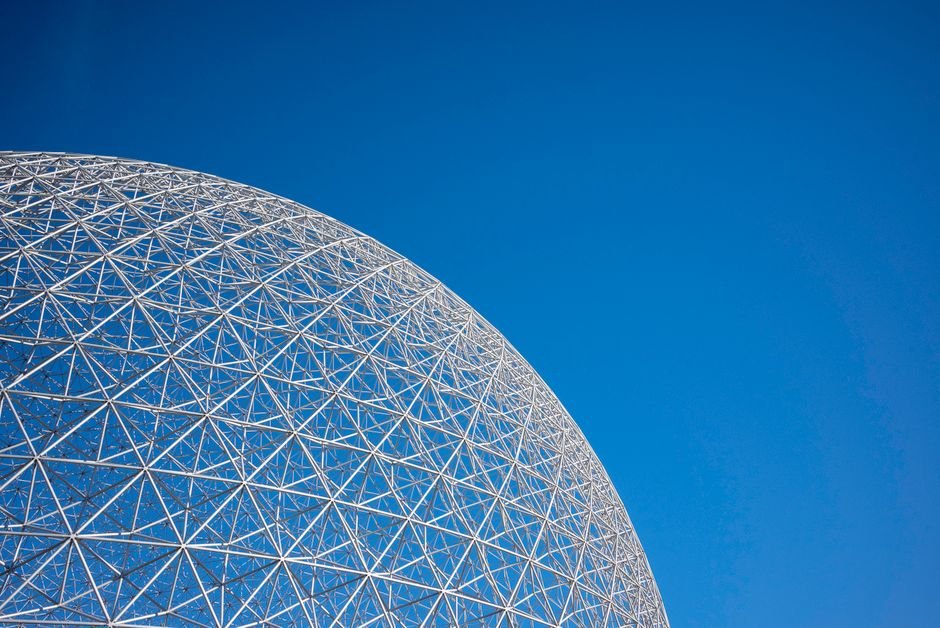
Fuller spent decades fixated on a single question: how do you enclose the most space using the least material? His answer was the geodesic dome – a structure built from a network of triangles arranged into a spherical form. The design distributes stress across every joint, meaning the whole thing stays rigid without a single internal support column. His most visible application of the concept was the U.S. Pavilion at Expo 67 in Montreal, a 76-meter-wide dome that later became the Montreal Biosphere. It is still standing. Fuller held a U.S. patent on the geodesic dome structure, and the design was eventually reproduced tens of thousands of times across military radar stations, homes, sports facilities, and scientific research outposts worldwide.
30 Books, Invented Vocabulary, and a Presidential Medal of Freedom
Fuller was not a narrow specialist. He wrote 30 books across architecture, philosophy, systems thinking, and futurism. He coined the term ‘Spaceship Earth’ as a framework for thinking about global resource management – treating the planet as a closed system with finite inputs. He invented the word ‘synergetics’ and developed an entire geometric and philosophical system around it. His honors stacked up across decades: the Presidential Medal of Freedom in 1983, over 47 honorary doctorates, and a long list of architectural and design awards. He held 28 U.S. patents by the time of his death in July 1983.
Why Fuller’s Efficiency Obsession Still Drives Carbon-Conscious Architecture
Fuller’s central argument – that doing more with less was both a moral and practical necessity – has re-entered mainstream architectural conversation as building-sector emissions have become a policy target. Geodesic and tensile structures use substantially less raw material per square foot of enclosed space than conventional rectangular construction. Research groups and low-cost housing organizations in several countries have revisited Fuller’s dome blueprints specifically because the reduced material load cuts both cost and embedded carbon. His framework was not metaphor. It was applied geometry with measurable outputs, and those outputs still hold up under modern structural analysis.
Fuller was nearly expelled from Harvard twice and never completed a formal degree there – yet he ended up holding 47 honorary doctorates and designing structures that outlasted most of the credentialed architects of his era. The Montreal Biosphere is still drawing visitors on the banks of the St. Lawrence River, which is about as concrete a legacy as a born inventor can leave.
Source: Read original
 Wake up to Only Happy News!