https://www.youtube.com/watch?v=zuoV0pC9zZ0
Dale Chihuly once blew his first glass bubble using an iron pipe he probably bought at the hardware store, guided by nothing more than a photograph on a wall of a glass blower with cheeks puffed out like a trumpet player. That accidental beginning now fills conservatories, citadels, and the base of the Space Needle, which means the distance between a hardware store pipe and 46-foot glass towers in Jerusalem is, at its core, a story about refusing to stop too soon. It is also a story about a kid from a working-class family who lost his older brother and his father within a year of each other and found, in the strange alchemy of sand and fire, a reason to keep going.
Sand that turns into honey
Chihuly describes the material the way a child would, which is precisely why it still sounds miraculous to everyone else. ‘You take sand and fire and put it together and you have glass,’ he explains, ‘and you make it turns into a liquid. Imagine the sand turns into a liquid and then you stick a pipe in there and gather it up like honey.’ For a kid, that is a magic trick. For the adult reading alongside, it is the oldest trade secret in the world, 2,000 years of accumulated human knowledge reduced to breath and a pipe.
His path to that pipe was neither straight nor planned. His father came out of the coal mines to become a meat cutter and a union organizer. His mother was a housewife who wanted her surviving son in college after a brutal two years that took both his brother and his father before Chihuly turned sixteen. He started weaving at the University of Puget Sound in 1959, transferred to the University of Washington, and by 1962 was fusing bits of stained glass into tapestries. ‘I knew that I had something there,’ he says. ‘That was the first time I really sensed I’d created something that was unique.’ He fished commercially in Alaska to earn graduate school tuition, earned degrees in Wisconsin and then at the Rhode Island School of Design, and landed a Fulbright that took him to a famous glassblowing factory in Venice. He was too intimidated to blow anything there. He just watched.
What baskets taught a glass blower about letting go
The breakthrough came in 1977 at the Washington State Historical Society in Tacoma. Chihuly was studying their Native American basket collection when he noticed the old baskets were crumpled and asymmetrical, imperfect in a way that felt alive. He went back to the studio and started beating freshly blown glass with a paddle to get the same quality. Then he discovered the furnace itself could do the work. ‘I soon learned that if I just used the heat of the furnace and the fire, I could get the same kind of movement from the fire itself, and it was more beautiful.’ That realization, letting heat and gravity and centrifugal force shape what human hands could only approximate, unlocked everything that followed: the sea forms, the Persians, the Venetians, the chandeliers.
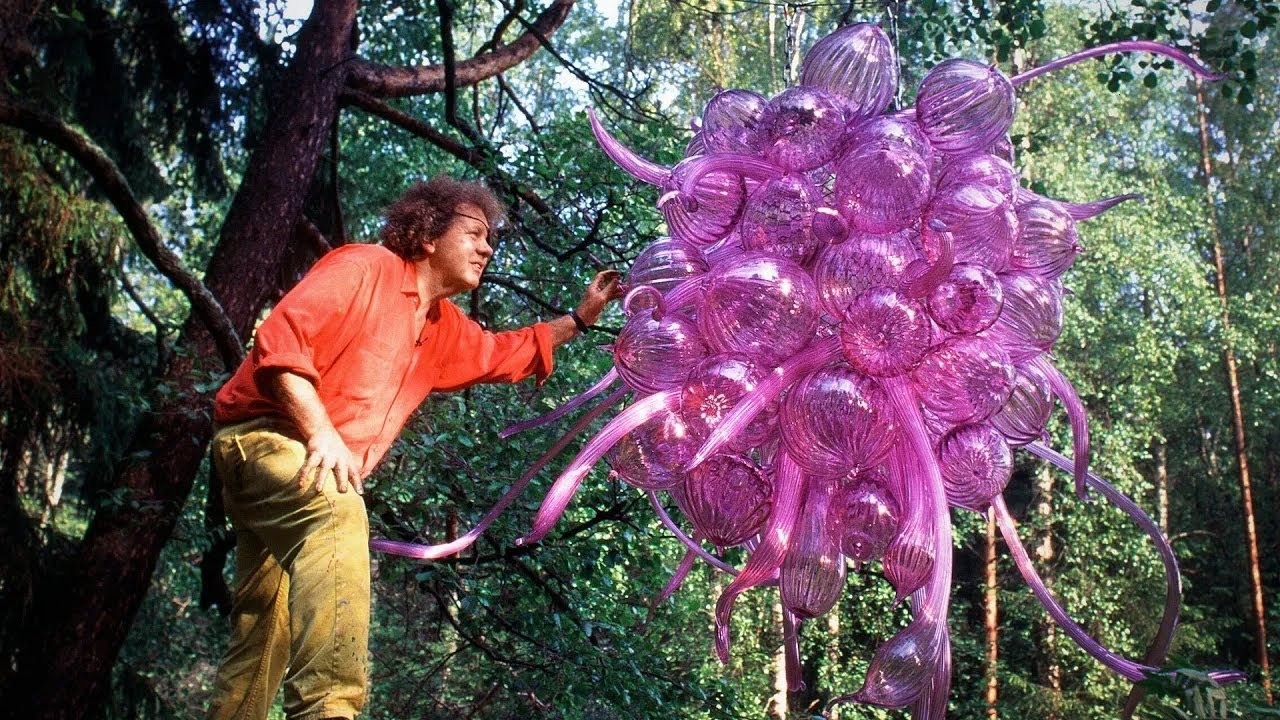
The chandeliers came from a single sentence he woke up with one morning: he wanted to hang them over the canals of Venice. The concept grew into a project spanning Finland, Ireland, and Mexico before the pieces ever touched the water. Eventually they reached the Citadel in Jerusalem, 14 installations climbing as high as 46 feet inside one of the oldest standing structures on earth. His project manager put it plainly at the time: ‘On paper it’s only 8 inches tall, not 45 feet tall. But that’s the challenge, to do it in a way that doesn’t hurt anything or people, and to make it what Dale wants.’
The largest project of his career was completed in 2012 at the base of the Space Needle: eight interior galleries, eight exterior garden installations, and a permanent home for what he describes as a culmination of the best work from 11 garden exhibitions over the previous decade.
Chihuly Sculptures in Atlantis Bahamas captured by Sandtastic Travels, OHN’s Sister Media Company – (SandtasticTravels.com)
The piece he almost walked past
Somewhere in the Garfield Park Conservatory in Chicago, inside one of the largest greenhouses in the world, a glass form sits among plants that have been growing since the building opened around 1910. The palm house rises 100 feet overhead. The glass does not compete with it.
Chihuly built his studio life around a team and around the hours before most people wake up, 4 or 5 in the morning, when no one else is asking questions and the next idea has room to arrive uninvited. The baskets became sea forms. The sea forms became Persians. The chandeliers came, he says, ‘out of nowhere.’ The hardware store pipe is long gone, but the bubble it made is still expanding.
 Wake up to Only Happy News!