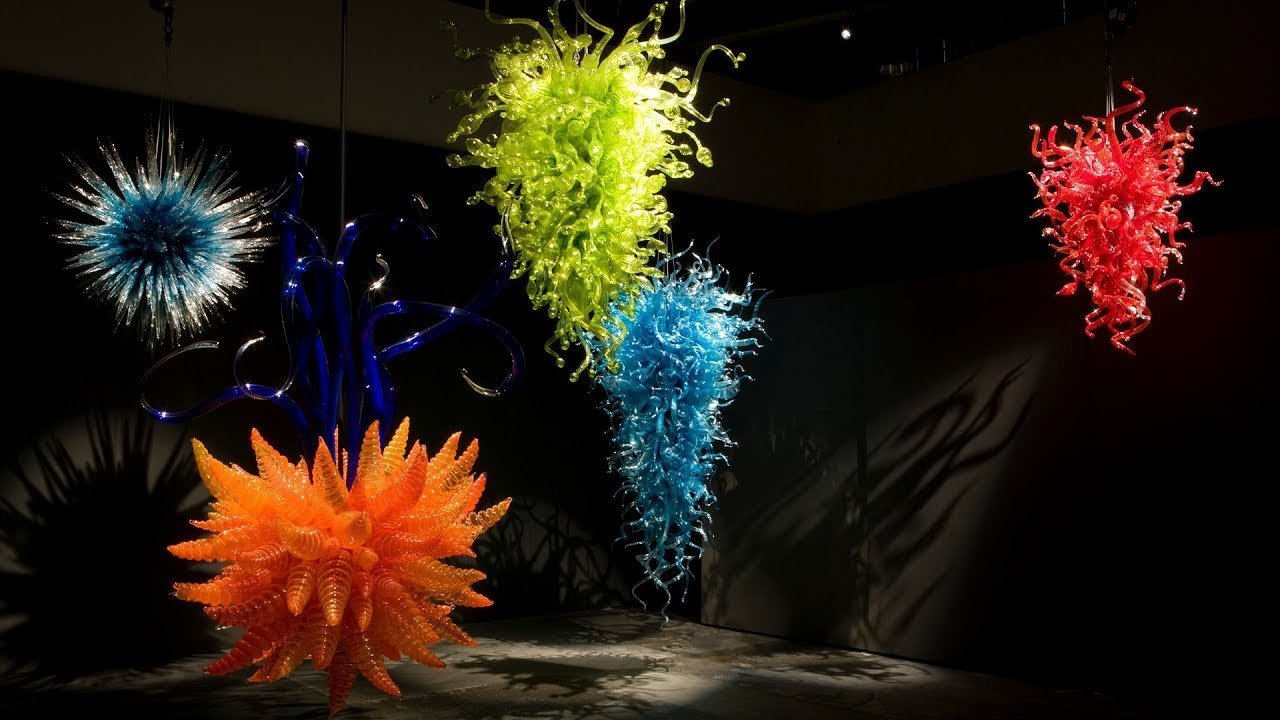
Somebody blew air down a tube thousands of years ago, watched a bubble take shape from nothing, and the world has never quite recovered. At Chihuly Studio, that original act of human breath meeting molten glass is still the engine behind some of the most arresting sculpture on earth, and the story of how those sculptures found their audience is, at its core, a story that anyone who has ever made something and waited for the world to catch up will recognize immediately.
Twenty-five chandeliers and zero buyers
It started with a low ceiling in Barcelona. Dale Chihuly walked into an Italian restaurant while traveling and found a chandelier hanging at eye level, not high above the room the way chandeliers are supposed to hang, but right there, at sitting height, so that diners looked up into it from below the way you look up through ice. That image unlocked something. Chihuly realized a chandelier did not have to be functional at all. It just had to occupy space in a way that changed how the space felt.
The first one went to the Seattle Art Museum: roughly 500 parts, simple forms, something that read from a distance like a cluster of yellow balloons. It came together in a ten-day sprint, because speed, for Chihuly, is not recklessness but honesty. ‘I really like to work fast,’ he has said, ‘and the faster it is, the more energy it takes, the better I like it.’ That initial force, that idea arriving before judgment has time to slow it down, is exactly what he chases every time he puts a team on a floor.
Over the next couple of years he made about 25 chandeliers. Not one of them sold. His own team told him plainly: they were running out of money, and nobody wanted these things. Chihuly kept making them anyway, unable to understand why the rest of the world was not seeing what he was seeing. Then, slowly, somebody bought one. Then another. The series that nearly bankrupted the studio became the work he is most recognized for, proof that an audience sometimes needs two full years just to catch up to an idea that was already finished.
Chihuly Sculptures in Atlantis Bahamas captured by Sandtastic Travels, OHN’s Sister Media Company – (SandtasticTravels.com)
The tower that started as an upside-down thought
The chandelier itself eventually produced an unexpected child. Chihuly looked at one of his hanging forms one day and simply imagined it flipped: the weight of the piece pulling downward becoming the weight of it pushing upward. The tower series was born from that one mental rotation, no sketch required, no committee, just a geometry already present in work he had made years before.
The same instinct scaled all the way to the Victoria and Albert Museum, where a chandelier made of more than 600 glass objects was commissioned as the centerpiece of the institution’s centenary celebrations. It was big, it was blue, and it weighed a ton. Chihuly saw it installed and, almost immediately, told the administrators it was not quite big enough. He offered to come back after his next exhibition, take it down, and replace it with one twice the size. The V&A said yes. What followed was not just a new chandelier but an entire show built around it.
The breath that started it
Back in the studio, a team moves around a growing floor sculpture, horns and gourds and forms in colors that have no precise names, and Chihuly calls out adjustments the way a conductor does, not specifying so much as responding. He notices two horns extending the same length on opposite sides and asks the team to solve it. They do. He spots a small open gap in the structure and says he likes it, because that is how nature would handle it. The whole pile, built fast, built without a predetermined answer, starts to look like something that could only have happened this way.
The piece that will not hold still
Somewhere in the studio, a four-foot glass horn sits on a table, slightly too long for the space where it was meant to go.
The morning Chihuly decided he wanted to hang chandeliers over the canals of Venice, his favorite city, he simply woke up and knew. He could not have told you the night before that it would happen. You never really know, he says, until afterwards, and even then maybe not entirely. The idea came from deep down somewhere, which is the same place every useful idea has ever come from, and the breath that shapes the glass is still, after all this time, the most extraordinary part.
 Wake up to Only Happy News!