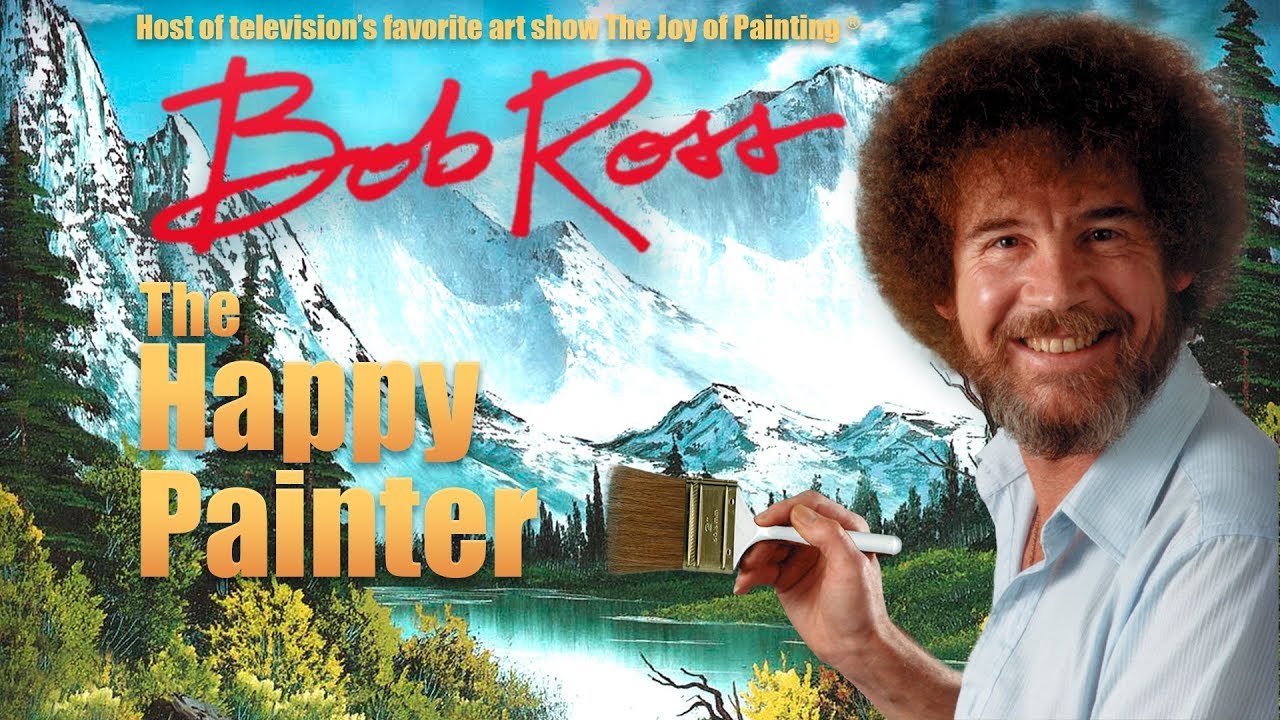
Bob Ross once told a color-blind man who could see only gray tones that he would paint a picture in gray that day, just to prove the point. That small, unscripted moment in a shopping mall captures everything essential about a painter from Daytona Beach, Florida who became one of the most recognizable faces in the history of American television. The Joy of Painting ran for 31 series and produced more than 400 episodes, yet the show’s real product was never a landscape. It was confidence.
Robert Norman Ross was born on October 29, 1942, and grew up in the Orlando area. His father Jack was a carpenter and builder, and Bob worked alongside him as a young man, losing a finger in the process. The injury was on his left hand, so it never touched his brush. His mother gave him something harder to quantify: a deep love of wildlife. As a boy in Florida he kept snakes, squirrels, and whatever else he could catch. One of those snakes escaped its cage, disappeared into the house for weeks, and eventually terrified his mother in the bathroom in the middle of the night.
At 18 he joined the Air Force. He rose to master sergeant and spent time stationed near Fairbanks, Alaska, where snow-capped mountains surrounded him and a part-time bartending job gave him a place to sell painted gold pans. One afternoon the tavern television was tuned to a PBS station and a German painter named Bill Alexander appeared on screen, demonstrating a centuries-old method called alla prima, or wet on wet. The basic premise is that thin paint will adhere to thicker paint, allowing colors to be layered and blended on the canvas without waiting for each coat to dry. Bob watched and recognized what he had been looking for.
The hamburger joint where a business was born
After retiring from the military Bob began teaching Bill Alexander’s classes across the country. One Florida seminar brought him in front of Annette Kowalski, who had enrolled while still grieving the loss of a child. She watched the effect Bob had on a room full of students and told her husband Walt over dinner every night that something about this man needed to be packaged. On the last Friday of that trip the Kowalskis invited Bob to a local hamburger joint and Annette asked if he would come to Washington DC and teach. He said okay.
The partnership that followed was unglamorous. They ran expensive newspaper ads for painting classes and got almost no one. One evening class drew a single student. Bob taught him anyway. The man was so moved that he offered the group a million dollars for 40 percent of their operation for life. They turned it down. Bob had his hair permed during this stretch not for vanity but to save money on haircuts, stretching the thousand dollars his wife Jane had given him when he left Alaska to try his luck.
A commercial they recorded for Bob’s classes ended up at a public television station in Northern Virginia, WNVC, whose staff watched the tape and immediately asked if Bob would do a series. The Joy of Painting was born. Series one aired on East Coast stations but the audio and video quality was poor and it was never repeated. Bob kept moving.
Thirteen programs in three days in Muncie
A VW bus pulling into the parking lot of a public television station in Muncie, Indiana changed everything. WIPB was one of ten stations permitted by Congress to sell commercials, and when Bob walked in asking for publicity for his mall classes, the station’s staff saw an opening. They aired a commercial before and after Bill Alexander’s program, Walt and Annette bought time on the Phil Donahue Show, and the class sold out. Bob then asked WIPB to become the permanent home of The Joy of Painting.
The production pace was extraordinary. Thirteen episodes, one full quarter of programming, filmed in roughly three days. Bob arrived on Sundays, arranged his reference paintings around the studio, and mapped out the order. He had already rehearsed every brushstroke in his head the night before, lying in bed mentally walking through the entire canvas. As his producer at WIPB put it, Bob knew exactly where he was going. He just took you on the ride with him.
Annette Kowalski described the intimacy of the set plainly. Bob told her he pretended he was talking to one woman in bed. Three cameras, a black curtain, an easel. No elaborate trapper’s cabin backdrop. Bob decided that anything behind him would break the closeness he was building with whoever was on the other side of the lens.
By the early 1990s translations of the program were running in Mexico, Costa Rica, Colombia, the United Kingdom, the Netherlands, Germany, Switzerland, Austria, Turkey, Iran, South Korea, and Japan. Japanese broadcasters reportedly considered removing his voice from their version, then reversed the decision. His sincerity crossed the language.
In 1992 he lost his wife Jane to cancer. He was already fighting his second bout of lymphoma, a diagnosis kept secret from almost everyone. He filmed his final series, number 31, and began making arrangements for instructors to carry the method forward. The Bob Ross workshop in New Smyrna Beach, Florida trained new teachers. There are roughly 2,000 certified Bob Ross instructors working around the world today, certified at the same rate as when he was alive.
On July 4, 1995, Bob Ross died of lymphoma. He was 52 years old.
The woman with the walker who drove an hour at 11:30 at night
At a PBS auction Bob painted live and a woman bought the canvas. She called ahead to ask if he would wait. She arrived with a walker at half past eleven, having driven for about an hour. She told him she did not have many good days anymore, but when she watched his show it was the best part of that day. Bob thanked her, gave her a hug, and said: ‘That’s why I do this.’
Blue Ridge PBS in Roanoke, Virginia still distributes The Joy of Painting to public television stations reaching more than 90 percent of the country. A new generation is calling in, and the people who answer the phones say the calls sound identical to the ones from 28 years ago.
 Wake up to Only Happy News!