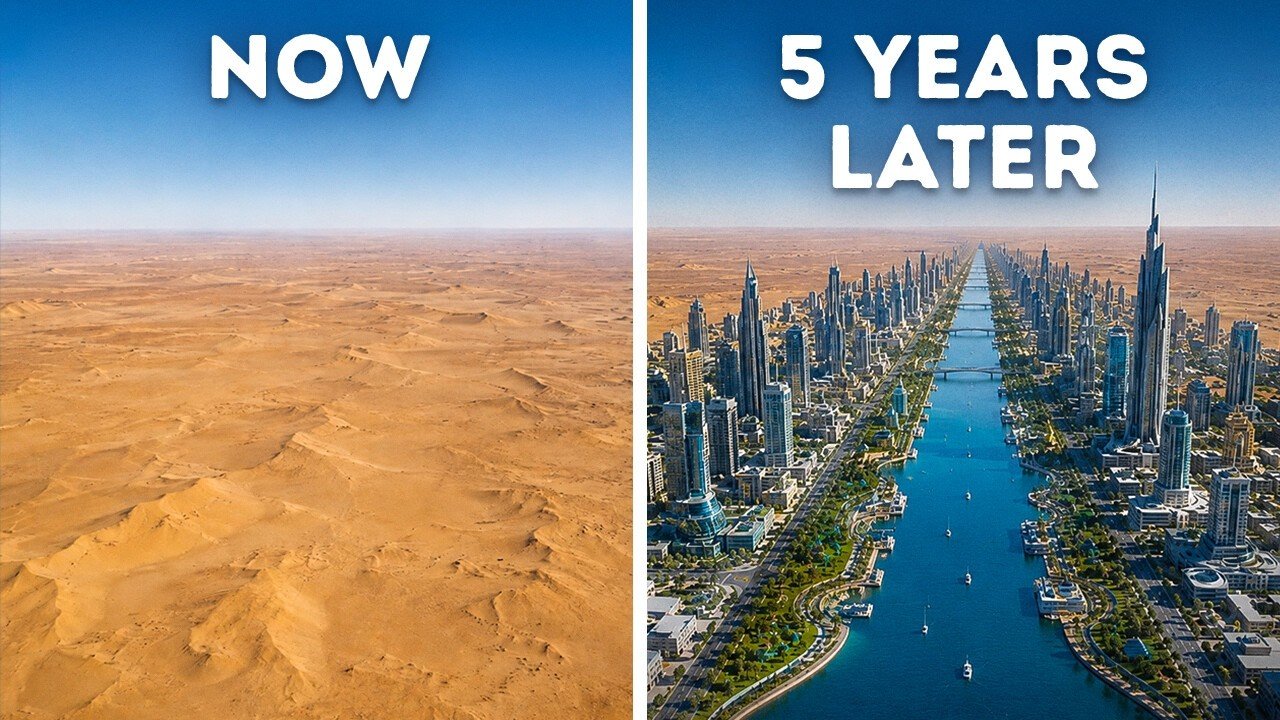
Stand in the desert west of Cairo today and you will find sand stretching to every horizon. Within five years, according to Egypt’s government, a river will run through that same spot, flanked by 80-story skyscrapers, university campuses, and enough homes for millions of families. The country is not moving a city. It is manufacturing one, complete with its own waterway, in a place that has never grown a single crop in recorded history. The project is called Jirean, an Arabic word meaning ‘flow’, and the name is doing real work: the entire city is designed around an artificial branch of the Nile carved straight through the desert.
Why Egypt had nowhere left to grow
The pressure behind Jirean has been building for decades. Egypt is home to more than 100 million people, and nearly all of them live squeezed into a narrow green ribbon along the Nile, because the river supplies roughly 97 percent of the country’s fresh water. Step away from the riverbank by even a short distance and the land turns dry and lifeless immediately. That strip was enough for thousands of years. Then Egypt’s population nearly doubled since 1990, cities consumed farmland, and the country became the largest wheat importer on Earth. Compounding the pressure, a massive dam being constructed upstream in Ethiopia has raised fears that less Nile water may reach Egypt in the future. The government faced a stark choice: keep compressing more people into the same narrow corridor, or find a way to create new land altogether.
Egypt chose the second option, and on a scale that strains comprehension. The broader effort is called the New Delta Project. Its stated goal is to reclaim roughly 2.5 million acres of desert and convert them into farmland for staple crops including wheat and corn. That is an area the approximate size of a small country, drawn out of pure sand. Jirean is the centrepiece of the whole undertaking.
The artificial river at the city’s core
At the heart of Jirean, developers are building a channel connected directly to the Nile. This is not a decorative feature. The channel will occupy about a fifth of the city’s entire footprint, and roughly 10 million cubic meters of Nile water are expected to move through it every single day, enough to irrigate thousands of acres of crops that could never have grown here before. The city itself sits on approximately 1,680 acres, and officials are planning for it to house somewhere between 2.5 and 3 million families. Plans include 80-story towers, luxury housing, international universities, hospitals, an eco-friendly hotel, commercial zones, and a dedicated cultural and media district.
Location adds another dimension. Jirean will sit just minutes from the Grand Egyptian Museum, one of the largest archaeological museums in the world, along with the Giza Pyramids and the Sphinx, and a nearby international airport. Ancient wonders and a futuristic city separated by only a few miles of open desert.
Construction began five months ago. Developers say the entire project will be finished within five years, a timeline that Egypt’s prime minister described at the official unveiling as ‘an urban and development revolution.’ Officials project that Jirean alone will create around 250,000 jobs and anchor a development zone roughly equivalent in combined size to four or five entire Egyptian provinces.
The water question nobody can fully answer yet
The ambition comes with real tension. Egypt’s foreign debt has roughly quadrupled since 2015, reaching more than 150 billion dollars, with the country relying on loans from the International Monetary Fund and financial support from the European Union to keep its economy stable while multiple mega-projects advance simultaneously. And the single assumption the entire scheme rests on, that enough Nile water will be available to sustain it all, remains genuinely uncertain. The dispute with Ethiopia over the Grand Ethiopian Renaissance Dam is unresolved, and any meaningful reduction in river flow would put direct pressure on exactly the kind of expansion Jirean represents. Egypt has attempted large-scale desert reclamation before, and a previous effort decades ago fell well short of its original goals despite enormous investment.
A canal still finding its level
The channel running through Jirean’s future core is rising steadily, its concrete foundations pressed into ground that has been dry for millennia.
For now the foundations are going into the ground and the canal is filling. Whether Jirean becomes the story Egypt needs it to be, or joins the long list of grand projects that did not quite hold together, may come down to something far less dramatic than skyscrapers or artificial rivers: whether the Nile itself has enough left to give.
 Wake up to Only Happy News!