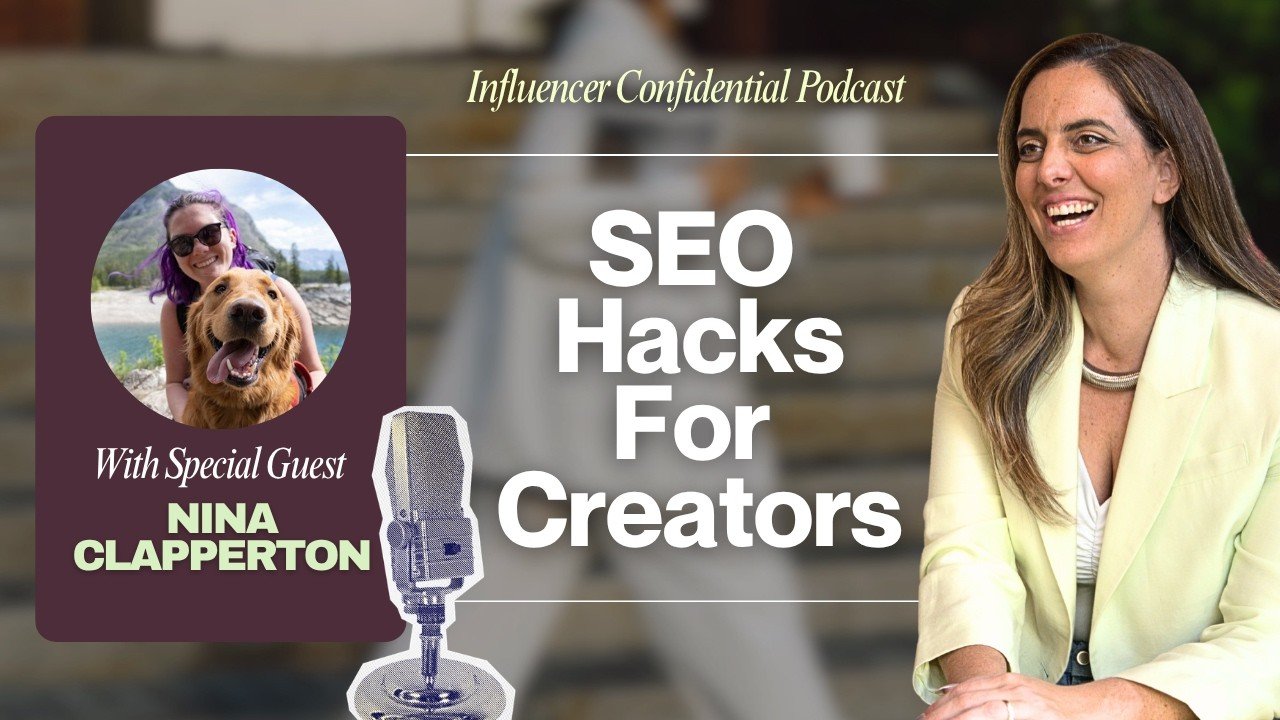
Nina Clapperton was living in her sister’s basement in Ottawa, freshly back from a master’s degree at Oxford after her visa changed, working full-time as a law clerk, and quietly furious at her dad for telling her that blogging was not a real business. That combination of frustration and spite turned out to be the most precise business strategy she never planned. Within six months of giving herself a 12-month ultimatum to earn $2,000 a month from her travel blog, she grew it from 5,000 to 65,000 page views. Six weeks after that, she hit $10,000 a month. By January of the following year, the site was generating $30,000 a month, consistently, almost all of it from affiliate revenue, while she was still clocking in as a law clerk with four part-time jobs on the side because, as she put it, she has raging ADHD and needed things to do. That trajectory is exactly why Sidewalker Daily founder Nadia Albano brought Clapperton onto the Influencer Confidential session in July 2026 to break down what SEO actually means for creators right now.
What SEO actually is in 2026 and why keywords are almost beside the point
Clapperton runs about 13 sites and tests every strategy three times before she teaches it, so her definitions carry weight. She describes SEO not as a technical checklist but as a translation exercise: figuring out how your audience phrases the thing you already know, then matching your content to that phrasing. The classic keyword-stuffing playbook is gone. Modern AI algorithms, including the ones running Google, Instagram, TikTok, and every other platform with a search bar, read content the way a person would. If a human can tell that ‘things to do in Toronto’ and ‘things to do Toronto’ mean the same thing, so can the algorithm. What the algorithm cannot tolerate is content that sounds like it is glitching.
For the tool side, she recommends Key Search, spelled K-E-Y-S-E-A-R-C-H, at around $24 a month, with a practical workaround she described plainly: ‘Buy it for one month, cancel it, two months off, buy it for another month.’ She largely ignores volume and difficulty scores because those figures come from the Google Ads API and reflect what converts for paid advertising, not what an educational creator audience is actually searching. Her preferred target is the zero-volume keyword: a trending question people are already asking inside Facebook groups that no keyword tool has indexed yet. She had one trending-topic post generate 30,000 page views in a single month from a term no API had priced.
The spreadsheet system that decides what gets published, paywalled, or posted short-form
Every question Clapperton or her community receives goes into a master spreadsheet. She now runs it through Claude, ChatGPT, or Gemini weekly to batch similar questions. The output drives a three-tier content decision: one instance of a question becomes short-form content, three instances becomes a blog post or searchable piece, five or more instances becomes a paywalled product, whether that is a course, a freebie, or a webinar. A $50 course she built this way, on a specific AI workflow she was using at the time, made $30,000 over 18 months without a single formal launch.
For creators whose monetization is brand deals and affiliates rather than courses, the same funnel logic applies. The SEO content chain moves a reader from a broad awareness post toward a specific affiliate or sponsored post through internal links, and every page view becomes documented proof of traffic for future brand pitches. She also flags that branded mentions now carry the same algorithmic weight as backlinks: if a publication spells out a creator’s name or brand in plain text, the AI reads it the same way a person would and connects the identity, no hyperlink required.
On AI-generated content, her position is grounded in Google’s own search quality guidelines, which she reads in full with each update: the algorithm does not penalize content for being AI-assisted. It penalizes content that says nothing. The sites getting wiped in spam updates are the ones publishing a hundred structureless posts a day scraped from booking sites by people who have never visited the places they are describing. Her own accessible-travel site, started last summer and kept anonymous as a live case study, had two of its first four posts rank number one almost immediately, including an affiliate post about the winter boots she buys for her service dog Theo.
Theo’s dog Crocs and a tax write-off still in negotiation
At the close of the conversation, Clapperton mentioned that photos of Theo in his dog Crocs appear across her platforms and that she is determined to turn the footwear into either a tax credit or a brand partnership.
The affiliate program has so far declined to cooperate, but she says she knows people at Crocs and considers it a personal challenge still in progress.
 Wake up to Only Happy News!