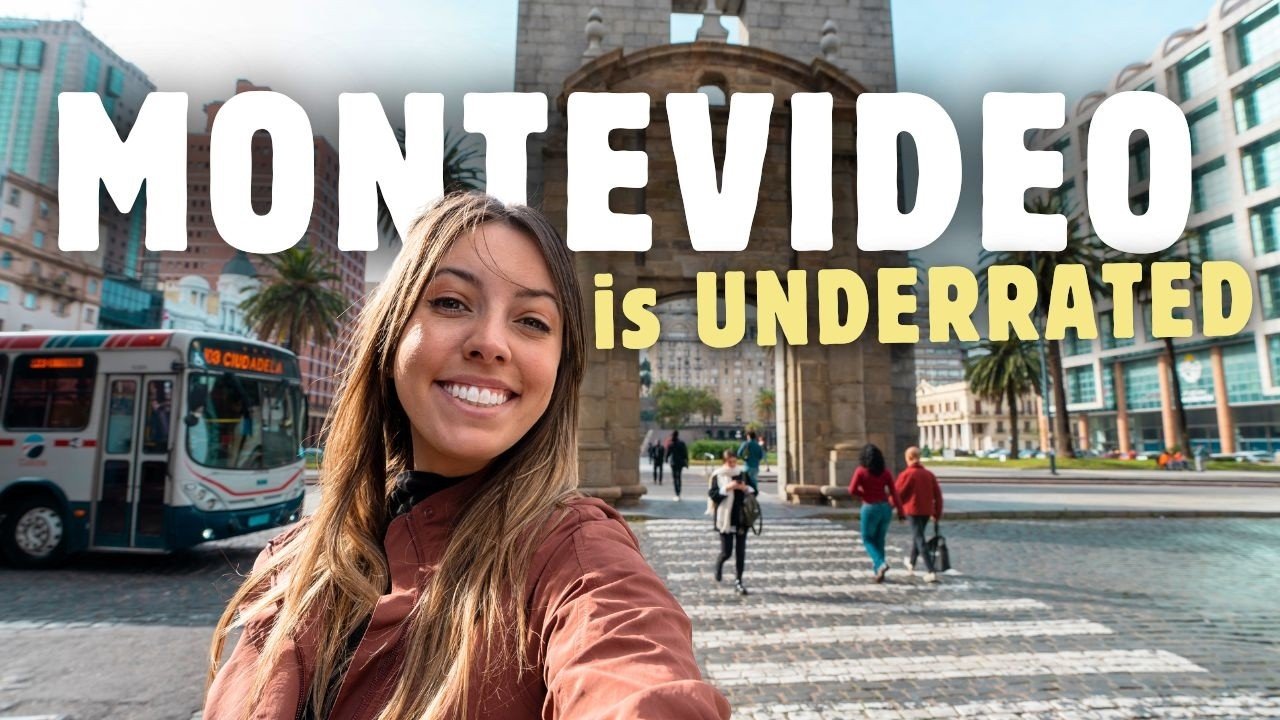
Montevideo does not announce itself. Uruguay’s capital houses roughly half the country’s population, yet its streets carry an almost eerie quiet, the kind that makes a visitor stop and check whether they took a wrong turn into a small coastal town. That stillness is not a flaw. It is the city’s entire personality, and for two travelers who crossed over from Montevideo’s louder neighbor on a whim after curiosity won out over itinerary, it turned out to be precisely what they had been missing.
Learning the rules nobody writes down
The day begins not with coffee but with mate, because in Montevideo that is the only socially acceptable answer. A local named Shirley meets the pair with a gourd, a bombilla, and about three centuries of cultural context. She explains that the Guarani people of Paraguay were the original practitioners, sipping the herbal brew from hollowed pumpkins long before the Spanish arrived and marveled at the energy it produced. What the colonizers took time to understand, Shirley makes clear in minutes: mate was never really about the caffeine. The social ritual around it carries as much weight as the drink itself.
The rules arrive fast. Never touch the bombilla. The server prepares and passes the gourd to everyone in the circle. And if you say ‘gracias’, you are out. That single word signals you are finished, and no more mate will come your way. By the second round, the difference Shirley had described is already noticeable. When asked later about the experience, one of the pair put it simply: ‘There are a couple of rules and a couple of things that you have to know before drinking it, so that was very useful. Shirley was awesome. What a great lady. She had so many stories, we could have talked to her for hours.’
After the lesson, Shirley points them toward a woman on the corner who fries pastelitos to order. A few blocks further, Las Ramblas opens up: a 13-kilometer walking path widely described as the longest continuous sidewalk in the world, running alongside the Rio de la Plata. They pull out a torta frita from a paper bag and eat it on a bench with the city skyline behind them. It was not on the itinerary. It was exactly right.
A stadium that started everything
Lunch leads to Espresso Paysitos, where the chivito has been done the old-school way since around 1910. Uruguay’s national sandwich arrives as a geological event: steak, egg, tomato, lettuce, cheese, mayonnaise, and ketchup, buried under a mountain of fries. One of the pair ordered the Canadian variation, which adds bacon and olives to the arrangement. The bread is soft enough to compress around everything without collapsing. A hard-boiled egg on a sandwich, it turns out, is not a mistake.
From there, the afternoon belongs to Estadio Centenario. Entry costs 300 pesos for foreign visitors, and inside sits a museum packed with football memorabilia anchored to a single fact: this is the stadium where the first-ever FIFA World Cup match was played, in 1930, right here in Uruguay. For Martin, who carried his father’s love of the sport into the trip, standing on that ground carried a weight that the museum’s displays could only partly explain. ‘For all the people that love football,’ he said, ‘coming here is as important as going to the Maracana, to the Azteca, to other great stadiums. Every single person who loves football should come here.’
Where the city shows its face
The old city rewards slow walking. The Puerta de la Ciudadela, a remnant gate from Montevideo’s original fortress, opens onto Plaza Zavala, where a large monument marks the founding of the city. Teatro Solis, the oldest theater in South America, stands nearby, its facade catching the late afternoon light. And then Palacio Salvo appears: an architectural twin to Palacio Barolo in Buenos Aires, both designed by the same architect, who originally intended the lighthouses on each building’s roof to beam light across the roughly 250 kilometers of water separating the two cities. The physics did not cooperate, but both buildings are still standing.
Sunset pulls them to Mirador de la Intendencia, a 360-degree rooftop lookout above a government building where a rotating lineup of Uruguayan musicians performs daily. Entry is free. On this particular evening, a large group of women had claimed the small cafe on the roof, all of them apparently regulars, all of them completely devoted to the artist performing. They had brought containers of homemade cookies. They were waving their hands and screaming. ‘They might be more entertaining than the view,’ one of the pair observed, which, given the view, is a significant statement.
Dinner that night was at a restaurant about 30 minutes away in an upscale neighborhood, reportedly one of the top 50 in Latin America, where the menu runs from wood-fired meat to sushi to fresh pasta stuffed with spinach and ham. After days of asado, the sushi felt like re-entry.
The woman on the corner of Sarandi and Canelones
On the corner where the morning’s pastelito stop happened, a woman works a small fry setup, turning out fried pastries without fanfare. The corner itself has no grand sign. She was simply there.
Montevideo had pulled them in on a whim, one border stamp away from the plan. Two days later, the city felt less like a detour and more like the point. The streets were still quiet. The mate was still being passed.
 Wake up to Only Happy News!