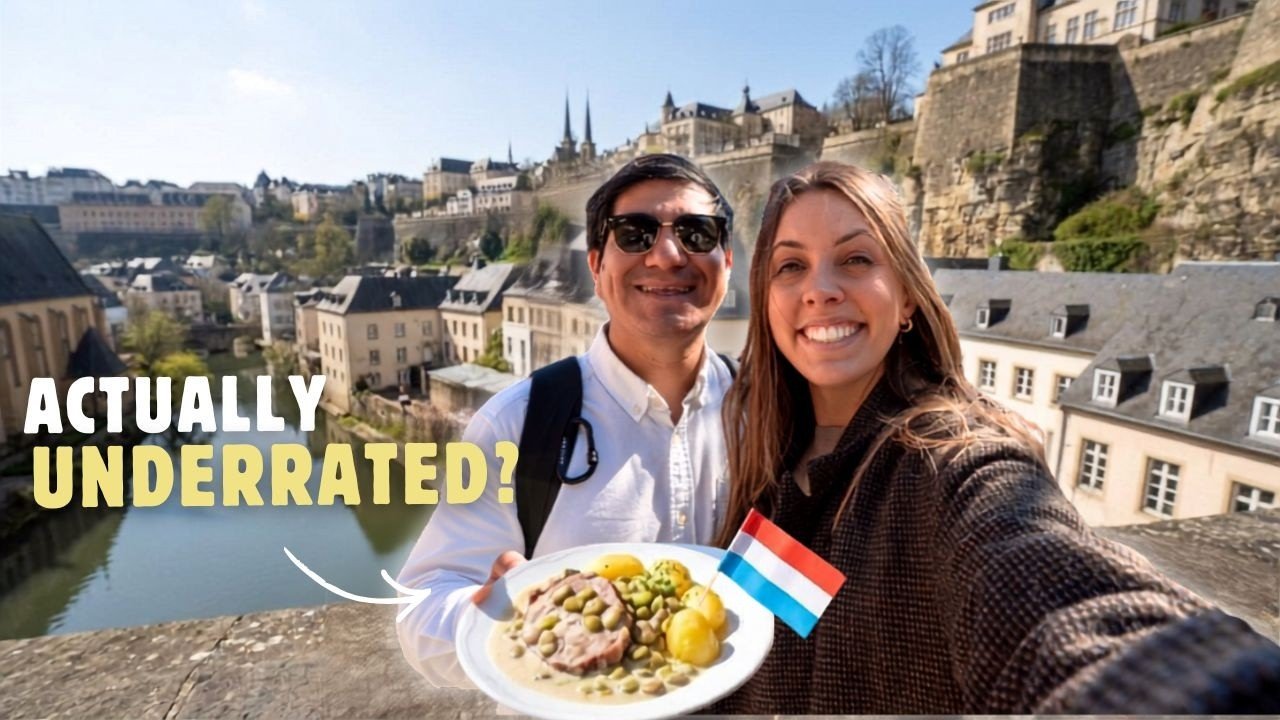
The bus pulled up, the doors opened, and nobody asked for a ticket. That was the first surprise Luxembourg had waiting for the team behind Tourist to Local, and it set the tone for everything that followed in two days inside the wealthiest country on Earth. For most travelers, Luxembourg registers as little more than a dot between France and Germany, a place for bankers and EU bureaucrats, not curious wanderers. But the country that holds the highest GDP per capita in the world, ahead of Norway, the United States, and Switzerland, turns out to have free trains, a dramatic canyon city, a genuinely distinct cuisine, and a medieval fortress with a villain the locals still refuse to name.
A city that costs almost nothing to move around
Luxembourg was the first country in the world to make all public transportation free for everyone, locals and tourists alike. Buses, trams, trains across the entire country, none of them require a ticket. The Tourist to Local pair made a point of riding even a single stop just to lean into it, and the savings added up fast in a place where a two-course lunch for two at a restaurant honoring classic Luxembourgish recipes ran to 67 euros.
The city center, anchored by a plaza lined with cafe terraces and, on the right weekend, a sprawling antique market, rewards walking. The Grand Ducal Palace, built in 1572 and still the working office of the Grand Duke, sits directly on an ordinary street with no barriers and no moat. A flag above the building signals when he is in residence. ‘This palace is just on a regular old street,’ one of the pair noted. ‘We could walk up and touch the thing, which is crazy.’
Two minutes from the palace stands the Cathedral of Our Lady of Luxembourg, the patron of the city, where John the Blind, a figure who reportedly rode into battle sightless and tied to two knights, is buried alongside members of the royal family. Entry is free, and on the afternoon the pair arrived, a Bach tribute band was performing inside beneath dramatic stained glass arches.
The city is built on a plateau sliced through by two river gorges, creating two entirely separate levels. The upper city holds the government buildings and the famous Bock Promontory, described since at least the 19th century as the most beautiful balcony in Europe. Below it runs 23 kilometers of underground military tunnels called the Casemates, which once housed more than 30,000 soldiers at their peak. Luxembourg was the most fortified city in Europe, sometimes called the Gibraltar of the North. Entry to the Casemates runs 11 euros.
National dishes, a gutted castle, and a businessman nobody will name
Luxembourgish food is almost impossible to find outside the country, which made lunch at a restaurant in the city a genuine discovery. The national dish, smoked pork served with broad beans and boiled potatoes alongside mustard, earned immediate approval. The country’s comfort food, soft potato dumplings with bacon in a rich sauce, drew a comparison to mac and cheese and the verdict that it could be eaten any day of the week.
Day two called for a free train ride into the countryside, 45 minutes by rail and then a short bus and walk to reach a hilltop fortress that has stood in some form since the 3rd century AD. The site reached its peak under a count named Henry, who was connected by marriage to practically every royal court in Europe. Then in 1820, the King of the Netherlands, short on cash, auctioned the entire property. A local businessman won the bid and stripped it for parts, selling off every door frame, handle, and fitting. Local houses nearby are reportedly still built from pieces of the castle. The outrage grew loud enough that the king repurchased the property seven years later for less than a third of what he had sold it for. Proper restoration did not begin until 1978. People in the town still will not say the businessman’s name out loud.
The bridge that ended the journey
Back in Luxembourg City, the final stop was the Adolphe Bridge, the last landmark of a two-day stay that cost far less than either traveler expected. Between the free transport, the no-cost entry to the palace exterior, the cathedral, and the scenic overlook, the expensive reputation of this country does not survive contact with the actual itinerary.
The Adolf Bridge stood quiet on a clear afternoon, its stone arches framing the gorge below, a clean ending to a city that kept producing surprises from the moment the first free bus arrived.
 Wake up to Only Happy News!