Matt D’Avella was sitting up in bed, chest tightening, hands constricting, the veins in his palms visibly pulsing. He was certain he was dying. He was not. He was running a creator business whose revenue was halving every launch cycle while his payroll kept climbing, and his body was sending the invoice. The moment is a useful entry point into a longer conversation about what actually happens when the dream of creative freedom becomes a going concern with six-figure monthly costs and a calendar that doesn’t stop.
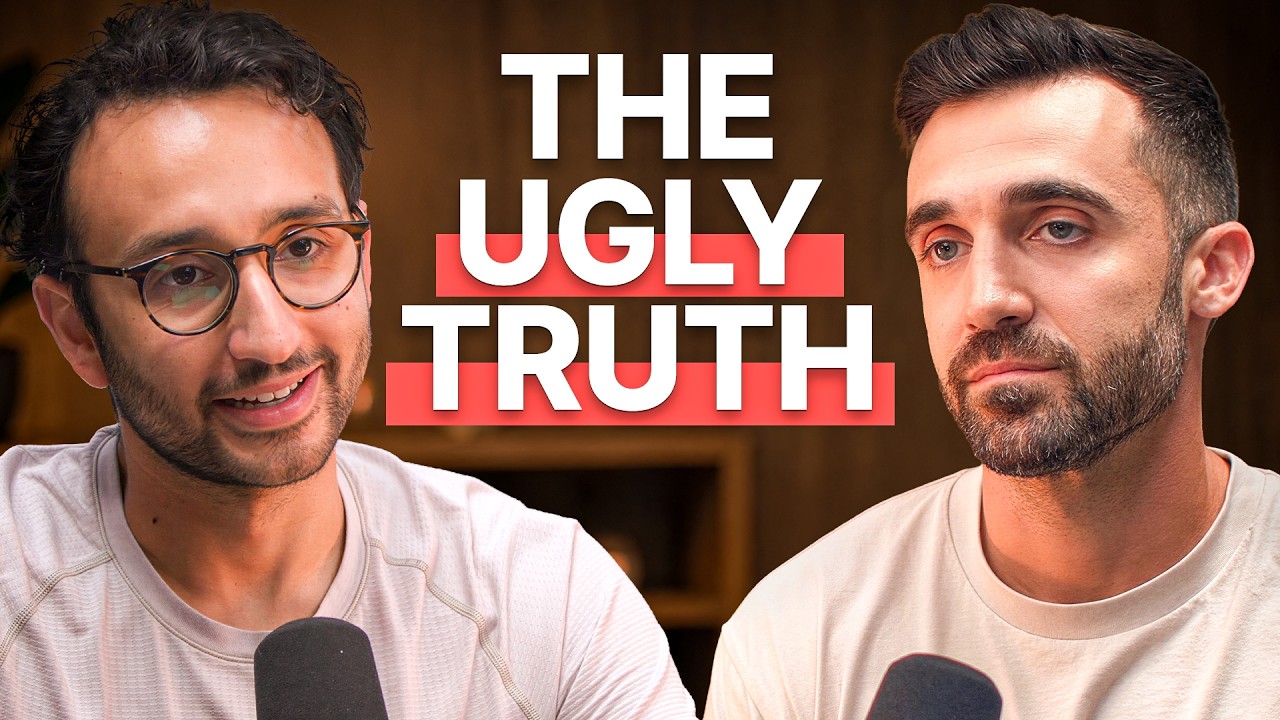
Ali Abdaal and D’Avella met in person for the first time in Sydney in early 2026, despite having been WhatsApp and Zoom friends for the better part of seven years. Both started taking YouTube seriously around 2017. Both built channel businesses, launched courses teaching others to do the same, hired teams, had to let people go, and eventually found themselves questioning why they were on the hamster wheel they’d sold other people tickets to. The conversation they sat down to have was less a masterclass and more two people comparing scar tissue.
When the revenue keeps halving and the payroll keeps growing
D’Avella’s most successful project was his YouTube course. The first launch was the peak. The next generated 50 percent of that revenue. Then 50 percent of that. Then 50 percent of that again. Meanwhile, he was adding employees and freelancers, eventually running a team of roughly five full-time staff and around ten freelancers. The math ran the wrong direction for long enough that the anxiety he’d been managing since a 2019 generalized anxiety diagnosis became something physical. ‘I thought I was having a heart attack,’ he said. ‘My hands would start to constrict and the veins in my hands would start pulsing.’ That was the night he began the difficult conversations about simplifying.
Abdaal’s situation rhymed. His operation now runs at roughly 200,000 dollars a month in costs, meaning the first 2 million dollars the business earns each year goes directly to other people. He described a low-key PTSD from the cohort-launch era, when each new round of his course generated less than the last. A mentor told him the pattern was almost universal: teams get hired around cohort two because growth looks promising, then the numbers reverse by cohort four, and the team has to shrink. ‘That actually makes me feel a lot better,’ Abdaal said.
The freedom people are trying to buy, and what it actually costs
D’Avella named the trap plainly: ‘A lot of people start on YouTube to try to get off the hamster wheel, to not have a 9-to-5 job, but then they become a prisoner to their own revenue, their own targets.’ He reached a point where he considered quitting entirely. Instead, he downsized, went effectively solo, and reduced his monthly business expenses to somewhere between two and four thousand dollars, his biggest current outlay being a business coach he’d just hired.
Abdaal, watching from the other side of the ledger, said he thinks about D’Avella’s path every week. The appeal is real. But so is the pull of the larger game: the team, the software, the business school they’re building, the feeling of playing, as he put it, on a harder difficulty setting. What keeps him on that setting is partly ego, partly genuine excitement, and partly the anxiety that if he stops, the lifestyle he wants to provide for his family comes under threat. He acknowledged the narrative is convenient. ‘Maybe it’s just for my own ego to try and make money or some stuff like that.’
Both men landed on the same observation from different angles: low overheads are the closest thing to actual freedom that exists in a creator business. D’Avella’s frugality, his family living within his wife Natalie’s salary alone, means YouTube has become optional rather than obligatory. Abdaal’s scale means it isn’t, yet.
Matt’s manuscript and the 5 a.m. schedule
D’Avella wakes at 5 a.m. now. Two hours of dedicated writing before his son Frankie wakes at seven, daycare drop-off at nine, gym for an hour, then work until five and pickup. His scripts are partly word-for-word, partly planned spontaneity. A full script takes two to three days to write, and the editing can run another 20 to 50 hours per video. He’s never been comfortable just riffing on camera and said so directly: ‘I am so bad at this.’ The realization that Abdaal’s ability to sit down with a few bullet points and talk for an hour is genuinely unusual came as a relief. It gave D’Avella permission to stop trying to replicate it and lean into what only he does: documentary-style explorative videos built around learning something new or pushing himself physically, shot with a mix of low-fi grab-and-go and high-end cinematography.
For the coming months, he’s bringing back the 30-day experiments format that built his audience in the first place, this time cycling through different forms of cardio each month. Zone 2 training, running a mile daily, then biking, swimming, jump rope, rucksacking. He’s not doing it because he thinks the videos will perform. ‘Even if it gets 100,000 views, that’s fantastic. That’s enough.’
The sons, the urine samples, and what actually matters
Both men are new fathers navigating the same arithmetic: family is now the most important thing, but it is not the only thing, and pretending otherwise breeds a different kind of resentment. D’Avella has a second son, Sunny, now sleeping through the night. Frankie, the older boy, is in daycare five days a week. The night nanny they hired for the first three months of Sunny’s life, initially five nights a week and tapering to three, came after ten months of broken sleep following Frankie’s birth that D’Avella described simply as breaking them.
The moment that landed heaviest in the conversation was quieter than the panic attacks or the halving revenue curves. D’Avella talking about looking back at videos he made two or three years ago and feeling nothing for them, then looking back at the same period and thinking about the moments he and Natalie built with Frankie and now with Sunny. ‘Those are infinitely more important,’ he said. ‘And so I don’t care. This is the moment right now.’
The business coach who is also his wife
For the past couple of years, D’Avella’s primary sounding board for business decisions has been Natalie. He put it without softening: ‘She’s severely unqualified for the job.’ Not as a criticism of her, but as a recognition that outsourcing decisions to people around him out of self-doubt, asking for permission rather than trusting his own instincts, had become a habit he needed to break. The recent return to the bonus channel, picking up a camera after eight months away from YouTube and just vlogging his behind-the-scenes process without asking anyone’s opinion first, was the experiment that started giving the joy back.
In Sydney, at a table they’d both been circling for seven years of calls and messages, D’Avella sat across from Abdaal and said the thing that tends not to make it into courses about building a creator business: ‘Let me just make mistakes again.’
The 30-day experiment on zone 2 cardio is already underway. The chest tightening hasn’t come back.