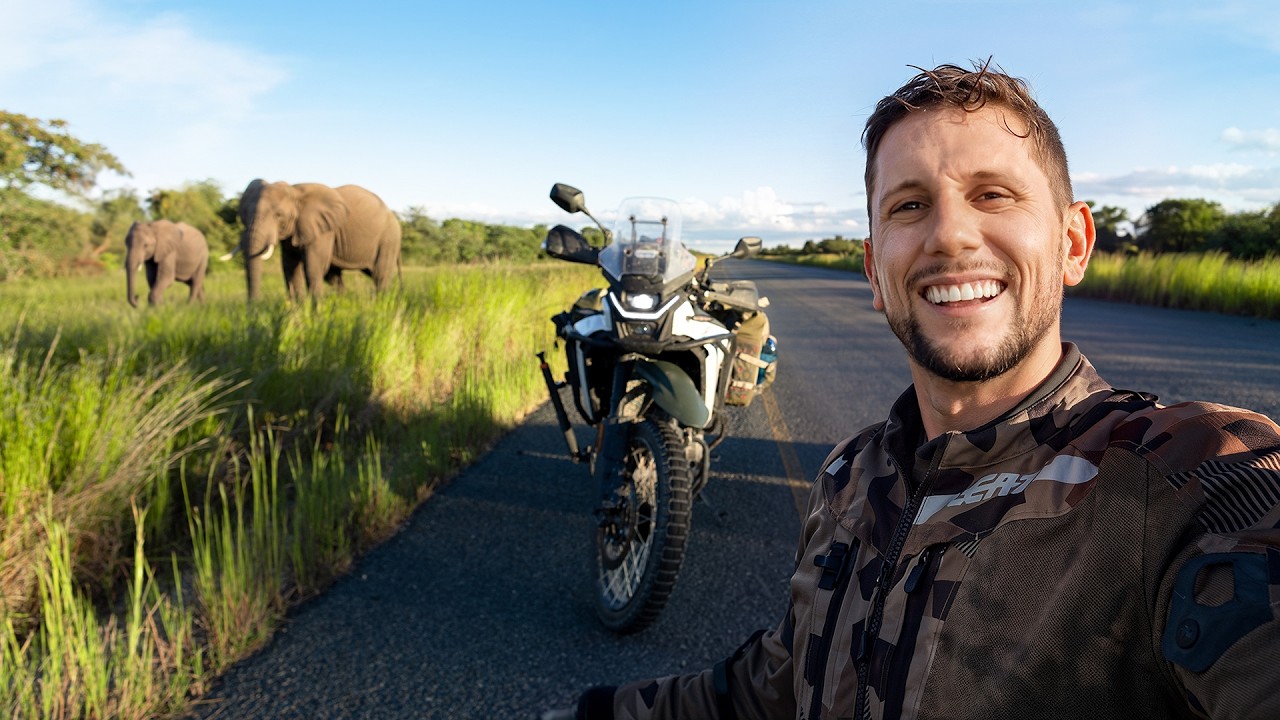
The elephant walked out of the tall brush maybe 30 to 40 meters ahead, crossed the highway without looking up, and disappeared into the grass on the other side. Lost LeBlanc and his riding partner Christian were doing roughly 90 kilometers per hour when it happened, and both hammered their brakes just in time. For anyone who has ever wondered what a coast-to-coast motorbike crossing of Africa actually feels like on the ground, that single moment on a Botswana national highway is the answer: wild, immediate, and completely without warning.
The two had already survived two days of chaos that defied easy summary. They had watched lions 200 meters away while stuck in the Okavango Delta mud, stumbled too close to a family of hippos, watched an anti-poaching unit vehicle sink deep into the same trail, and spent the better part of a night being pulled free by a rescue vehicle whose tow cable eventually shattered on impact with the ground. The morning after all of that, they pointed their bikes toward Chobe National Park on what the GPS was calling somewhere between six and a half and eight hours of riding.
Where the highway becomes the safari
Botswana’s national highways run directly through its national parks, which means the roadside elephant warning signs posted every few kilometers are not decorative. The first roadside elephant appeared while LeBlanc was mid-sentence narrating population statistics about Botswana’s roughly 2.6 million people. He stopped himself immediately. ‘Who cares about facts on freaking populations,’ he said, voice rising, as a bull materialized on the shoulder. That first sighting was followed by a second, then a third, then a fourth. At one point, an elephant threw sand over itself and the dust caught the backlight of the lowering sun in a way that stopped both riders cold.
The highway itself offered its own separate challenge. The potholes were deep enough that hitting one at 110 kilometers per hour sent a genuine shockwave through the frame, and LeBlanc admitted stopping to ask Christian to check whether his tires had survived direct impact. At one stretch, a road closure sign with no explanation forced a detour through a narrow passage with water on both sides, horses in the road, and palm trees pressing in from both edges. They were also running on the last possible fumes of fuel, their range display having stopped calculating entirely before they finally spotted a Shell station.
Signing the bike somewhere in Botswana
Somewhere inside that day, Cam had started a new tradition: a black marker and an open invitation. At the Dusty Donkey Cafe over breakfast, a man who introduced himself as ‘Destroy’ signed his name in a flourish that LeBlanc called one of the coolest signatures he had ever seen. A border checkpoint officer signed it. A third-generation farmer named Kurt, who grows millet and vegetables, signed it at a fuel stop near the end of the day. Each name in permanent marker was one more person who had briefly shared the road.
Ruby, LeBlanc’s girlfriend, had been in Cape Town for roughly 20 days and flew into Victoria Falls in Zimbabwe to meet them at Chobe House that evening. She and her sister Bridget had already been on what Ruby later described as the best safari of her approximately 30 safaris with LeBlanc. It included a kill. LeBlanc, who had not seen one in all of his safaris, received this news over a glass of Jameson at a riverside bar and insisted, several times, that he was not upset about it.
Something moving just outside the tent
The group headed deep into Chobe National Park for a mobile camping night surrounded by the same elephants, hyenas, and buffalo they had been riding past all day.
After the campfire, with Ruby beside him in the tent, LeBlanc heard something just outside the canvas. The two grabbed each other and went completely still, too afraid to make a sound. He felt what he described as a bead of sweat running down his back. Then came a low, reverberating sound he could feel in his chest, something large enough that he could sense it breathing against the side of the tent. Whatever it was stayed for over 30 minutes before it was gone.
Back on that Botswana highway in the fading afternoon, an elephant had thrown sand over its back and the dust had hung in the backlit air like something out of a photograph nobody could quite believe they had taken.