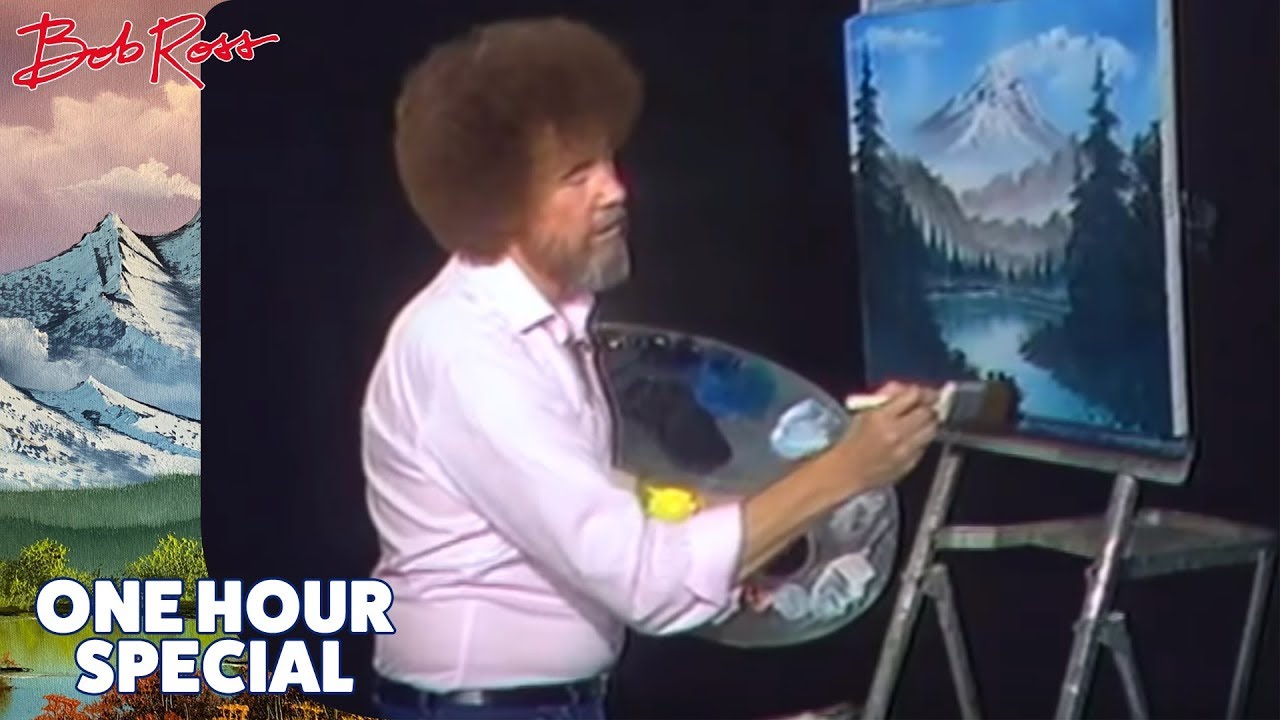
Bob Ross pulled a tall stool to the front of his studio, told the viewer to pour a glass of iced tea, and made a quiet promise: the painting about to appear on the canvas had never been shown on television before. That promise carries real weight for anyone who has spent years watching his public series, because this particular summer scene, with its cloud-softened mountain, layered foothills, mirror-still water, and dense foreground evergreens, was reserved specifically for a private, step-by-step instructional lesson. It is a complete course in a single sitting, and the painting itself serves as the curriculum.
Why the liquid white coat changes everything
The session opens with a ritual Ross treats as foundational. He loads a two-inch natural bristle brush with liquid white, a thin oil-based primer, and covers the entire canvas in long horizontal and vertical strokes. The goal is not decoration but chemistry: a wet surface lets color blend directly on the canvas rather than fighting a dry ground. He flags the most common beginner error immediately: too much liquid white. His fix is practical and low-stakes. Wipe the brush clean and drag it back across the canvas to lift the excess. For anyone working on a white-primed rather than a gray-primed canvas, he suggests mixing a small amount of liquid black into the liquid white so the coverage is visible as you go.
The sky follows, built with a touch of phthalo blue tapped firmly into the bristles and applied in criss-cross strokes from the top downward. Because the canvas is already wet, the blue lightens automatically toward the horizon without any deliberate blending. Water comes next using phthalo blue with the faintest addition of phthalo green, pulled inward from the outside edges and upward from the bottom, leaving a pale strip of light across the center. A clean dry brush then unifies the two zones without destroying that sheen.
Building depth one plane at a time
Ross pauses midway through the session and holds the canvas close to make a specific point about what creates the illusion of distance. Every layer introduced, the mountain, the misty foothills, the distant evergreens, the foreground trees, the water line, adds what he calls a plane. He counts them aloud and then steps back so the viewer can see the cumulative effect. The more planes, the deeper the painting reads. It is the single most transferable lesson in the entire session.
The mountain is built with a palette knife loaded with a dark mix of prussian blue, midnight black, alizarin crimson, and van dyke brown, pressed firmly to push pigment into the canvas weave. Snow highlights follow using titanium white on the knife edge with zero downward pressure, the knife simply floating along the ridgeline. Mist at the mountain’s base is lifted with a clean two-inch brush tapping upward in the direction of the slope.
Foothills in a cooler blue-gray come next, rendered with a one-inch brush pulled straight down, their bases softened with upward lifts to preserve the misty separation from the mountain above. Ross is direct about that gap: ‘if you kill that misty area these foothills are going to look like they are right up against the mountain and you do not want that.’
The tree that corrects itself
Foreground evergreens are built with a two-inch brush sharpened to a chisel edge by wiggling it through dark paint and pulling it flat. Ross demonstrates the repair that most students never expect: if a finished tree looks too short, paint a larger one directly over it. ‘We do not make mistakes,’ he says. ‘We have happy accidents.’ The same logic applies to bushes scraped off with a knife and repainted, rocks described as ‘baby mountains that with proper care and nutrition will grow up to be big mountains,’ and stray highlights that disappear when the surrounding dark color is worked back in.
The liner brush near the edge of the water
In the final minutes, a script liner brush is dipped in paint thinner and loaded with van dyke brown thinned to the consistency of ink. Thin sticks and twigs appear with a single flowing stroke wherever the brush touches. The same brush, reloaded with bright red and more thinner, moves to the lower corner of the canvas for the only mark Ross calls the most important part of the painting: his signature.
The iced tea, suggested at the very start, is still cold. The canvas that was blank an hour ago holds a mountain, water, clouds, and a forest. Ross signs off with the same phrase he always uses, because some things do not need to change.