In the port city of Trapani, the limestone walls have watched empires arrive and leave for more than two thousand years. Standing along the Luna Marada, the long coastal promenade that curves around the city’s crescent-shaped peninsula, you can see the historic district’s church cupolas rising above honey-colored baroque facades, with the open Mediterranean stretching toward North Africa just beyond. That proximity is not accidental. Western Sicily has always been a crossroads, and for travelers willing to push an hour west of the capital, it rewards that curiosity with a version of the island most visitors never find.
Trapani sits at the western tip of Sicily, a position that made it coveted by the Phoenicians, the Romans, and the Muslims in turn. That layered history shows up most vividly on the plate. Couscous con il pesce, the local seafood couscous known as couscous elatrazi, is not a novelty dish or a fusion experiment. It is a direct descendant of North African couscous, carried here during the period of Muslim rule and transformed over centuries. The lamb and meat of the Maghreb gave way to the fish and seafood that the coastline produces in abundance. A light, fragrant seafood broth replaced the heavy stew. Malini Angelica, who traveled this corner of Sicily slowly and deliberately, put it simply after her first bowl: ‘the flavor is 100% Sicilian.’
A hilltop town built from centuries of arrivals
Sitting at 750 meters above sea level, the medieval town of Erice commands 360-degree views across northwest Sicily. The coastline is visible in every direction, including the curve of beach at San Vito Lo Capo cutting into the sea below. The town’s main duomo dates to the 1300s, built during the period of Spanish rule in the Gothic style, with a bell tower whose horseshoe arches carry an unmistakable echo of the mosque minarets that preceded it. Just beyond, the Castle of Venus juts dramatically from the mountain’s edge. The site began as an ancient temple to the goddess of love, built by the Greeks, and was converted into a Norman castle around the 12th century. The layering is literal: Norman stone on top of ancient ruin.
Down a narrow street from the castle, the pastry shop opened by a woman named Maria in the 1950s still draws visitors for its almond pastries. Maria grew up in Erice after being sent there as a child to an orphanage, spending her formative years learning to make the town’s traditional sweets. The boncini bruti e belli, meaning the beautiful and the ugly, carry a dense, old-fashioned marzipan flavor that tastes of a different era entirely. The cannolo, filled with sweet ricotta cream, needs no introduction.
The Egadi Islands from the water
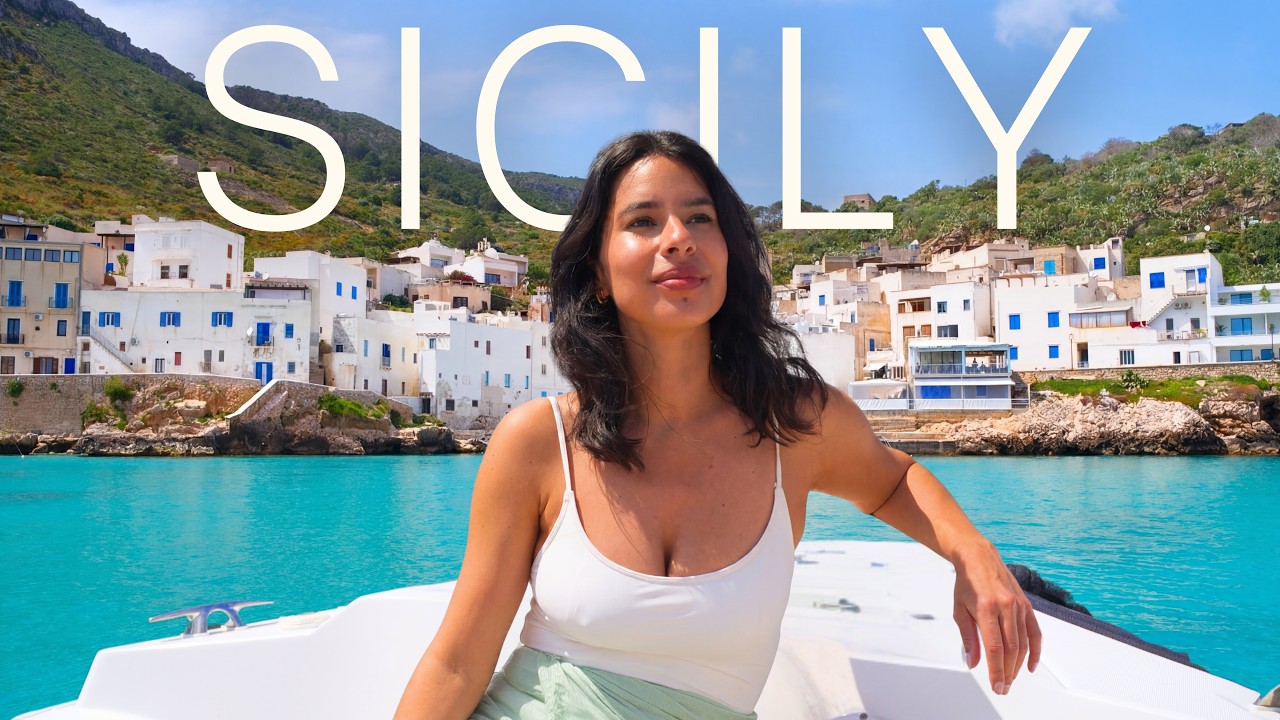
Just off the west coast, the Egadi Archipelago offers a different kind of discovery. The three main islands are best seen by private boat, and a charter out to Favignana brings you first to Cala Rossa, a cove whose name, meaning red beach, traces back to a local legend about the Punic Wars, when the sea allegedly ran red during a battle between Rome and Carthage nearby. Today the water is electric turquoise.
Favignana’s old tuna factories still stand along the port, relics of the fishing economy that once made this small island one of the most significant in the Mediterranean. Fresh tuna is still served in the restaurants of the old town: raw as a tartare starter, and as amatriciana-style spaghetti where guanciale has been replaced by thick chunks of tuna steak and pecorino cheese. The dish bridges Rome and the sea in a single bowl.
The neighboring island of Levanzo has only around 200 permanent residents. At the port, a man born there in 1939 mentioned that he had traveled the world but always came back. His red boat, the Mariana, was moored just below.
Salt pans, sea reserves, and the best prawns in western Sicily
The ancient salt flats stretching between Trapani and Marsala have been harvested since the Phoenicians worked them nearly 2,700 years ago. The old windmills still stand at the edge of the pans, and at sunset the light across the water is extraordinary.
The Zingaro Nature Reserve runs for 7 kilometers along the northwestern coast with no roads, no resorts, and no traffic. A hiking trail connecting its limestone cliffs and hidden coves takes most of the day to walk. In early May the wildflowers are in bloom, and the water in the coves is still cold enough to stop most people at knee depth.
Marsala, at the southwestern tip, closes the loop. Founded by the Phoenicians in the 4th century BC, its old town center still carries the narrow street layout of a North African medina, a legacy of the Arabic name the city still carries: from the word ‘Allah Marsah’, meaning harbor of God. The red prawns fished from deep waters off the coast are served raw in the seafood restaurants along the port, prized by international chefs for their sweetness and buttery texture. As the sun goes down, the town’s wine bars fill with locals ordering glasses of the region’s famous fortified Marsala wine, dipping cantuccini biscuits into the glass in the way it has been done here for generations.
The man with the red boat
At the port of Levanzo, an old fisherman gestured toward the red boat moored at the dock. He had named it the Mariana, after his wife.
Western Sicily moves at its own pace, shaped by every civilization that ever wanted it and still tasting of all of them.