Robert Herjavec was not at the table when Davie Fogarty arrived at his house. He was on the beach, sprinting after a toy rocket he had bought for one of his sons, laughing like a kid who had no idea he was also one of the most recognizable investors on American television. That image set the tone for an entire week in Los Angeles, a city where the gap between what billionaires project publicly and how they actually spend a Tuesday turns out to be surprisingly small, and surprisingly human.
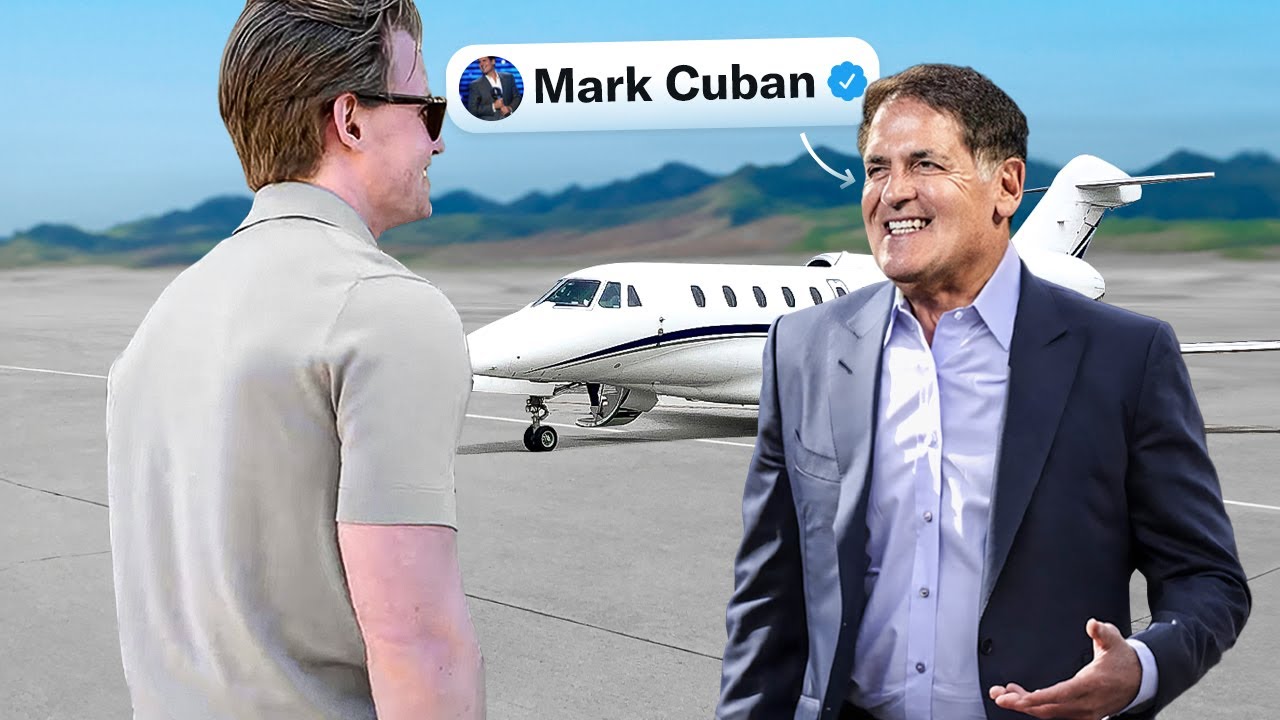
Forgarty, the Australian entrepreneur behind the Oodie, had wrangled access to three of the most famous names in that city: Herjavec, Mark Cuban, and Jay Leno. The result was a ground-level look at what drive, taste, and money actually look like when the cameras are pointed somewhere else, and occasionally when they are pointed directly at a 50th Anniversary Lamborghini Countach.
On the Shark Tank floor with Cuban
The US Shark Tank set runs long. Cuban confirmed the crew would be there until 8 pm, which meant roughly 12 hours of filming and at least 10 pitches in a single day. For context, that is a pace that dwarfs the Australian production Fogarty knew. A 30-second advertising slot on the show costs around $300,000, Cuban noted, which means a founder who actually pitches is sitting inside a media moment worth multiples of that in pure exposure. Cuban also offered one of the week’s sharpest observations on artificial intelligence: ‘There are going to be two types of companies, those who are great at AI and everybody else.’ He drew a line from computers to the internet to streaming, arguing that AI would follow the same arc, integrating quietly into everything until it simply became the infrastructure nobody thought about. His longer-horizon prediction was more specific: a child born today would, by age six, have a personal AI model that learned from every conversation, allowing a parent to review what it had been teaching and redirect it.
Jay Leno on cars, frugality, and a Scottish mother
Leno’s garage is not a museum. Every car there is, as he put it, ready to go. He walked Fogarty through a 1966 Jaguar E-Type that Enzo Ferrari reportedly called the most beautiful car ever made, a Cadillac Escalade V fitted with a Corvette engine, and the centrepiece: a 50th Anniversary Lamborghini Countach, one of only 112 built, that Herjavec acquired for around 2.8 million dollars. Leno took Fogarty for a spin in it at a cautious 16 miles per hour, the two of them laughing because first gear on that car reportedly runs all the way to about 50 miles per hour.
On the business of collecting, Leno’s logic was blunt and specific: ‘It costs just as much to store a worthless car as it does a valuable car, so if you start with something valuable it will be worth more.’ He applied the same thinking to watches, pointing to a cluster of German watchmakers from a small town producing pieces that he argued were quietly challenging the Swiss establishment, and going up in value among the knowledgeable.
Leno’s frugality came up naturally. He traced it to his Scottish mother, who, when his Tonight Show credit read ‘The Tonight Show Starring Jay Leno,’ rang him repeatedly to say it was too grand. He eventually called the producer and had it changed to ‘with Jay Leno.’ ‘What do I do, I don’t sing, I don’t dance,’ he said. ‘Just make it with Jay Leno.’
Herjavec on big bets, happiness, and 200 emails a day
Aboard a superyacht Herjavec confirmed cost a million and a half dollars to build, the conversation shifted from cars to decision-making. His framework for big bets was not about cliff-jumping: ‘I always say, why not walk down to the water and see how deep it is.’ Start at ten thousand dollars, and if it works, go to twenty, then a hundred thousand, then a million.
He also offered a counter-intuitive test for whether a bet is genuinely bold: ‘If you walk into a room and everybody already knows the answer and it is self-evident, it is probably too late. There is margin in the non-consensus.’
On happiness and material possessions, Herjavec was precise in a way that cut against the usual answer. ‘People who know me really well know I am not driven by money at all,’ he said. ‘I am driven by success. I want to squeeze every second out of every moment and I kind of feel like the stuff will come out of it.’ He runs his business on roughly 200 emails a day, always tracing issues back to the engineer or customer-facing person actually living them, not a filtered summary.
The gift Fogarty brought him landed perfectly: a Patek Philippe, chosen because Herjavec owns around 75 Rolexes and zero Pateks. His reaction, visibly stunned, was the best unrehearsed moment of the trip.
The yellow Lamborghini Miura he almost gave away
Leno mentioned, almost in passing, a yellow Lamborghini Miura he had held onto for years when almost nobody else wanted one. He believed in the design before the market agreed. The car is now worth two to three million dollars.
Back on that beach at Herjavec’s house, a man sprints after a toy rocket in the last of the LA afternoon light. He catches it, turns around, and is already looking for the next thing to launch.