Dan Martell did not hesitate when a student asked whether schools should be allowed to use AI. His answer landed hard and fast: keeping students away from these tools is not cautious, it is negligent. For millions of young people being handed a diploma and pointed toward a workforce already running on AI, that distinction matters enormously. The question, Martell argued, is not whether students will encounter AI in their professional lives. It is whether they will be prepared for it.
What schools are actually measuring when they ban the tools
The core of Martell’s argument is a definitional one. Schools that block AI, he said, are confusing memorization with education. By his reading, genuine education is creative thinking and problem solving, not the ability to recall and reproduce information without assistance. When a teacher bans AI to ensure a student ‘does the work,’ the unstated assumption is that the work being measured is the retrieval of stored knowledge. But in nearly every adult professional environment, that is not the work. The work is judgment, synthesis, and the ability to arrive at a useful output. AI does not replace that process. It accelerates the parts that do not require it.
The gap between classroom rules and working reality
Martell was direct about the stakes. He described the world he and most working adults inhabit as one where avoiding AI is not a principled stance, it is a liability. The framing he offered was blunt: ‘AI is not going to take your job. Somebody using AI is going to take your job.’ That distinction reframes the entire conversation. The threat is not the technology itself but the competency gap it creates between those who learn to work alongside it and those who are never given the chance. A student graduating without hands-on experience using AI tools is not protected. They are simply underprepared for an environment where those tools are already standard.
The student who asked the question
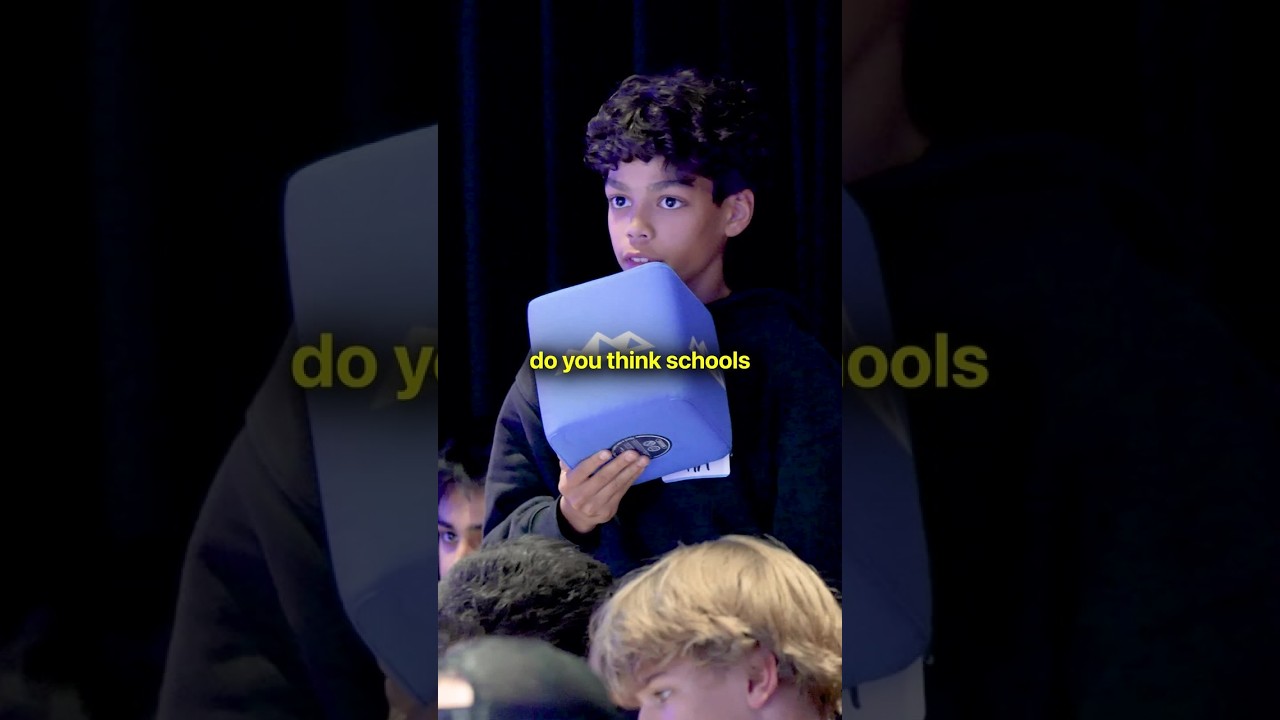
A student posed the original question directly to Martell, asking whether schools should be allowed to use ChatGPT. The exchange was short and pointed. There was no hedging in the answer.
Martell put it plainly: ‘I think it’s ridiculously irresponsible of schools not to let you guys use AI.’
The grounding detail here is not a statistic. It is the posture: an adult who lives and works inside the AI-accelerated economy telling a student that the institution responsible for preparing them is making a consequential error, and saying so without qualification.
The student who asked that question walked away with a sharper frame than most curriculum committees have yet adopted. Whether the schools around them catch up before it matters is the part still unresolved.