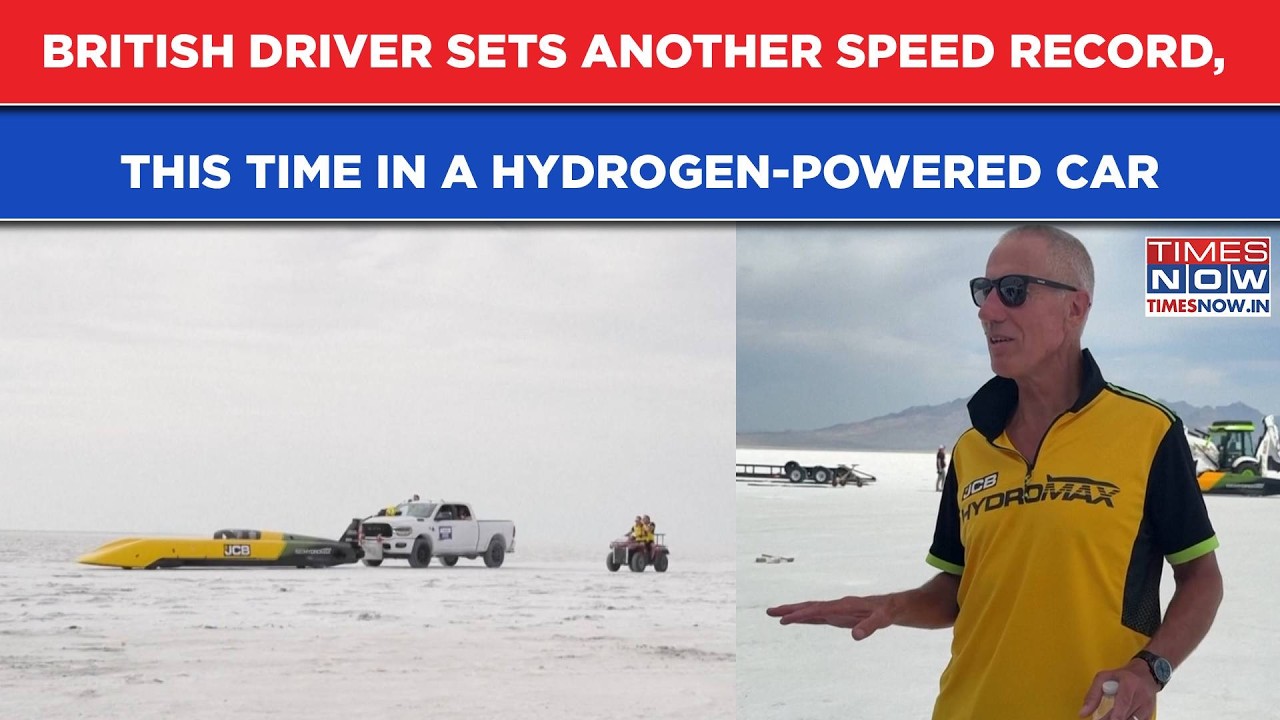
On the Bonneville Salt Flats in Utah, a surface that looks and behaves like packed snow, a hydrogen-powered race car built by JCB and Williams Advanced Engineering crossed 406 miles per hour and left nothing behind but water vapor. That single run rewrote what a zero-carbon vehicle is capable of, and the number that followed the question ‘would you like to hear the speed?’ landed like a starter pistol going off in reverse. The car clocked 406.320 mph, and the crowd’s reaction said everything before the engineers could.
Why salt at 400 mph is harder than it sounds
Bonneville is not a forgiving track. The team had to detune the engine simply to keep the wheels from spinning out of control, and even then the car was breaking traction in first, second, and third gear. There were moments during earlier runs where the wheels were still spinning in fourth gear, which means the car was fighting for grip at well over 250 mph. That is the paradox of Bonneville: the same salt crust celebrated as the world’s best racing surface is also one of the most treacherous. Getting a hydrogen internal combustion engine to plant itself and pull cleanly under those conditions required the kind of engineering patience that does not show up in the headline number.
The speaker who built the case for the run put it plainly: ‘You reflect back and say that car did over 400 mph on this really difficult surface. That’s why I’m a huge fan of it being one of the best ever.’
What comes out of the exhaust is the point
The record is striking. The technology behind it is the part that carries real weight beyond motorsport. The car runs on hydrogen through an internal combustion engine, and when it burns, water comes out of the exhaust. No carbon, no particulate, no emissions that require a footnote. JCB is already manufacturing and selling hydrogen-powered commercial construction equipment on the open market, including to countries that have no domestic oil or gas supply. The logic is direct: with electricity, sunshine, water, and a solar panel, any community can produce its own hydrogen and run its own machines. The race car is the proof of concept, but the diggers and excavators already operating in the field are the point.
Williams Advanced Engineering partnered with JCB on the engineering, combining motorsport-grade construction with the company’s hydrogen technology to produce what the team described as the first of a new breed of racing vehicle.
The moment before the number
A voice in the crowd asked the question, the room went quiet for a half-beat, and then came ‘406.320.’ The applause that followed was not the polite kind. It was the kind that starts before people realize they are clapping.
The white crust of the Bonneville Salt Flats stretched out behind the car after the run, flat and pale and entirely unmarked by anything that would persist, because everything the car burned had already turned back into water and drifted off into the desert air.