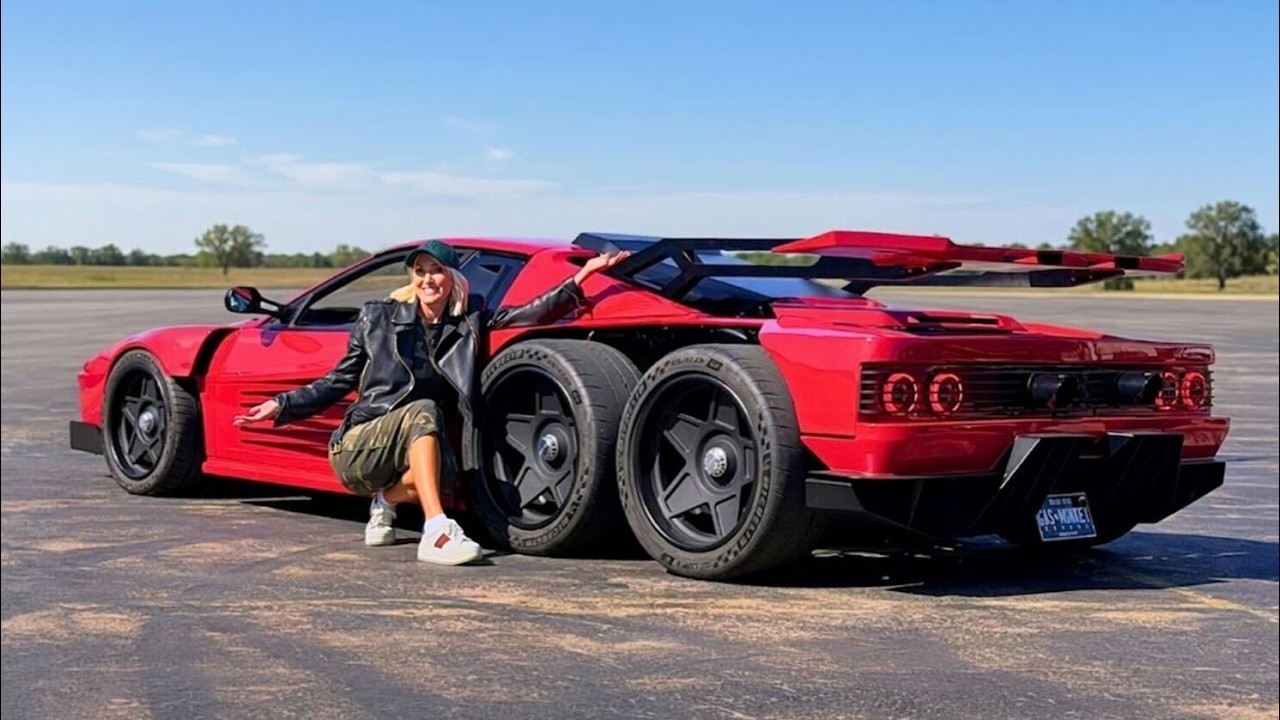
Richard Rawlings was standing next to something that should not exist: a Ferrari Testarossa riding on six wheels, stretched roughly three and a half feet longer than the day it left Maranello, and pushing around 1,200 horsepower through a supercharged engine borrowed from General Motors. The stakes for anyone who cares about cars are immediate. One of the most sacred production Ferraris ever made had been cut, extended, widened, and handed an entirely new mechanical identity. And Supercar Blondie was about to become one of the first people on earth to drive it.
Rawlings, one of the most recognizable car builders of his generation, spent two years on this build at Gas Monkey Garage. The idea, he explained, arrived ‘over a few cocktails at the garage beer bar.’ The donor car was not some pristine collector piece. Rawlings and his team had purchased five Testarossas out of Ireland that had been used in a Mark Wahlberg film, ranging from the hero car all the way down to the wrecked versions. This particular chassis was one of the heavily damaged examples, and the choice was straightforward: turn it into something extraordinary, or let it rot.
What they actually did to the car
The front retains original panels, the original windscreen, and the original side strakes, but the pop-up headlights are gone, replaced by a fixed F40-style unit that sets the visual theme for the entire build. From roughly the B-pillar rearward, the car becomes Gas Monkey territory. The body was widened with custom-fabricated panels, a hood scoop was added, and a large rear wing was engineered specifically for downforce rather than aesthetics. The tail lights swap the original round Testarossa units for a shape that again echoes the F40. Rawlings named the finished car the F6.
The original flat-12 engine, which produced somewhere around 180 to 200 horsepower from the factory, now sits on a counter at the garage waiting, Rawlings confirmed, to be turned into a margarita machine. In its place sits a supercharged LT4 unit sourced from General Motors, mated to an Audi transmission, producing approximately 1,200 horsepower. The practical upside: any competent mechanic with GM parts access can service it. The wheels were fabricated specifically for this car and cannot be fitted to any other vehicle. That process alone cost around $60,000.
Ten miles on the clock when they handed over the keys
The car had logged exactly 10 miles before the test drive. Inside, it felt almost calm. The interior is trimmed in Alcantara and leather with carbon fiber seats, the original Testarossa steering wheel retained, and an F40 dashboard panel digitally scanned, cut by machine, and grafted into the center console. The F6 badge is stitched into the floor mats.
At low speeds, the handling surprised both drivers. The clutch was light, the manual gearbox cooperative, and the sheer size of the thing felt manageable. Then the supercharger kicked in. ‘The only time you think, oh, I’m in something really super outrageous here,’ one of the drivers observed, ‘is when the supercharger kicks in and you look in the side mirror and see all of these wheels behind you.’
The drive ended with an attempted burnout, which revealed a bent tie rod. Rawlings attributed it to putting down significantly more horsepower than the chassis was expecting in that moment, and confirmed the car was heading to semi-truck alignment specialists for a full realignment before its next outing.
The bent tie rod, still sitting at an angle
The folded tie rod was visible at the rear of the car after the burnout attempt, its curve clearly wrong against the geometry around it. Rawlings pointed at it without ceremony.
The F6 Testarossa will go to whoever buys it next, a one-of-one car with a bent piece of steel and about 18 miles on the clock, carrying the kind of history that cannot be ordered from a factory.