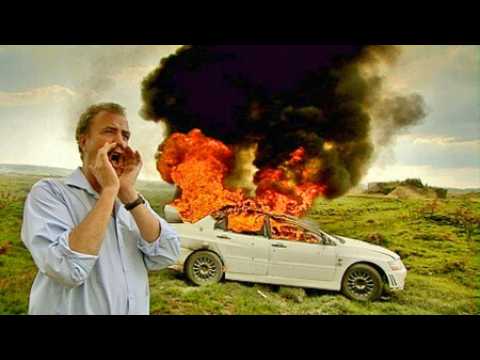
Jeremy Clarkson eased all 6 feet 5 inches of himself into the Peel P50 outside BBC Television Centre, picked up the car by its rear handle, and carried it through the front doors. Nobody looked up. That image, simultaneously absurd and oddly logical, captures something essential about why Clarkson’s best moments on Top Gear endure long after the studio lights go off. These are not just car reviews. They are dispatches from a man determined to find out what happens when you take things too far, and then go a little further.
The one where the smallest car ever built went to work
The Peel P50, all 54 inches of it, had been listed in the Guinness Book of Records as the smallest production car ever made. It was built on the Isle of Man in the early 1960s and cost £198 new, doing a claimed 100 miles to the gallon. What it could not do was reverse. That detail became the engine of the entire segment. Clarkson squeezed through London traffic, filtered past a gridlocked junction by driving between the cars, and then, when he reached his BBC meeting on the fourth floor, took the lift. Fiona Bruce was already in it. ‘Sorry, Fiona, could you give me a push? It’s got no reverse gear.’ She did. He admitted afterward, on air, that he said something he perhaps should not have said out loud about her departing figure.
The follow-up segment with the P45, a slightly larger single-seater with a 100cc two-stroke engine and a 1.7-litre fuel tank, added a motorway run on the A3 that produced genuine, unscripted terror. At 34 mph, surrounded by lorries, Clarkson’s voice shifted from performance to something closer to actual distress. ‘Help. Help.’ He took the P45 to a shopping centre in electric mode, drained the batteries, and was left pushing it out by hand, apologising to every shopper within earshot.
The race against sunrise and a tank that made smoke
The segments that hold up best are the ones built around a real constraint. Clarkson set off in a supercharged V8 Jaguar XJ from Land’s End at the moment the sun dipped below the horizon, racing it to the most easterly point of England before dawn arrived. He had 6 hours and 54 minutes to cover 432 miles, needing to average 62 mph. Roadworks, average speed cameras protecting workers who ‘aren’t here,’ and a fuel stop on the M25 all conspired against him. He described the Jaguar’s purple velvet-lined glovebox as ‘like lifting up the queen’s skirt and finding she’s wearing a thong.’ He did not quite make it in the dark, missing by 26 seconds at the line, which he greeted with laughter rather than disappointment.
The Range Rover Sport versus Challenger 2 tank segment worked because the stakes, though theatrical, were real. Live ammunition. The Challenger’s turret could complete a full rotation in 9 seconds and its thermal camera could detect a hot supercharger engine hiding in woodland. Clarkson’s plan of using the enormous Trojan engineering vehicle as a moving shield was, as he put it, genius, right up until the Trojan’s crew noticed and shunted him off course. The car survived long enough to be declared a draw, at which point Clarkson revealed it had belonged to a convicted drug dealer whose judge had ordered it destroyed. ‘He was probably watching that in his prison cell,’ Clarkson said. ‘And it gets worse. It was only damaged. There’s still a mile and a half of the course left.’
The Nurburgring, and the moment the diesel coughed back to life
Sabine Schmid, born in the village of Nurburgring and with around 15,000 laps of the circuit to her name, told Clarkson plainly that he was about 80 percent talent-free. He accepted this. His target in a Jaguar diesel was 10 minutes around the 13-mile, 147-corner circuit. His first lap came in at over 15 minutes. Breakdowns, a moment off the road in the wet, an admission that he had changed into second gear at 110 mph (‘that’s why the engine went into safety mode’), and a running series of increasingly elaborate excuses for slow sectors all preceded his final run, which he completed in 9 minutes and 59 seconds. ‘I did it. I did it. A 9:59.’ He got out of the car shouting for Sabine.
The Audi V8 diesel single-tank run from London to Edinburgh and back, 800 miles on one fill, ended with the fuel gauge reading zero, the trip computer insisting the car had run out 35 miles earlier, and Clarkson coasting toward the same petrol station he had left the morning before. He could hear the fuel pump, he said, ‘kind of sucking on nothing.’ He made it.
The 928 that got there in time
Clarkson saved his Porsche 928 defence for last. In 1994, he got a call that his father was critically ill in Sheffield. He had just taken a chicken out of the oven. He grabbed it, ran to the 928 he had on test that week, and drove. When he arrived in Sheffield, the chicken was still warm and his father was still alive. His father died half an hour later. ‘If I hadn’t been driving a car which could sit quite happily at 170 mph, I wouldn’t have had the opportunity to say goodbye to my dad. So, as far as I’m concerned, the 928 is all right.’
The studio went quiet after that one.
The Peel P50, still parked somewhere inside the BBC
The Peel P50 in the BBC corridor: 54 inches long, no reverse gear, one door, 49cc moped engine ticking over quietly in the building where Tomorrow’s World was cancelled.
It is not a difficult thing to picture. A car that you carry inside with you, left in a corner while the meetings run long, exactly as its owner said it should be used.