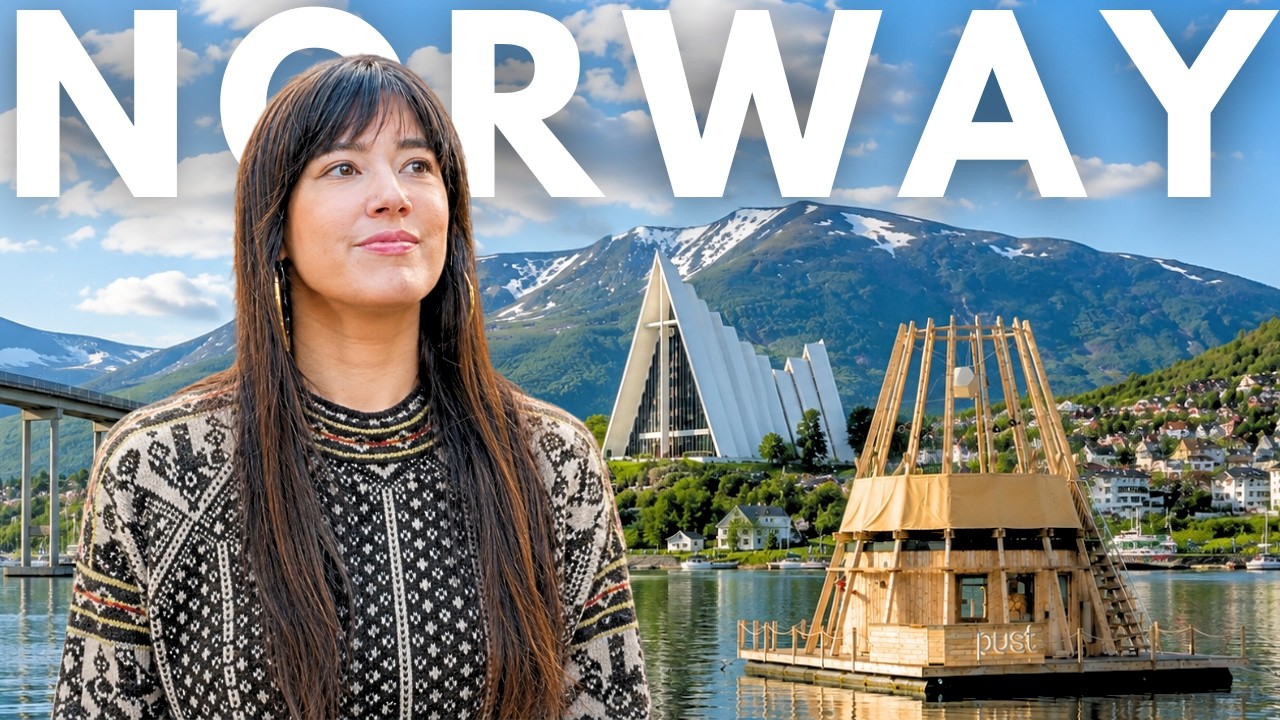
Tromsø greeted its summer visitors the way the Arctic often does: with sideways rain and seagulls that, as one local vendor warned, ‘don’t care about where you come from, so California people don’t care much.’ The largest city in northern Norway sits at roughly 70 degrees north, surrounded by mountains and fjords, and its 60,000 residents have built a city that punches well above its size in restaurants, bars, and things to keep you warm when the weather turns. For the Dots on a Map crew, this particular July happened to be what locals called the coldest, rainiest summer in 20 years, which turned out to be the best possible forcing function to actually live the city rather than just photograph it.
A tunnel, a cathedral, and a harbor plunge
Getting across Tromsø Sound to the city’s most recognizable landmark, the Arctic Cathedral, means skipping the scenic pedestrian bridge entirely when you’re driving and dropping into a long underwater road tunnel instead. The descent feels like it goes on forever, the walls closing in just enough to make a passenger mutter that it would make a convincing setting for purgatory. The Arctic Cathedral itself is worth the crossing. Designed in 1965 by a Norwegian architect, the angular white structure is meant to evoke the Arctic landscape: a snow-covered mountain, an iceberg, or the tent of the Sami people, the indigenous community of northern Norway. Inside, the space is deliberately minimal, the eye drawn immediately to a massive stained-glass mosaic along the back wall.
Back in the city center, on the harbor’s edge, sits a sauna facility called Pir, pronounced with some uncertainty by first-time visitors but experienced with no ambiguity at all. The structure smells of fragrant wood before you even change clothes. The views from inside take in the iconic bridge and the Arctic Cathedral across the water. After enough time in the heat to summon courage, the only logical next step is the harbor itself. The water is every bit as cold as the Arctic label suggests. ‘So cold. It’s so cold,’ came the report immediately after surfacing. One second was, by general consensus, more than enough.
Twenty-one courses and a blue cheese ice cream that requires a warning
The rainy evening led to what turned out to be the trip’s most memorable meal. A restaurant called Smak seats only 16 people in a circle around an open kitchen, run by a Norwegian chef and his Swedish wife, who moves table to table explaining each dish as it arrives. The focus is hyper-local: a king crab salad and Norwegian caviar bite meant to be eaten whole in one go, salmon cured for four days and lightly smoked from a town roughly three hours away, a cured lamb from a nearby farm where the farmer keeps 95 animals, paired with scrambled eggs and meant, again, to go down in a single bite. Course six brought prawns with in-season radish and freshly churned buttermilk. ‘That prawn is like nothing I’ve ever had,’ came the verdict. ‘It almost melts in your mouth.’
The 21-course format stretched late into the night, through a duck breast main and, at the finish, a blue cheese ice cream that delivered exactly the smack in the face its name implied. After roughly ten glasses of wine and two hours at the table, the group left ‘drunk, very full, and very happy.’ Tromsø, it turns out, also holds more bars per capita than any other city in Norway, a statistic that makes complete sense when you consider the city spends part of the year in near-total winter darkness.
The reindeer hot dog cart near the world’s smallest bar
A lifesize stuffed polar bear stands just inside the entrance of one of those bars, which the crew found a three-minute walk from the sauna, all dark wood and warm light, with live music on the night they arrived. Earlier, in the rain, they had stopped at what is allegedly the smallest bar in the world for something more portable: reindeer hot dogs topped with onion, ketchup, mustard, fried onions, and what tasted like pickled cabbage. ‘This is really good,’ was the on-the-spot assessment. ‘I don’t know if I can tell that it’s reindeer, but it’s a really, really high-quality hot dog.’
About 30 minutes outside the city, a small cafe sits directly on a fjord, its first floor given over to a ceramic and homeware shop. On a clear day the patio would be the obvious choice; on a rainy July afternoon, the inside with coffee and a lemon vanilla cream pastry with poppy seeds did the job just as well. The final stop before leaving was a secondhand shop in the city center, name uncertain (either ULF or UF, by the crew’s own admission), where a pair of hand-knit patterned sweaters, the kind associated with this corner of northern Europe and with Iceland, came home for him and her.
The harbor at 10:30 p.m., still in full daylight
The Pir sauna sits on the harbor in the city center, its wood-plank structure still warm to the touch when the group gathered outside after their plunge. The time was close to 10:30 p.m. The sky was as bright as midday.
That is what July in Tromsø actually looks like. The sun does not fully set. Whether the day brought a 21-course dinner, a freezing harbor jump, or a reindeer hot dog in the rain, the light outside remained exactly the same, indifferent to the hour, indifferent to the weather, and entirely indifferent to the seagulls still circling the hot dog cart.
 Wake up to Only Happy News!