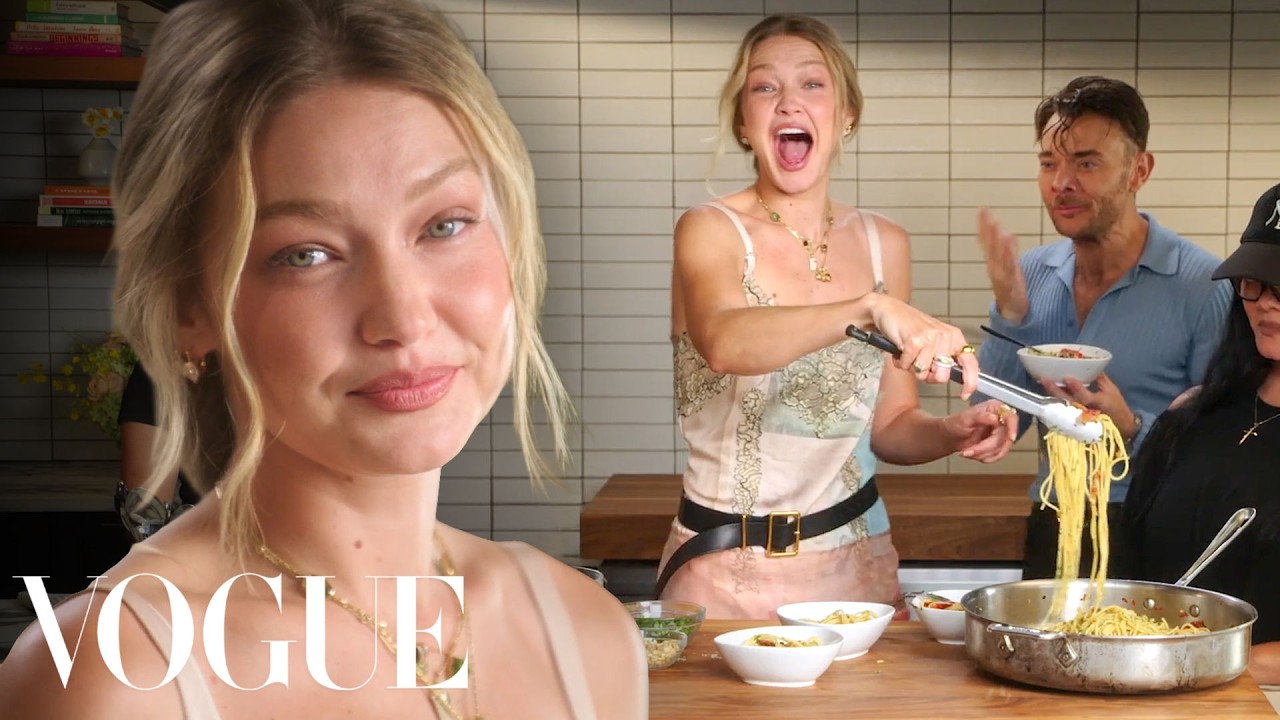
Gigi Hadid was standing at the stove, breaking apart a prosciutto flower with two forks, watching the thin outer edges go crisp while the chunkier center pieces turned chewy, when she offered the simplest possible explanation for why she cooks this way: ‘You need to cook from the heart, people.’ The dish she was making, a spaghetti built on olive oil, garlic, and hand-torn crisped prosciutto, is one she has returned to more than almost any other, and the story of how it arrived in her kitchen is exactly the kind of thing that makes a recipe feel worth keeping. For anyone who has ever wanted a genuinely repeatable weeknight pasta with a real origin story behind it, this is that dish.
The recipe came into her life during the later stretch of the COVID lockdowns, when travel had just started opening back up again. She and her family hosted her mother’s best friend and that woman’s husband, a man named Tim, who cooked this pasta for the table. The name stuck. ‘In our house we call it Tim’s pasta,’ Hadid said. ‘It’s Tim’s pasta, GG’s version.’ The additions she made over time include red pepper flakes for heat and pine nuts for texture, both departures from however Tim first made it, both clearly non-negotiable to her now.
The prosciutto flower and why the cut actually matters
The technique she uses for the prosciutto is the part of the recipe that no written ingredient list would ever convey. She lays the slices down one at a time on the cutting board, rotating each one slightly as she goes, building what she calls a prosciutto flower. The result is a stack where the middle yields thick, uneven chunks and the outer edges taper into thin ribbons. When that whole arrangement goes into hot olive oil, both textures fry simultaneously: the thin pieces go properly crispy and the thick ones stay chewy. She added garlic to the oil near the end, roughly a clove and a half per person for four people, then turned off the heat entirely before folding in the cooked spaghetti, coating everything in the spiced oil before finishing with Parmesan, toasted pine nuts, fresh cilantro, and cubed tomatoes on top. ‘The best part and what everyone will come back for are these crunchies,’ she told the room. ‘I’m telling you. They’re heaven.’
Her approach to measuring, or the deliberate absence of it, traces directly back to her father, whom she named as the natural chef of the household. He can cook for 50 people without measuring anything, she said, and what he passed on was the idea that cooking is another form of being creative: tasting, smelling, feeling it out. His Palestinian cooking, the recipes her grandmother passed to him, are the food she finds most comforting, and she keeps a large jar of za’atar in her kitchen that she uses regularly.
An Arnold Palmer built entirely to taste
Before the pasta came an Arnold Palmer, assembled with the same cook-from-the-heart logic: black tea steeped in a large pitcher, honey dissolved into hot water and chilled, lemon juice squeezed from four lemons using a countertop juicer she called ‘the juice king,’ making herself ‘the juice queen.’ The ratio was adjusted by sipping and adding until it landed right. ‘You can add water, you can’t take it away,’ she said. ‘So, it’s like salt.’
The bowl that went to Demetri first
When the pasta was plated and the first bowl went out to a crew member named Demetri, his reaction arrived before he had even tasted it: ‘Oh my god. Oh my god, it smells so good.’ The table fell into a chorus of cheers and clinking glasses, the kind of moment a recipe earns only when it has been made enough times to know exactly how it lands.
The pasta finished warm on the counter, pine nuts scattered across the top, tomatoes still holding their shape, the crunchies exactly where she said they would be.