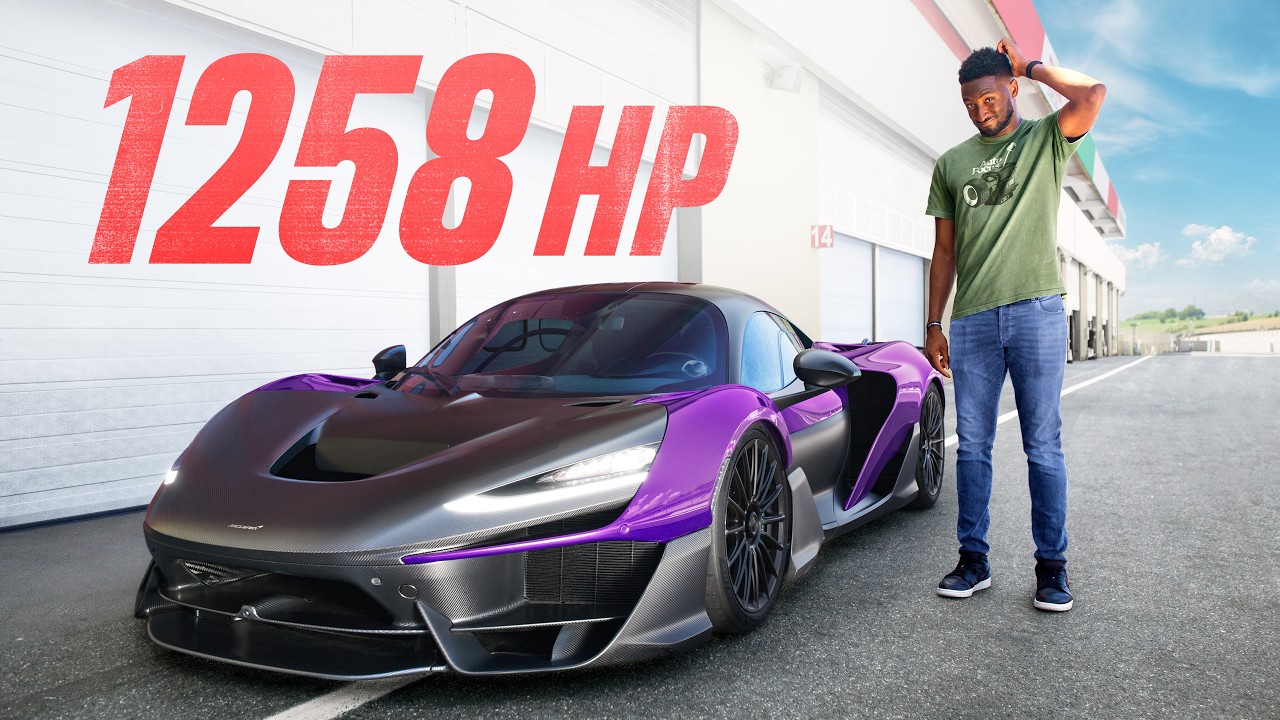
Marques Brownlee had three hours inside the McLaren W1, split between tight Italian mountain roads and the same Mugello Circuit where Lewis Hamilton won a Formula 1 race in 2020, and by the end of it he had a new answer to the question every car-obsessed kid eventually gets asked. The W1 is the successor to the F1 and the P1, two cars with a genuine claim to being the greatest road cars ever made, which means the stakes for this machine are about as high as they get in the automotive world. What unfolded across a full day of driving was a portrait of a car that is simultaneously chasing the present and doubling down on a philosophy most manufacturers have quietly abandoned.
A featherweight in a world of heavy hitters
The numbers alone are enough to stop a conversation. The W1’s in-house twin-turbo flat-plane-crank 4-litre V8 produces over 900 horsepower on its own. Add the electrical system, sourced directly from Formula E, and the combined output reaches 1,200 horsepower. That electric motor draws from a 1.4 kilowatt-hour battery, small enough that it can only push the car one to two miles on electric power alone, but dense enough to eliminate turbo lag entirely. You hear the engine spool, and simultaneously feel the electric motor push you forward before the combustion system fully arrives. The result is what McLaren calls torque fill, and it is immediately noticeable even in comfort mode on a public road.
What makes that power figure genuinely extraordinary is the weight it is pulling. McLaren quotes a dry weight of 1,399 kilograms. Add fuel and the number rises to roughly 1,450 kilograms, still under 3,200 pounds. For context, Brownlee placed the newest Porsche 911 Turbo S alongside it: that car makes around 700 peak horsepower and weighs 1,700 kilograms. The W1 reaches 186 mph in 12.7 seconds. The Porsche takes about 22 seconds to cover the same ground. The W1 stays rear-wheel drive and uses hydraulic steering, two choices most manufacturers have moved away from, and both of which are immediately felt in the wheel the moment the road begins to curve.
What 190 mph feels like at the end of a one-kilometre straight
At Mugello, with race mode engaged, the rear wing extends nearly a foot rearward, past the bumper line, making it technically no longer street legal. That position turns the wing into a functional extension of the rear diffuser, and the car locks to the ground with a grip that caused a specific and remarkable problem: the G-forces during cornering pulled the glass element inside the camera lens out of focus, rendering several laps of footage unusable. The car itself never flinched. Through 15 turns, elevation changes of 50 feet, and twisting S-curves, the only moment the rear end showed any personality was under full braking from 190 mph into turn one, where the back end moved slightly before settling. That was it.
Brownlee, who has driven the P1 and the Rimac Nevera among others, was direct about where the W1 sits: ‘I think I have a new poster car for the bedroom now.’ The car is being built in a run of 399 units at a starting price above two million dollars.
The carbon tub, the knit seats, and the world’s thinnest sun visors
The seats are fixed to the carbon fibre structure of the car and cannot be adjusted. Instead, the pedals move toward or away from the driver, and the steering wheel repositions independently. The interior uses a knit material across the surfaces that Brownlee compared to concept cars shown at CES, and every speaker panel, including those housing the Bowers and Wilkins system, is covered in the same acoustically transparent fabric. There are two cup holders. There is cargo space behind the driver and passenger rated, generously, as room for a duffel bag and a backpack. The sun visors are carbon fibre, thin enough that Brownlee described them as ‘barely compliant.’
The rear-view mirror is a camera feed, and the bottom quarter of its image is permanently occupied by the rear wing, which moves continuously while driving. Brownlee rated the overall visibility at B-plus for what the car is, which is either a mild criticism or high praise depending on what you were expecting.
The rear wing, captured in a camera frame
The active rear wing in its full race extension, stretching past the rear bumper of the W1, visible and slightly intrusive in the bottom of the rear-view camera feed throughout every lap at Mugello.
Of the 399 W1s being built, nearly all will almost certainly live in climate-controlled garages far from public roads. The Italian mountain roads and the perfectly smooth asphalt of Mugello may represent the most honest driving conditions this car will ever see, which is its own kind of extraordinary thing to sit with.