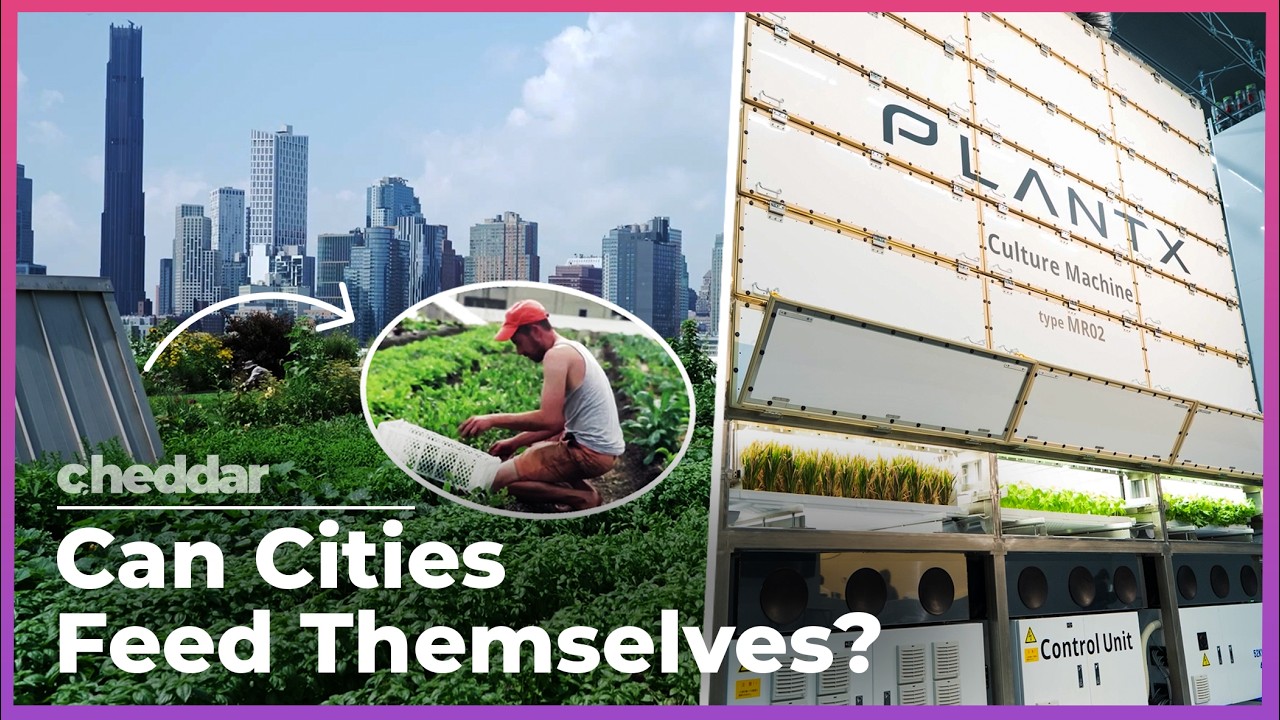
Eleven stories above the streets of Brooklyn, at the Brooklyn Navy Yard, there are no tractors, no pesticides, and no flat fields stretching to the horizon. There is just soil, sunlight, rainbow chard, and a radical proposition: that the underutilized rooftops of American cities might be among the most productive growing spaces the country has left. What makes New York City’s experiment so striking is that two completely different versions of that idea are playing out almost on top of each other, and neither one looks like a farm.
The rooftop that became the world’s largest of its kind
Brooklyn Grange started 16 years ago with a straightforward observation: city rooftops get full sun and sit mostly empty. The company opened its first commercial farm on a 43,000-square-foot roof in Long Island City, Queens, at a time when the idea was almost unheard of. It has since expanded to the Brooklyn Navy Yard and Sunset Park, and today operates the largest soil-based rooftop farming operation in the world. At the Navy Yard location alone, more than 100 different plants and crops grow simultaneously: bush beans days from harvest, scallions, rainbow chard, arugula, salad mixes, and trellis cucumbers that must be picked every couple of days before they outgrow themselves.
The engineering required to run a farm this size on a rooftop is nothing like flat-ground agriculture. Irrigation runs across roughly 25 Wi-Fi-enabled zones, each connected to water and rain sensors that shut the system off automatically during a downpour. Tomatoes and peppers get drip lines so their leaves stay dry; smaller seeds get aerial sprinklers for lighter, even coverage. The soil itself is a custom blend of spent mushroom compost from Pennsylvania mixed with drainage materials, pumped up 11 stories through a pipe and spread by hand. A new zone could go from bare roof to planted beds in a day or two.
Pests are handled without pesticides by building the roof’s own food chain. Edge plantings and flowers create habitat for predator insects, tiny carnivorous bugs that keep the leaf-eating pests in check. As the company’s founder put it: ‘You actually have spaces in the city that get full sun, that are totally underutilized, and are actually the size of some smaller agricultural operations that might be outside of the city.’
Beyond the vegetables, Brooklyn Grange has installed over 200,000 square feet of green space across New York and manages more than 135 gardens citywide. One of its most ambitious sites sits on a 1-acre farm atop the Javits Center in Manhattan, staffed by a crew of five every day through the growing season. Everything harvested there goes directly to the Javits Center’s catering operation below. A 2019 New York City building code law now requires green roofs on new construction, which means Brooklyn Grange fields regular calls from developers with nothing more than a concept and a structural capacity question.
The stormwater case for green roofs is blunt. During a heavy rainstorm, water hits impermeable city surfaces and funnels into drains almost instantly. A soil roof holds and slows that water for hours or days, reducing flash flood pressure on the lowest-lying parts of the boroughs.
The plant factory that grows lettuce in 25 days
Just below Brooklyn Grange’s rooftop, Kubota, the 130-year-old Japanese farming equipment company, is testing a fundamentally different answer. Its PlantX system is a fully sealed indoor environment called a plant factory with artificial lighting, where temperature, humidity, water temperature, and CO2 concentration are all controlled by computer. No soil, no natural sunlight, no seasons.
The core growing method is hydroponics: plants root in a continuously circulating nutrient-rich water solution, absorbing exactly what they need with almost nothing lost. Kubota says the system saves 20 liters of water per head of lettuce compared to conventional growing. Where a standard outdoor crop cycle takes roughly 60 days, the PlantX facility harvests lettuce in around 25 days. Automation, conveyors, robotics, and AI-driven algorithms handle much of the labor load, and the company says this can reduce production costs by more than 50 percent.
The scale comes in two sizes. The Type XS is a smaller research unit used to test growing conditions and develop recipes for new crops. The Type M is the commercial workhorse, designed to operate inside distribution centers, supermarkets, and dedicated vertical farm facilities close to major cities. That proximity matters on the East Coast: most of the leafy greens consumed in New York City currently travel more than 2,500 miles from West Coast farms before reaching a grocery shelf.
The tarp between the crops
Back at the Navy Yard, one detail from the rooftop operation is easy to miss in the rows of vegetables: a black plastic tarping system Brooklyn Grange started using five or six years ago. Between crop cycles, the tarp goes down for a couple of weeks. Heat builds underneath it, breaking down remaining organic matter from the removed plants and leaving the soil more workable for whatever goes in next.
Brooklyn Grange’s founder described the roof simply: ‘People just love poking around and seeing the farm. There is a magic to it that’s hard to put to words, hard to really fully explain till you’re up here and you see it. But people don’t really want to leave.’
Eleven stories up, on the same roof where a crew dragged a soil pipe skyward and planted a bed in a day, that tarp sits quietly between harvests, doing exactly what the rest of the operation does: making something grow in a place no one expected it to.