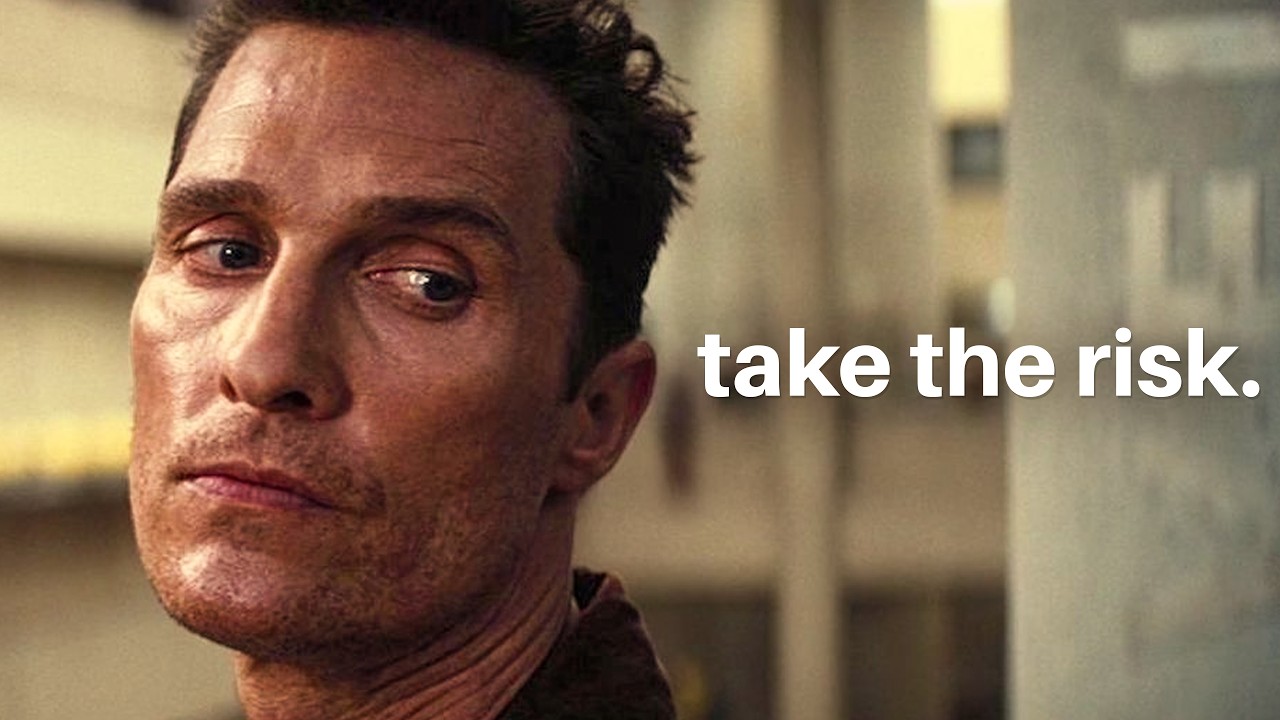
At 4:00 a.m., Matthew McConaughey was in tears. His wife was pregnant with their first child, his personal life had never felt more alive, and he was quietly planning to walk away from everything Hollywood had given him. The moment that decision locked in was not a boardroom meeting or a publicist’s call. It was a sleepless night, a mirror, and a private conversation with himself that he would carry for the next 20 months. What he did next became one of the more studied career pivots in modern film, and the reasoning behind it lands harder than the outcome.
When rolling the dice looked like career suicide
By his own account, the romcom years were comfortable in a way that ate at him. He could ‘roll out of bed and do one of these tomorrow morning,’ and the roles kept coming. But his life outside work had become louder and more vital than anything on set, and the gap between the two was widening. His solution was radical: stop taking the work that was available and wait for the work he actually wanted. When that work did not materialize, he stopped working altogether.
Almost everyone around him thought he had lost the plot. ‘What is your major malfunction, little brother? You got it made. Why are you throwing a jack knife in this? You’re tripping yourself running downhill, man,’ he recalled people telling him. The lone dissenter was his wife. He turned down a $14.5 million offer during that stretch, and the refusal itself became the signal. As he put it: ‘You don’t just step out of Hollywood unless you turn that down because you got a plan. You got somewhere you want to go.’ He did not have a polished plan. He had a 4:00 a.m. clarity and a decision to roll the dice.
After roughly 20 months of genuine anonymity, the phone started ringing with different offers.
The pothole you keep twisting your ankle in
The deeper argument McConaughey makes is not about career strategy. It is about the specific kind of courage that is harder than persistence: the courage to stop. He grew up, as he tells it, knowing only ‘the courage of the persistent,’ the instruction to be resilient, get up, dust yourself off, and keep going. The problem with that, he argues, is that it guarantees you repeat the same mistakes at full speed.
‘I’m going to let some people pass me in the race right now,’ he said, ‘because I’m going to look at why I keep stepping in that damn same pothole and twisting my ankle in the same spot.’ The willingness to sacrifice forward momentum for genuine self-examination is, in his framing, rarer and more valuable than hustle.
The same logic runs through his thinking on time. He cites John Wooden, the UCLA basketball coach, whose instruction to his players was: ‘Be quick, but don’t be in a hurry.’ McConaughey’s version is the Lego set analogy: rush the build, skip the directions, and you reach the end with 12 pieces left over and nowhere to put them. He guards his own pace deliberately, including sleeping 9.5 hours a night, a number he named flatly and said he will not trade for extra working hours.
The golf round he did not know was his best
On the question of performing at your peak, he frames self-consciousness as the direct enemy. ‘If you’re aware that you are playing your best game ever as you’re playing it, that’s when you mess it up.’ His preferred model is the golfer who walks off the 18th green without realizing it was the last hole, still mentally heading to the next one. The score is real. The strokes are recorded. But checking the scorecard mid-round is what produces the three-putt on 18.
The same principle shaped his shift from screenplays to personal writing: a more direct form of expression with no director, no cinematographer, no editor between the thought and the page.
The $2,000 and the six-week motorcycle trip that changed everything
In Los Angeles with $2,000, sleeping on a contact’s couch after small early roles, McConaughey pushed for an agent meeting too soon. The contact saw it immediately and told him to leave, take some time, forget about Hollywood entirely. McConaughey and two friends took what little money they had and motorcycled through Europe for six weeks. By the time he returned, the agent meeting had become almost an afterthought. A week later, the contact told him: ‘You’re ready.’ The meeting happened. He got the agent. He credits the outcome entirely to the fact that he had stopped needing it.
His distillation of that experience: ‘I really want this, but I don’t need it. And there’s a big difference.’
The 4:00 a.m. decision held. The dice landed.