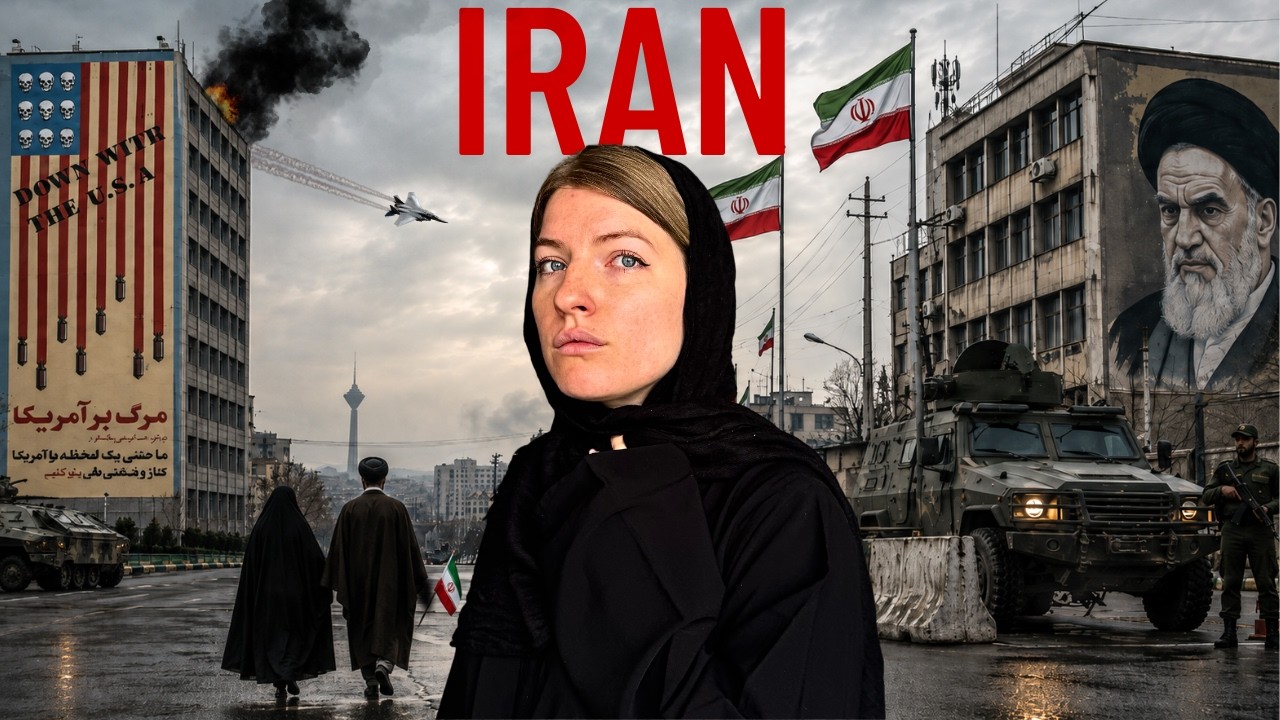
The border crossing between Armenia and Iran took less than 15 minutes. No dark rooms, no hours of interrogation, no limping British passport holders. Matt and Julia walked across a bridge over the river separating two entirely different worlds and were welcomed into the Islamic Republic of Iran with a smile. For anyone who had been reading Western government travel advisories, including the British Foreign Office warning that nationals risk arrest and detention simply for being there, that outcome felt almost impossible to believe. But in September 2026, after months of conflict with Israel and the United States, internet blackouts, and widespread reports of internal tension, the two travelers crossed anyway. What they found was not what anyone had told them to expect.
Getting there before the bus disappeared
The journey started in Yerevan, Armenia, where the plan was simple: one bus a day to the Iranian border, leaving at 7:30 in the morning. Matt and Julia arrived at the station at 6:45. By quarter past seven, no bus had appeared and they were the only people heading in that direction. The bus never came. A taxi price came up at 180 pounds on the app. They tried negotiating with drivers at the station. Then Matt went to pull cash from an ATM, and the machine swallowed his card. By the time they reached Agarak, the last Armenian town before the frontier, and checked into what amounted to a converted shipping container with air conditioning but no water for the first two and a half hours, at roughly 18 pounds a night, the trip had already tested them. The crossing itself, when it finally happened the next morning, was so uneventful it felt anticlimactic.
British, American, and Canadian passport holders cannot travel Iran independently. For the entire trip, Matt and Julia were accompanied by a guide named Amin, whose presence made the logistics both legal and navigable.
What Tabriz looked like on the other side
The first city was Tabriz, and the first stop was what Amin described as the largest undercover bazaar in the world. Stalls selling carpets, fruit, household goods, and bulk quantities of everything lined corridors that seemed to go on without end. The bulk-buying habit had a specific cause: inflation. A trader in the bazaar explained it plainly, holding up a stack of currency. The Iranian rial had dropped in value by half compared to the previous year. Someone earning the equivalent of 200 dollars a month in real terms was now effectively earning 100, even though the number printed on their paycheck had not changed. Prices, meanwhile, had kept rising.
Outside the bazaar, a call to prayer rang across the city and the streets kept moving. Nobody stopped. Nobody closed a shop. Amin told them that older people might be found praying in the mosque, but that life in Tabriz simply continues. Julia, who had been worried she might be required to wear a headscarf at the border, was told by Amin it was voluntary. She chose not to wear one.
That evening, the pair walked through a city park as the temperature finally dropped. Families, young people, elderly couples, and children filled every bench and path. A small lake in the middle had paddle boats on it. Matt put it plainly: ‘you’d think that here in Iran, no one’s going outside. It’s all gone. But it’s not the case.’
The next day they drove south through East Azerbaijan province toward the mountains, stopping in Bonab, a town apparently famous for lamb kebabs, and at a roadside restaurant where they ordered something called a Zam Zam cola, the local alternative to Coca-Cola. Petrol at the pump cost three dollars for 100 liters, heavily subsidized by the government, though Amin noted that raising the price was being discussed and that doing so risked bringing more tension to the country.
The Kurdish village with no name on the map
Somewhere on the mountain road, they stopped at a village they had simply noticed from the car window. A local man walked them through it: 95 families, 250 people, almost all relatives. Two young women, cousins, came out to meet them. A greeting was explained through Amin: placing a hand over the eyes, a gesture that translates roughly as ‘you step on our eyes.’ An invitation to welcome someone so completely that you would give them your sight to walk on.
Julia was crying by the time they left.
A hand placed over someone’s eyes
The cousins stood at the entrance to their home in a Kurdish village in northwest Iran, one hand raised to each of their faces in the traditional gesture of welcome, looking at two strangers who had stopped for no particular reason.
Matt and Julia got back in the car and kept driving toward the mountains.
 Wake up to Only Happy News!