David Bayer was mid-sentence, pen moving across a pad in his home studio, when his hand wrote something his mind had not planned. He had started the sentence with ‘I don’t feel like’ and expected it to finish with ‘doing any work today.’ Instead, his hand landed on ‘anybody cares about me.’ The gap between those two endings is exactly the territory Bayer wants more people to explore, and he believes a simple pen and paper is the only tool required to get there. For anyone who has ever dismissed journaling as a self-help cliche, his argument, built across five distinct mechanisms, is harder to brush aside than it first appears.
Why writing by hand does something typing simply cannot
Bayer opens with what he calls the subconscious unlock. When a person types or speaks, the mind already knows where the thought is going before it arrives. Writing by hand is slower, and that slowness creates a gap, a small interval in which quieter, deeper information has room to surface. The false problem, the one the mind articulates first, gives way to the real one. Bayer describes reading sentences he has just written and genuinely not knowing where they came from.
The second mechanism is neurological. He points to neuroscience showing that handwriting engages significantly more of the brain than typing or thinking alone, because the physical movement of the hand is bound up in the formation of the thought. He extends this into territory that is openly more speculative: the ancient treatment of inscription as a form of intention-setting, from runic symbols to early spiritual traditions where writing was considered a ritual act rather than simple record-keeping. His framing is careful. ‘I can’t scientifically prove to you that writing something on a piece of paper changes some external energetic field,’ he says plainly. ‘But here’s what I can tell you: it changes you.’
The third and fourth unlocks sit on opposite sides of the same lever. Journaling gives difficult emotions a pathway out. Writing ‘I’m angry,’ then writing why, then writing what you wish you could say, produces actual movement in feelings that have been held in place. At the same time, writing gratitude in full sentences rather than letting the thought pass in two seconds extends the neurological experience of appreciation. The emotion is not just noted; it is sustained and reinforced. One direction clears what no longer serves; the other deepens what does.
The three-step practice that changed his mornings
The fifth unlock is the most personal. Bayer wanted a relationship with his higher power that felt genuinely conversational rather than abstract, and the idea that came to him, which he initially dismissed as inconvenient, was to wake early, go down to his studio, and write directly to God. He resisted it twice. Then, during a breathwork session, his body sat upright and his hands began writing in the air. He took that as the message he needed.
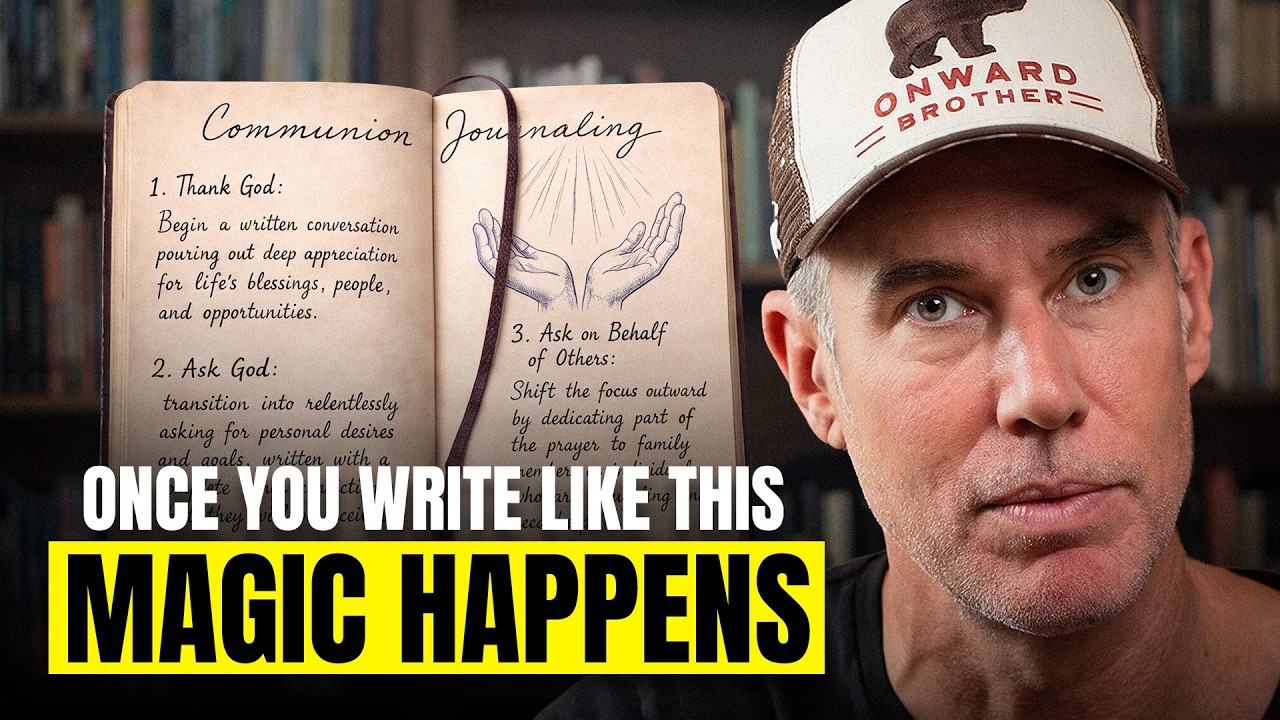
The next morning he sat down with no prompt and no plan, touched pen to paper, and started thanking God for his wife, his son, his business, his sobriety, his house, and his friends. The gratitude ran long, almost like, as he put it, ‘a way overdue pen pal letter.’ From there, the process shaped itself into three steps. First, he thanks God. Second, he asks for what he wants, with what he describes as the unguarded directness of a three-year-old who fully expects to receive what he requests. Third, he prays for other people, writing prayers that he says came out of his fingertips sounding like something from a skilled preacher. He calls it communion journaling, and it takes him between five and fifteen minutes depending on what surfaces.
The pen, still sitting on the pad
Down in the podcast studio, the journal pad from that first morning sits somewhere in the same room where Bayer now records. The words from that session, the gratitude list, the requests, the prayers for people he knew were struggling, are still on the page exactly as his hand wrote them.
For anyone who has spent months thinking about a problem without resolution, Bayer’s invitation is narrow and specific: get a pen, get a pad, give it fifteen minutes, and if nothing comes, start with thank you. The problem will still be there when the pen goes down. The person holding it may not be quite the same.