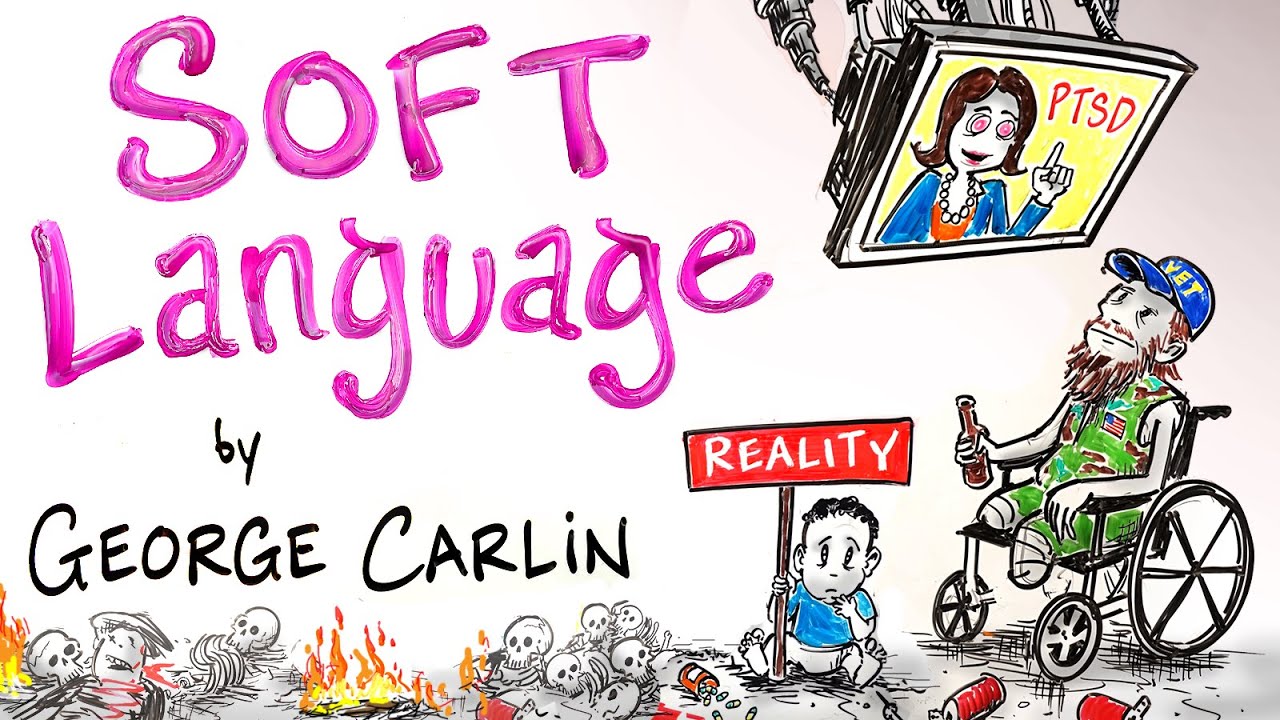
George Carlin had a problem with toilet paper, and it had nothing to do with plumbing. The comedian and language critic stood before a live audience and made a case that has only grown more relevant with time: that the slow, deliberate softening of American English is not an innocent social habit but a mechanism for concealing reality from the people living inside it. The argument is funny, precise, and genuinely unsettling, because once you hear it, you cannot stop noticing it.
From shell shock to post-traumatic stress disorder
Carlin anchors his entire thesis to a single, devastating example. In World War One, when a soldier’s nervous system had been pushed past its breaking point by combat, the condition was called shell shock. Two syllables. Direct. Almost onomatopoeic, he notes, sounding like the guns themselves. By World War Two, the identical condition had been renamed battle fatigue, four syllables, with ‘fatigue’ carrying far less visceral weight than ‘shock.’ Korea brought ‘operational exhaustion,’ eight syllables, so clinical it could describe a malfunctioning vehicle. Then Vietnam produced ‘post-traumatic stress disorder,’ also eight syllables but now buried under a hyphen and medical jargon, the person inside the phrase almost entirely gone.
The progression is not accidental. Each rename puts more distance between the word and the wound. Carlin’s sharpest observation on this point lands quietly: ‘I’ll bet you if we’d still been calling it shell shock, some of those Vietnam veterans might have gotten the attention they needed at the time.’ He is not certain. He says so. But the implication is hard to shake.
The list that keeps going and going
From there, the examples multiply. Toilet paper became bathroom tissue. Sneakers became running shoes. False teeth became dental appliances. Used cars became ‘previously owned transportation.’ The dump became the landfill. People in slums became ‘the economically disadvantaged’ occupying ‘substandard housing in the inner cities.’ People who were fired now had their positions eliminated because management wanted to ‘curtail redundancies in the Human Resources area.’ They were no longer ‘viable members of the workforce.’
Each substitution follows the same logic: the original word touches something real, something uncomfortable, something that demands a response. The replacement word smooths that demand away. Carlin catalogues the government and intelligence community versions with equal precision. The CIA does not kill people, he notes; they ‘neutralize’ them or ‘depopulate the area.’ The government does not lie; it ‘engages in disinformation.’ Nuclear radiation gets measured in something the Pentagon calls ‘sunshine units.’
The comedy sharpens when he reaches aging. He admits freely that he caught himself doing it in his own mirror, telling himself he was ‘getting older’ instead of getting old, because ‘older sounds like it might last a little longer.’ And death itself, he concludes, has been abolished from polite American vocabulary. He will not die. He will ‘pass away,’ or ‘expire like a magazine subscription.’ In the hospital it will be called a ‘terminal episode.’ The insurance company will log it as a ‘negative patient care outcome.’ If malpractice was involved, a ‘therapeutic misadventure.’
He ends with a demonstration. The language he has spent the whole performance dissecting, he says, makes him want to vomit. He stops himself. Corrects it. He wants to ‘engage in an involuntary personal protein spill.’
The man who almost kept a straight face
Carlin, delivering the therapeutic misadventure line to a room that erupted before he finished it.
The language he spent a career documenting did not stop after he named it. New terms arrive on the same schedule he predicted, softer every cycle, the original condition still waiting underneath.