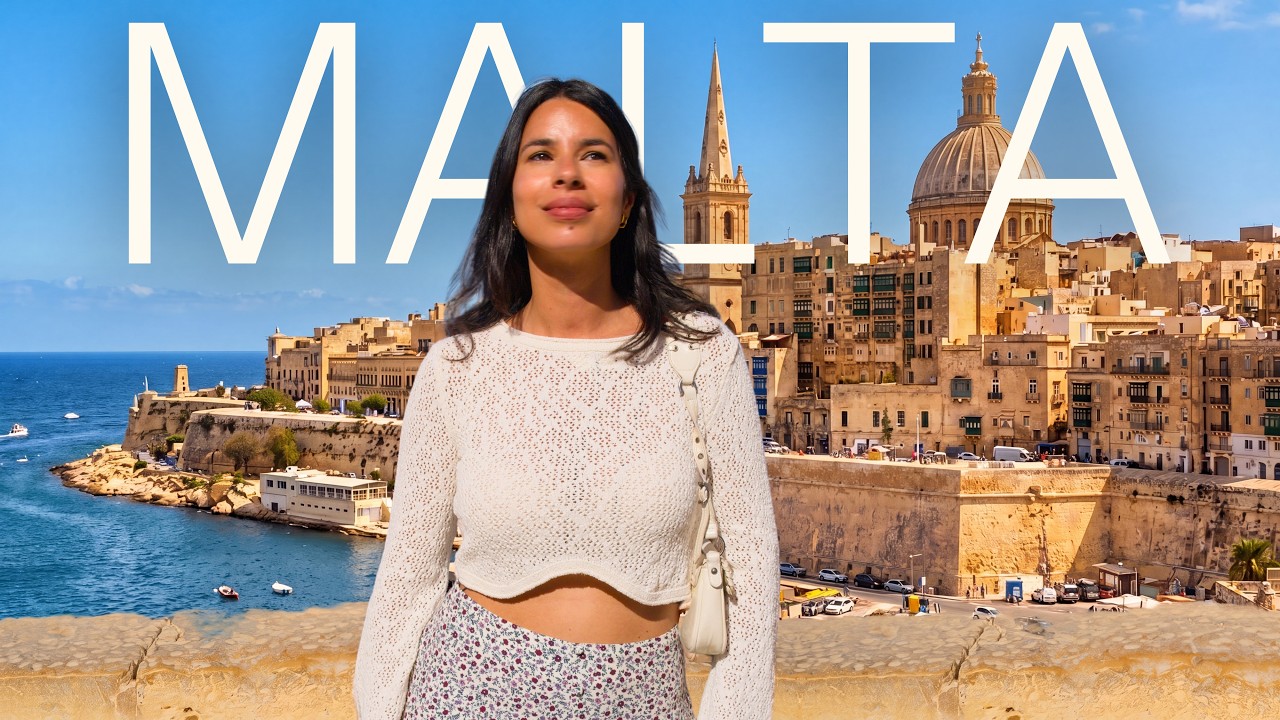
The streets of Valletta rise steeply from the harbor, narrow and sun-bleached, lined with wooden balconies painted in every shade of rust, green, and ochre. Malta sits at the crossroads of Europe, Africa, and the Middle East, a small island nation that has been fought over, colonized, and rebuilt by nearly every great Mediterranean power for thousands of years, and the weight of all that history presses in from every direction. Travel journalist Malini Angelica arrived here on a partnership with Med TV, the Mediterranean satellite and streaming channel, and what she found was a country so dense with beauty, food, and living history that it left her, more than once, genuinely speechless.
A cathedral, a sandwich, and a fortress city
Valletta was built as a military headquarters by the Knights of St. John after they were driven from Rhodes following their defeat by the Ottomans in 1523. The grand limestone city they constructed between 1530 and 1798 still stands largely intact, and its Co-Cathedral of St. John is the defining monument of that era. From the outside the facade is deceptively plain, almost severe. Step inside and the contrast is total: walls draped in gold, an elaborately carved marble floor where individual slabs commemorate the victories of aristocratic knights, and ceiling frescoes narrating the order’s transformation from pilgrim caretakers to a naval military force. Eight chapels line the cathedral, one for each of the eight countries that contributed knights, each lavishly decorated. The crown of the entire space is the largest painting Caravaggio ever produced, a depiction of the beheading of St. John the Baptist, completed in 1608 and gifted to the cathedral. Standing before it, his signature command of light and shadow is immediately visible.
Before pushing further into the city, Angelica stopped at a traditional local institution famous for its ftira sandwiches. What arrived at the table was enormous: thick hobz bread soaked in olive oil and packed with tuna, beans, tomatoes, capers, and olives. A regular at the spot for 25 years, a local diner summed up the ideal way to eat it: ‘near the sound of the sea.’ Across the harbor at golden hour, a short ride on one of Valletta’s traditional wooden luzzu boats brought her to the fortified city of Birgu, the Knights’ original Maltese base and home to Fort St. Angelo. On May 18, 1565, roughly 300 Ottoman vessels sailed into this harbor, beginning a four-month siege in which a force believed to number more than 40,000 men fought against 8,000 soldiers and 700 knights. The fort never fell.
Mdina’s brass door knobs and the Sunday fish market at Marsaxlokk
Twenty-five minutes inland, the ancient hilltop city of Mdina has been inhabited since the Bronze Age and served as Malta’s capital under successive civilizations, from the Phoenicians around 1000 BC through the Romans, Arabs, and Normans, until the Knights relocated the capital to Birgu in the 16th century. Its main gate, the Mdina city gate, is recognizable internationally as the entrance to King’s Landing in Game of Thrones. Inside the walls, wandering off the main piazzas reveals a detail that most visitors miss: the brass door knockers cast in the shapes of fish, lions, and other animals were used historically to signal a household’s trade, wealth, and social standing. Bastion Square, at the far edge of the old city, opens onto views that stretch across the entire island to the Mediterranean beyond, and it becomes clear immediately why this elevated position was chosen as a capital for so long.
Down at the coast, the Sunday fish market at the fishing village of Marsaxlokk provided an entirely different kind of history lesson. The harbor was crowded with luzzus, the brightly painted traditional wooden fishing boats whose curved hull shape evolved over centuries of Mediterranean influence and whose painted eyes on the prow trace directly back to Phoenician seafaring tradition, a protection ritual thousands of years old. At the market stalls, everything on offer had been caught that morning: tuna, octopus, clams, mussels, sardines, mullet, crab, and enormous prawns. A Tunisian resident who has lived in Malta for 11 years noted that the Maltese and Tunisian languages share roughly 70 percent of their vocabulary, and that the Sunday market itself carries the feel of a North African souk. Lunch afterward at a harbourside spot was deliberately simple: deep-fried calamari, those outsized prawns with tartare sauce, and a cold Cisk, the local Maltese beer.
At the Med TV offices in Malta, Angelica met Manolo, the channel’s COO, who put the reach of their Mediterranean mission plainly: ‘You are reaching more than 300 million people through Med TV because we cover all Europe, North Africa and part of the Middle East.’ The team had laid out a cake to mark the occasion, and Angelica’s face appeared across screens throughout the building.
The piselli pastry from Rabat
In the working-class neighborhood of Rabat, just outside Mdina’s walls, a local cafe was already busy with residents collecting their breakfast pastries when Angelica arrived. The traditional Maltese pastizzi come in two forms: ricotta-filled and piselli, the latter packed with a spiced, mashed-pea filling that she described as tasting remarkably close to a vegetarian Indian samosa, with the same layered filo pastry shattering into crisp shards at every bite. The tea, a patta with milk, carried what she recognized immediately as a faint PG Tips quality, a small but unmistakable trace of the nearly 200 years Malta spent inside the British Empire before independence in 1964.
At the Blue Grotto on the southern coast, sheer limestone cliffs drop into water that glows in shades of electric turquoise even when the sun is not shining directly into the cave mouth. When the light does hit, the colors inside shift through a range that explains the name without any further description needed.
The luzzu boat, still at the dock
A traditional wooden luzzu sits tied at the Birgu waterfront, its painted eyes facing outward across the Grand Harbour toward Valletta’s limestone skyline, the color still bright against the hull.
The steep streets of Valletta were where this journey began, the balconies overhead and the fortress walls pressing close. By the time the calamari arrived at the harbourside table in Marsaxlokk and the cold Cisk was poured, it was clear that Malta’s real draw is not any single monument or view but the density of it all: the way a brass door knocker, a fish market, a sandwich eaten near the sound of the sea, and a 1608 Caravaggio painting can all exist within a few kilometers of each other, each one entirely itself.