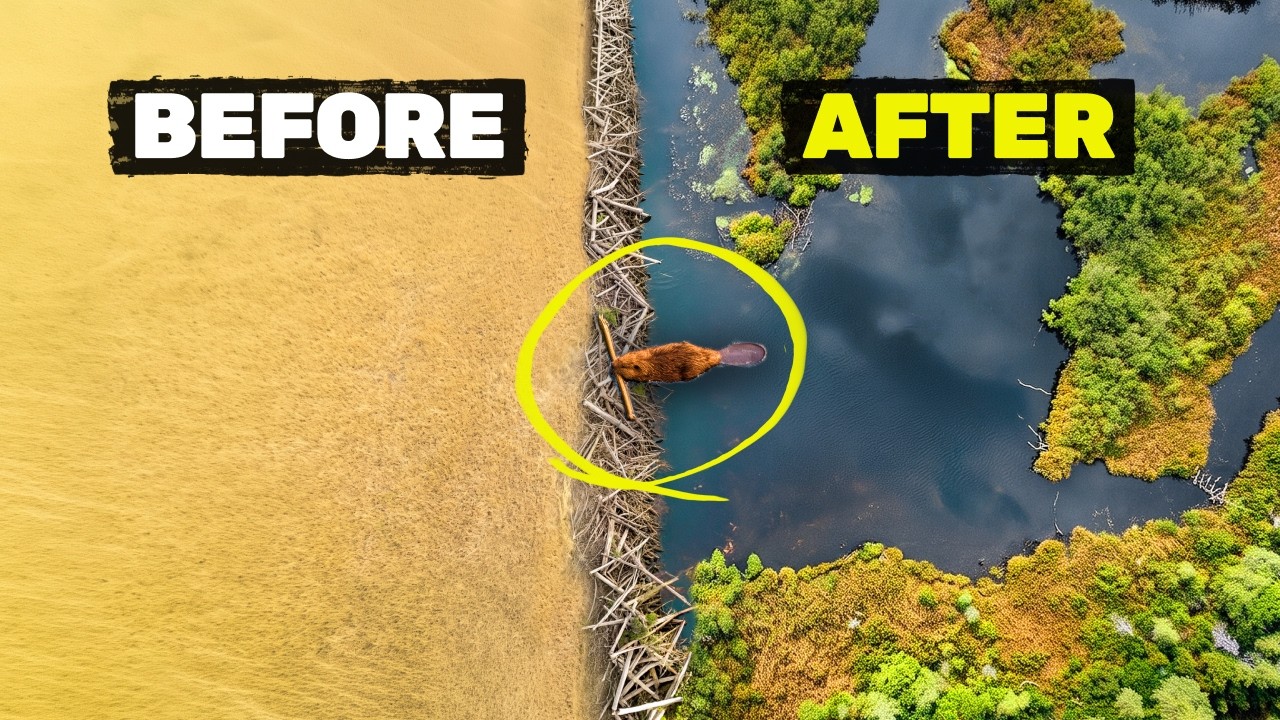
The concrete lock at the abandoned fish farm in the Oder Delta region of Poland sat rusting and purposeless over a stretch of brown, dried-out land that had once been a natural marshland, then a chemical-laced aquaculture operation, and was now simply nothing. A few weeks after the Planet Wild community purchased the 20-hectare site, something changed. The beavers that had been quietly scouting the perimeter moved in, located the old drainage lock, and started building. No blueprints, no construction crew, no project manager. Just teeth, mud, and an architectural instinct refined over millions of years. The stakes behind that quiet act of dam-building are enormous: wetlands are vanishing faster than any restoration program can reverse, and the creature best equipped to rebuild them was nearly exterminated for hat fashion and vanilla perfume.
From functionally extinct to 100,000 strong in Poland alone
Just 70 years ago, beavers were considered functionally extinct in the wild in Poland. The collapse had been centuries in the making. Starting in the 1600s, beaver fur became a marker of social status across Europe, and a gland near the animal’s tail that produces a vanilla-like scent was harvested for perfume and food flavoring. Demand wiped out the European population, the fur industry expanded to North America, and over roughly 200 years, 99.9% of the world’s beavers were hunted and killed. By the early 1900s, only 1,200 individuals remained across the entire continent. The wetland systems they had maintained, home to fish, amphibians, insects, deer, elk, and wolves, drained away with them.
The recovery has been extraordinary and, at times, spectacularly unconventional. In 1948, conservationists in Idaho packed 76 beavers into wooden crates, fitted them with World War II surplus parachutes, and air-dropped them into wilderness to restart wetland ecosystems. The plan worked. In Scotland, beavers were fully extinct until a mysterious population appeared in the wild, likely released illegally or escaped from captivity. Nobody is entirely sure. Their descendants now populate much of the Scottish Highlands. Across Europe, that founding population of 1,200 has grown to over 1.5 million, and Poland alone now hosts more than 100,000, one of the continent’s largest concentrations.
Why a beaver’s dam is harder to engineer than it looks
Frauke, a conservation specialist who has worked alongside beavers for 17 years and is part of Rewilding Oder Delta, walked the site with the Planet Wild team and was direct about the limits of human intervention. ‘What beavers do can help restore our landscape much better than we can do with our engineering,’ she said.
The reason comes down to method. Beavers use self-sharpening, iron-reinforced teeth to fell trees in a single night, cutting the trunk so it drops into water for easy transport. They select narrow streams in flat valleys so even a modest dam floods a disproportionately large area. They anchor large logs into the riverbed, layer in branches, mud, and leaves, and then monitor the sound of running water to gauge when the seal is complete. In Canada, a beaver colony built a dam twice the length of the Hoover Dam. The lodges they construct beside these dams include a lower wet chamber for shedding water before retreating to a dry upper living area with a built-in ventilation shaft. In winter, body heat and decomposing organic walls warm the interior while the water below functions as a cold-storage pantry. Frauke noted that beavers also tend a small garden of food branches staked into the soil near the lodge entrance, a cache they manage deliberately.
Studies cited in the project documentation show that introducing beavers to an area can triple the biodiversity there, attracting insects, birds, amphibians, and large mammals including wolves, in a cascade that artificial wetland construction has never reliably replicated.
Planting 9,000 willows to keep the peace
The challenge is that beavers are exceptionally good at claiming land, including land humans would prefer they left alone. Flooded agricultural fields, blocked drainage ditches, and felled ornamental trees have created friction as populations expand. To pre-empt that conflict at the Oder Delta site, the Planet Wild community is planting 9,000 willow trees. Willows are a preferred beaver food source, and because beavers never fully consume them, the stumps re-sprout, creating a self-renewing supply that draws attention away from old-growth trees. Local residents are also being given non-toxic anti-bite glue, low-voltage electric fencing, and wire cages to protect high-value trees on their own property.
The 20-hectare core site is designed to radiate outward. The team estimates it will positively influence roughly 400 hectares of surrounding land by hydrating the forest ecosystem, filtering water, preventing wildfires, and creating habitat connections for species ranging from insects up to apex predators.
The dam that was already there when the team arrived back
On a return visit to the fish farm, the old drainage lock that had held the artificial pond in place was no longer idle. The beavers had found it and started building over it, raising the water level and turning the surrounding brown earth visibly green within weeks of their arrival.
Frauke put the whole enterprise simply: ‘I am very sure they already made some plans, what they can do there.’
The abandoned fish farm where chemicals and growth hormones once turned a marshland into a production facility is, stone by stone and branch by branch, becoming something it has not been in a very long time.