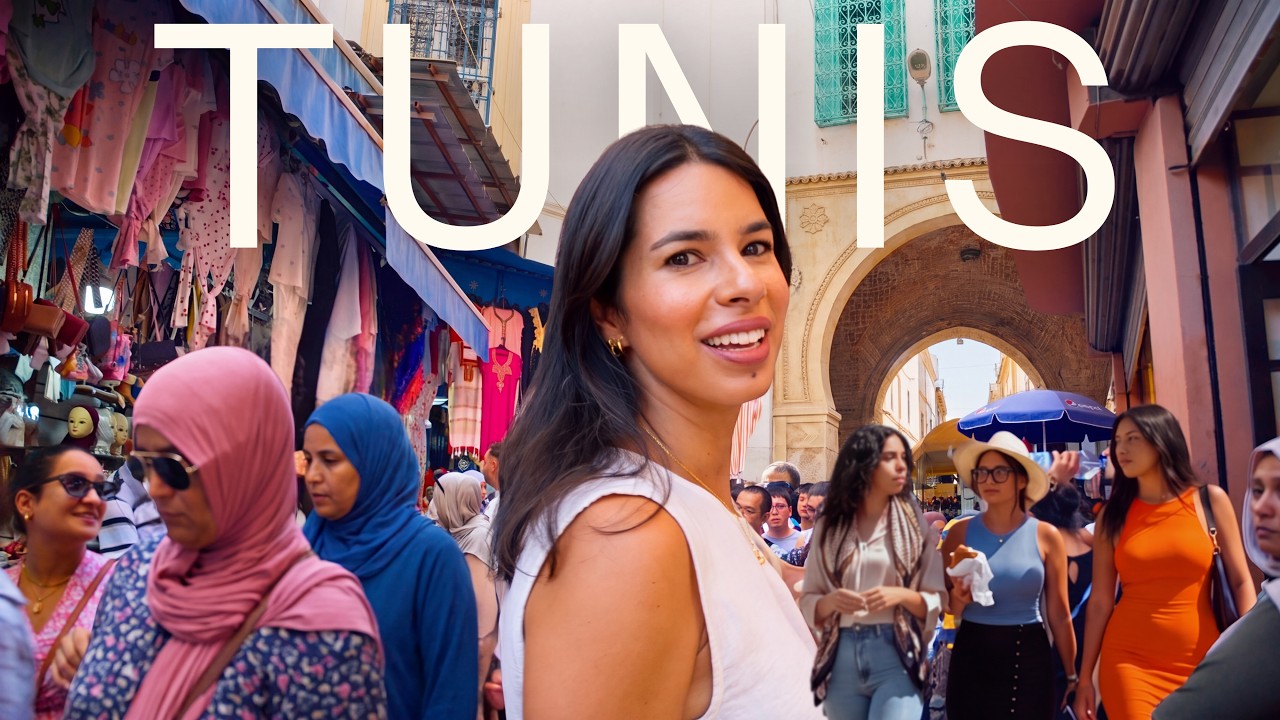
At Bab Albad, the ancient gate that opens into the Tunis Medina, the call to prayer drifts out from somewhere deep inside the old city on a busy Friday, mixing with the noise of thousands of shoppers moving through lanes so narrow and old that the vaulted stone ceilings overhead have been filtering daylight for centuries. Tunisia’s capital sits in a part of North Africa that most travelers still overlook, and that gap between its richness and its reputation is the first thing a visitor feels. What follows inside those walls, and in the beach suburbs to the north and the chaotic fish market just outside the gate, is a city that has been accumulating layers of identity since the 7th century, and has not finished yet.
A medina built by everyone who passed through
The Medina of Tunis was founded by Arab forces in the 7th century AD, built around the Zitouna Mosque, the oldest in the city and for centuries one of the Islamic world’s major centers of learning. The mosque’s courtyard is ringed by colonnades whose columns were not quarried fresh but lifted directly from the Roman ruins of ancient Carthage, the maritime empire that once outshone Tunis entirely. A minaret added in the 19th century carries the lattice arches and geometric tiles of Spanish Moorish design. Three eras of architecture share a single courtyard without explanation or apology.
The surrounding souks radiate outward from that point the way a city plan always does when it grows organically around a single anchor. A covered jewelry and gold market, originally built in the 15th century as a slave market, still has its original stone columns and aisled interior intact. A fragrant spices souk opens just around a corner. In one metalwork workshop, a craftsman has been engraving copper since he was five years old, lifting and pressing the metal by hand, exactly the way it has been done for generations in the same lane. A hammam, the communal bathhouse that every medina neighborhood once relied on, still stands with its mosaics and arches, no longer fully functioning but striking enough that passersby stop.
The residential alleys away from the commercial heart are quieter and more telling. Wooden doors painted in deep yellows and blues, many of them faded to something closer to memory than color, line the narrow passages. Buildings that ran out of ground-floor room have been expanded outward across the alleyway, small bridges connecting upper floors across the lane above. A goat wandered into one of the homes during the afternoon. Nobody seemed surprised.
Where the French grid meets harissa and fresh prawns
In 1881, France established a protectorate over Tunisia and, rather than demolishing the Medina, built an entirely new city beside it. The Ville Nouvelle runs on a grid, its central boulevard named after Habib Bourguiba, the country’s first president after independence in 1956. Art nouveau and art deco facades line the avenue, a cathedral stands at one end, a municipal theater modeled on Parisian design at the other, and terrace cafes fill the pavement between them. The French left the architecture, the language, and the baguette, which shows up beside every bowl of cafeteria, the minced roasted vegetable dish served with a mandatory spoonful of harissa paste.
Just outside Bab Albad, the Marche Central has been open since 1891. Its fish market, housed under original wooden beams that were recently restored, operates at a volume that functions as performance art. Vendors shout prices and trade jokes across the stalls while locals shop for the Mediterranean’s best catch. The prawns at one stall were so large that a vendor ate one raw on the spot to demonstrate freshness. Stingrays were being filleted in the corner.
Malini Angelica, who made the journey through Tunis, captured the fish market’s energy directly: ‘they’re literally putting on a performance, shouting out their prices, cracking jokes with each other, super proud of their beautiful fresh fish.’
In the beach suburb of La Marsa to the north, the city shifts again. Students studying engineering and medicine gather around evening food stalls. One local described life there simply: ‘freedom.’ Friya, a pillowy fried bread stuffed with boiled egg, olive, tuna, potato, and harissa, appeared at one stall. Bambalouni, fried doughnuts doused in sugar, appeared at the next. The Zitouna Mosque’s call to prayer was nowhere to be heard, but the harissa was identical.
A makroud seller and dates from the Sahara
Back in the Medina, a woman at a sweets stall pressed a piece of makroud into a visitor’s hand before any money changed hands. The pastry, filled with sweet date paste and almond, then soaked in syrup, is one of Tunisia’s most traditional confections. The dates for the filling come from the south of the country, from the Saharan oases. The seller confirmed it without much ceremony and went back to filling trays.
Tunis put independence to work in education after 1956, deliberately funding schooling for women and building a large middle class. By 2010, that same educated middle class drove the Jasmine Revolution, pushing a president from power and altering the country’s direction. The city on the boulevard today, with its young engineering students sharing shapati street food at a square in La Marsa, is a product of both of those moments.
At Bab Albad on a Friday afternoon, the gate is simply a gate again, stone and old, people moving through it in both directions, the Medina’s noise pulling them in, the Ville Nouvelle’s wide avenues releasing them on the other side. The city does not resolve itself into a single thing. It stays in two directions at once, and seems to prefer it that way.