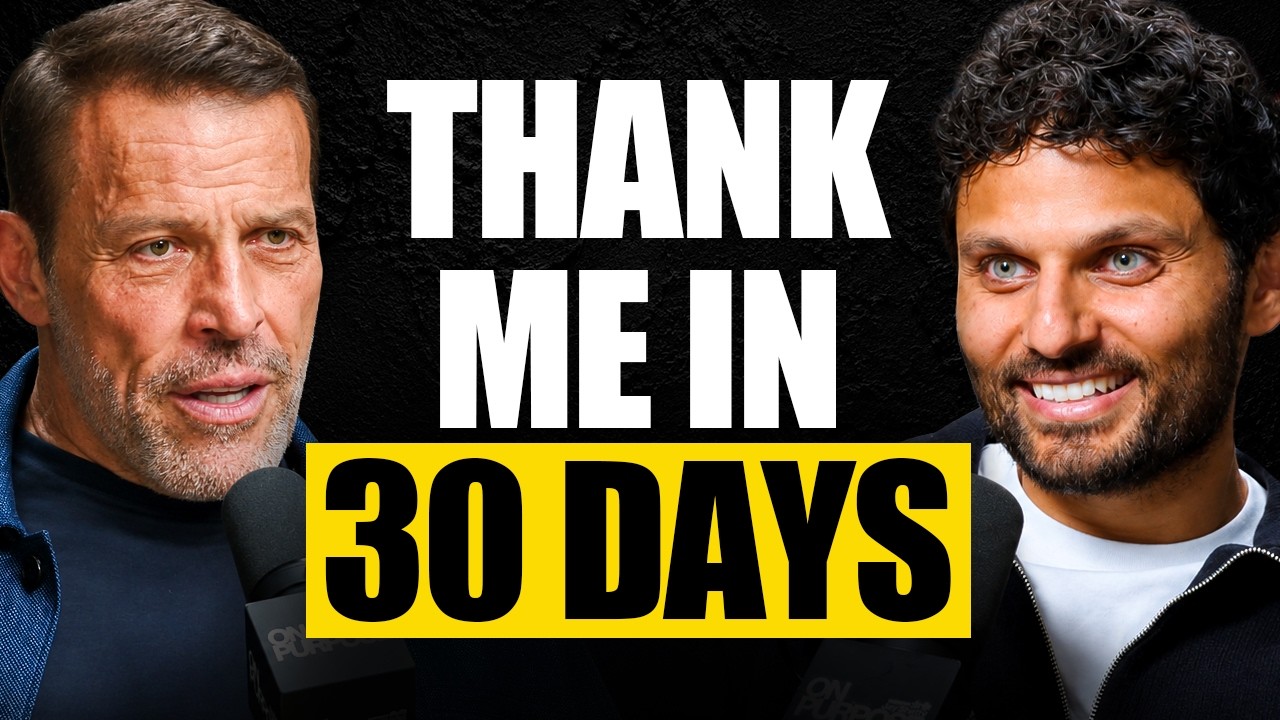
Tony Robbins grew up with four different fathers, no financial stability, and what he described as significant physical and emotional abuse in the home. He did not escape that environment by waiting for better circumstances. He made decisions. That distinction, between the conditions life hands you and the decisions you make inside those conditions, is the central argument Robbins brought to his conversation with Jay Shetty, and it is one he has been road-testing for nearly five decades across hundreds of millions of people.
Why most decisions never actually happen
Robbins is direct about where the problem starts. Fear stops people from deciding, he told Shetty, and the fear almost always comes dressed as a need for more information. He pointed to the investors he interviewed for one of his books, figures like Ray Dalio and Warren Buffett, who told him the same thing independently: the smartest people are often the worst investors, precisely because they will not move until they know everything. By the time they know everything, the opportunity is gone.
But the larger insight is structural. Most people treat a decision as a single moment. Robbins argues it is three distinct steps: decide, commit, and resolve. Deciding happens in the moment and can evaporate the instant you walk out of the room and get pulled back into email or a family obligation. Commitment takes the decision into the future, requiring energy and intention. Resolve is the final state, the one where uncertainty disappears. He described it with a nine-year-old girl’s definition that Jim Rohn once shared with him: ‘Promising yourself you will never give up.’ When you reach resolve, Robbins said, ‘it’s done in me. It may not be done in the world, but it’s done in me now.’
To lock a decision in before the moment passes, he uses a personal rule: within minutes of making a decision, do something that commits you to following through. Burn the boats, as he put it. As long as the brain has a way back, it will take it.
A six-step process Robbins uses across 114 companies
For consequential decisions, Robbins uses a framework he developed years ago when he had a single small business and every choice felt existential. He runs 114 companies today doing over 10 billion dollars in annual revenue, and the same process still governs the big calls. He calls the trigger letters OC EMR.
Outcomes first: write down what you actually want, put the outcomes in order of priority, and attach the emotional why behind each one. Options second: one option is no option, two is a dilemma, and you need at least three before you have a real choice. Consequences third: write the upside and downside of each option honestly. Evaluate fourth: assess the probability of those consequences, because a catastrophic downside with near-zero probability should not paralyze you. Mitigate fifth: look for ways to combine elements of different options or reduce the worst downsides, which is where the brain gets creative because it is no longer trapped in anxiety. Resolve sixth: commit fully and act.
He told Shetty he made 400 million dollars personally from a single decision run through this process, then added without hesitation that the spiritual and emotional value of the decisions he had made that way was simply not quantifiable in money.
The general who decided in the room
The clearest illustration Robbins offered came from a story Norman Schwarzkopf once told him. The Pentagon had spent more than a decade analyzing a strategic decision, with equally matched arguments on both sides and no resolution. A general walked in, heard both sides in back-to-back twenty-minute presentations, and said, ‘Do this.’ Everyone saluted and left. A young private who had worked on the problem for four weeks with eight people was stunned. He knocked on the general’s door and asked how he could possibly have decided without all the information. The general’s answer: ‘Because a decision needed to be made. If I’m wrong, we’ll find out quicker. If I’m right, we’ll continue. If I’m wrong, we’ll make a shift.’
Robbins sat with that story for years. Not deciding, he concluded, is always the worst decision. The brain does not handle uncertainty well, and the fastest route to certainty is to make a decision, act on it, and discover what is real.
The orange square on Steve Wynn’s wall
Steve Wynn, the developer behind a large portion of the Las Vegas Strip, called Robbins at 8:15 in the morning from their shared vacation community in Sun Valley, Idaho, to announce that a painting he had coveted for thirteen years had been delivered to his home the night before as a birthday gift to himself. The price was 86.9 million dollars. Robbins came for breakfast instead of lunch.
The painting turned out to be a Rothko: an orange and red square. Robbins told Wynn he thought they missed a few spots and offered to recreate it for a hundred dollars in red paint and twenty minutes. Wynn was not amused. But the point Robbins drew from the moment was not about art snobbery. Wynn, who can barely see, experiences something close to an emotional peak standing in front of that canvas because he knows what every brushstroke means. The fulfillment is real. ‘What makes you feel fulfilled,’ Robbins said, ‘depends entirely on what you focus on.’
Back in Sun Valley, the painting hangs in a room Wynn enters alone.