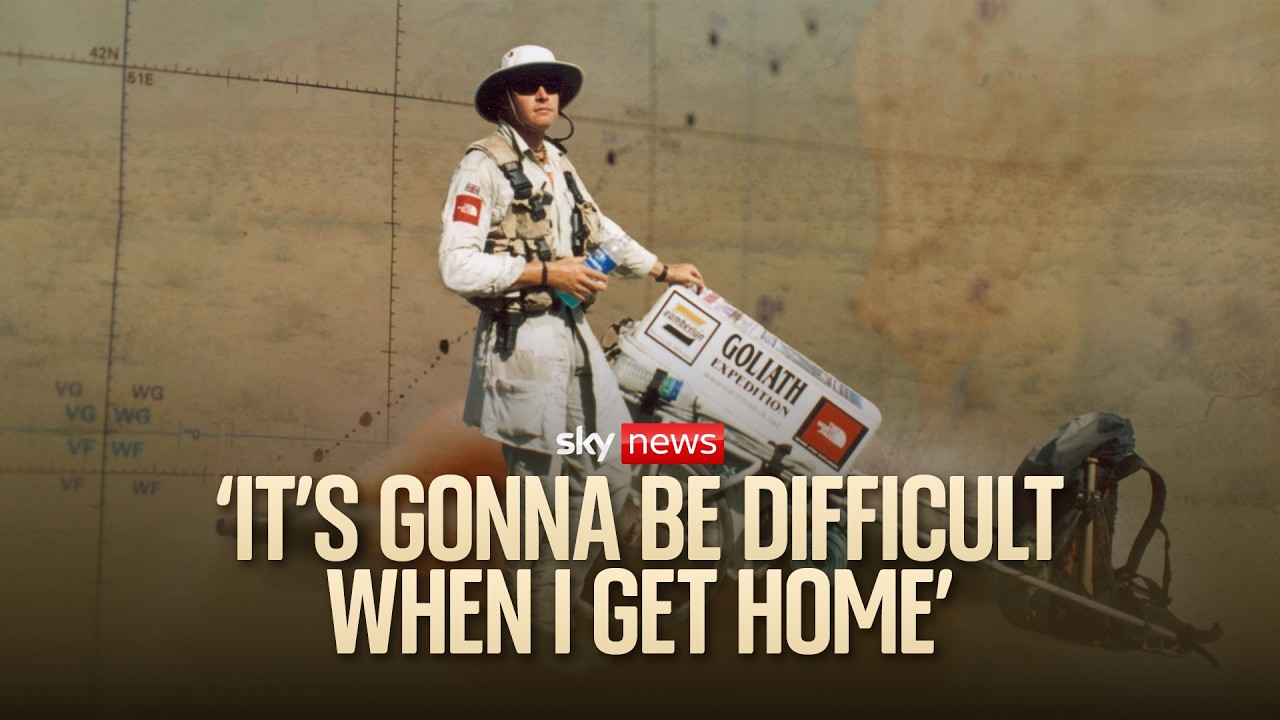
Karl Bushby is pushing a heavily loaded cart along the French-Belgian border, 30 kilometres behind him for the day, when he pauses long enough to describe the cart itself. He calls it the Beast 2, a machine he redesigned from scratch after the first version failed him in South America, and in the 28 years since he left the southern tip of South America on foot, it has been kidnapped, recovered, hauled through the Arctic, dragged across deserts, and forced over mountain passes. It is still going. So is he. For anyone who has ever felt trapped by a commute or a calendar, the sheer physical fact of one man walking 50,000 kilometres across 26 countries without once boarding a bus, a train, or a plane reframes what a human body is actually capable of.
The moments that almost ended everything
The Darien Gap came early. That lawless jungle borderland between Panama and Colombia, where Karl had to thread his way around the front lines of active fighting between FARC and the Colombian government, navigating crocodiles and dense rainforest at the same time, set the tone for a journey that would never become routine. Alaska added a different kind of terror, remote, cold, and unforgiving enough that Karl describes it plainly as producing a couple of genuine ‘oh my god, we’re going to die moments.’ Then there was the Caspian Sea. Because Karl cannot use any form of transport, crossing a body of water means swimming it, and the Caspian took 30 days. Arriving on the coast near Baku, Azerbaijan after a month in open water is the kind of milestone that cannot be explained to someone who has not attempted it, only reported as a fact.
The Bering Strait crossing into Russia stands as another. ‘Arriving in Russia having crossed the Bering Strait was just an enormous deal,’ Karl said. ‘We made history that day. You know, it doesn’t get much better than that.’
What a former British soldier learned from strangers on the side of the road
Karl spent years in the British Army before this journey began, a background that did not predispose him to optimism about human nature. The road corrected that. Strangers across every continent have stopped, offered food, pressed money into his hands, invited him to sleep under their roofs, and nursed him back from illness. He remembers people living in shacks built from car parts tied together with string in the Peruvian desert who brought him in anyway, set a bowl of rice in front of him, and just wanted to sit and swap stories. That pattern, repeated across dozens of countries and thousands of interactions, became the unexpected emotional core of the journey. The daily grind of pushing the Beast 2 along another road, week in, week out, he admits has long since become the job rather than the adventure, but those human moments kept pulling him back to the reason he started.
The Andes contributed a brief and unhelpful detour involving a pack donkey that Karl describes as ‘a reincarnation of Genghis Khan. All he wanted to do was eat, fight, and rape. Didn’t want to walk.’
The swim that still has him nervous
The English Channel is next. Compared to the Caspian, 37 kilometres at the closest point near Calais sounds almost modest, but Karl is candid about the differences. The Caspian crossing had extensive preparation and dedicated training time behind it. The Channel is colder, and the six-hourly tidal currents will force him into a snaking path across the water, adding significant distance to whatever the direct-line figure suggests. The final departure point, still subject to French permission, will determine how much harder it gets. Waiting at the other end, in Hull, is his mother. He has not seen her since 2015.
The man who designed the Beast 2
Somewhere on the French-Belgian border, the cart sits loaded and road-worn, its frame carrying the physical memory of every terrain Karl has crossed since leaving home. It has outlasted conditions that most equipment would not survive.
Karl has a plan for what comes after the finish line: find another passion, another fight, another mission. He is not treating the end of 28 years as a conclusion so much as a transition point, which may be the only mindset that makes sense after a life spent moving forward one day at a time, 30 kilometres at a stretch.