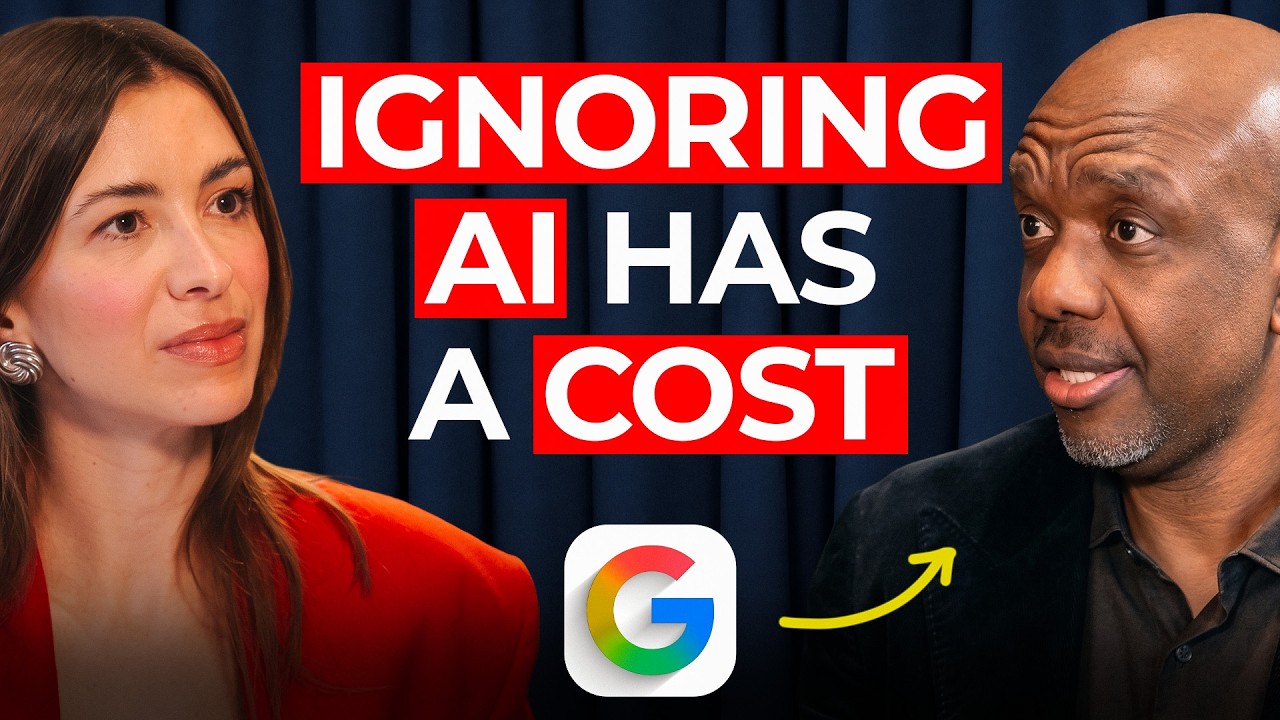
James Manyika has spent years inside one of the most powerful technology organizations on earth, and his most urgent warning has nothing to do with rogue models or robot uprisings. It is about something quieter: the possibility that AI capabilities pull so far ahead of humanity’s ability to build them safely that the gap becomes impossible to close. That tension, between extraordinary promise and genuine complexity, shapes everything Manyika believes about where this moment in history is actually headed.
Why the job apocalypse keeps getting postponed
Manyika, Google’s senior vice president of research, technology, and society, has been studying what happens when AI meets labor for well over a decade. His position is deliberately measured. Three things will happen to jobs, he argues, and all three will happen at once: some jobs will shrink, some will grow, and many more will simply change in content while keeping the same name. The loudest predictions, the ones forecasting 50 percent white-collar wipeout within two years, have already lost their bets. Manyika took those bets personally. When the deadline passed, the forecasters moved the goalposts. ‘They said okay, no, it’s the next two years,’ he noted with visible amusement.
The data he points to is striking. The best available estimate, cited by a recent roundup in The Economist, attributes roughly 200,000 job losses to AI so far, while jobs created as a result of AI effects have exceeded one million. Software development, one of the sectors most frequently cited as doomed, has actually added positions. The reason the catastrophe keeps not arriving, he explains, is that the rate at which AI capability translates into real economic activity is far slower than capability benchmarks suggest. Google’s own Atlas study, which drew on close to two billion users across the Gemini app, Gemini APIs, and AI-powered search, found that AI adoption is wide but still very shallow. In a typical job, people apply AI to roughly 21 percent of their tasks, and mostly as a helper rather than a replacement. The other 79 percent involves workflows, judgment calls, and multi-step complexity that current systems simply cannot handle end-to-end.
For workers anxious about their own exposure, Manyika pushes back on a phrase he has heard too often: ‘if you’re exposed, you’re hosed.’ Radiologists were supposed to be the cautionary tale. Instead, demand for radiologists went up, because AI made diagnostic throughput faster and opened new use cases. The same thing happened with bank tellers after ATMs arrived. Exposure, he argues, is not a verdict. It is a starting point that can go in either direction depending on what the worker does with it.
The risk hiding inside the connected systems
When asked what AI danger the public conversation is missing, Manyika does not reach for alignment theory or existential risk timelines. He points to something more immediate: the fact that AI models are now being wired into grids, infrastructure, and other critical systems, and those system-level interactions are almost never evaluated the way individual models are. ‘We think about AI models in isolation,’ he said, ‘but we don’t often do these system-wide evaluations.’ Managing electricity grids with AI creates real efficiency gains. It also creates new security and safety questions that a benchmark score on a single model will never surface.
He adds a second underappreciated risk, one he first heard raised at a UN high-level body on AI by representatives from the Global South: misuse. Not misuse in the sense of bad actors deploying the technology, but misuse in the sense of communities that desperately need the technology never getting it at all. County-by-county assessments of healthcare access inside the United States already reveal enormous gaps. AI that could help close those gaps but is never deployed there is, in Manyika’s framing, a form of harm through omission.
The bet he is willing to make on science
The conversation that genuinely lights Manyika up is not jobs. It is what AI is doing inside laboratories. Google’s genome model predicted over 2.2 million theoretically possible crystal structures in chemistry. Of those, a few hundred thousand looked viable for synthesis. When researchers tried to actually synthesize them, the number dropped to a few thousand. The bottleneck has shifted from generating hypotheses to verifying them in physical labs. A similar pattern appeared when a Google model proposed cancer treatment pathways that researchers at Yale then tested, with only a handful proving viable in the lab. Hypothesis generation is becoming almost trivially fast; verification in living systems remains stubbornly slow.
Manyika is willing to bet that when people look back in ten years, the biggest contribution AI will have made is to science itself, specifically to health, well-being, and crisis resilience. He frames AI not just as a general-purpose technology but as something rarer: an invention for making inventions, more analogous to the microscope or the scientific method than to any single industrial machine.
A fruitfly’s brain, fully mapped
A few weeks before this conversation, Google published a complete wiring diagram of a fruitfly brain, done in collaboration with the Howard Hughes Medical Institute. It was the first time the feat had ever been achieved.
The full-circle reality Manyika keeps returning to is that most of the AI effects already touching human lives are invisible as AI. A woman in the UK whose early-stage breast cancer was caught in a mammography study involving over 180,000 participants does not walk away thinking about machine learning. A family in one of the 150 countries now covered by Google’s flood prediction system who gets a phone alert to evacuate six days before the water rises does not credit a model. The connection back to AI, as Manyika puts it, ‘may not be as direct.’ The technology is already reshaping what is possible. Most people just experience it as a slightly better outcome than they expected.