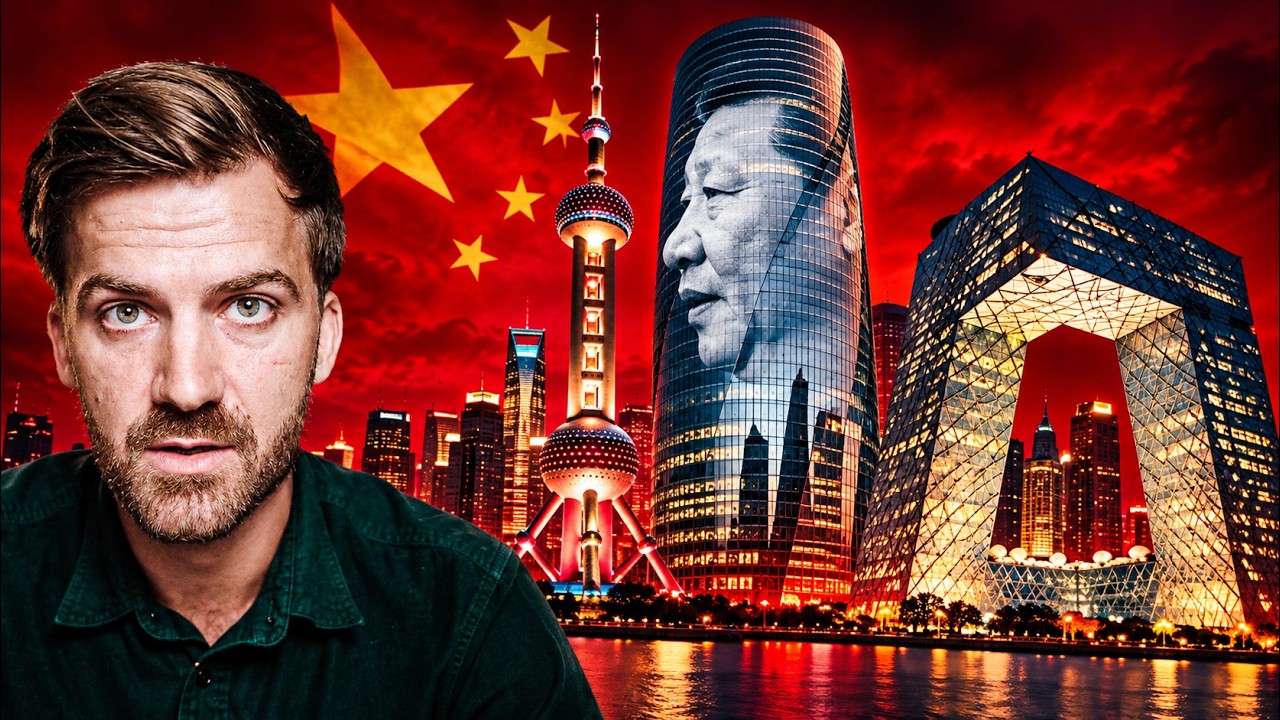
Johnny Harris opened a package on camera, pulled out a set of shapes, and was asked to assemble the Chinese flag from memory. He got it wrong. That small exercise turned out to be the entry point into one of the more genuinely surprising policy stories of the last half century: not just what China built, but the specific machinery that made it happen, and why the popular explanation falls apart under scrutiny.
For years, videos of gleaming Chinese skylines, train stations the size of airports, and bridges arcing over mountain gorges have flooded Western social media feeds. The gut reaction from most American viewers has been equal parts awe and envy, followed quickly by the assumption that an authoritarian government with a single powerful leader simply waved a magic wand. Harris and his producer Adam spent months testing that assumption. What they found is far more textured and, in some ways, more instructive.
The beehive that Deng Xiaoping built
The real engine behind China’s infrastructure surge traces back not to Xi Jinping or even to a single ideological commitment, but to a set of bureaucratic incentive changes introduced by Deng Xiaoping after Mao Zedong’s death in 1976. China at that moment was poor and politically chaotic. Deng, a pragmatist rather than a revolutionary romantic, understood that the Communist Party’s survival depended on delivering economic results. So he rewired how millions of government officials across the country got promoted.
Under Mao, party officials advanced by demonstrating ideological fervor and loyalty to the center. Deng changed the scorecard. Economic development moved to the top, in big letters, as a hard target. As one researcher explained it to Adam during the reporting: it is really predictable who gets promoted based on increases in GDP, increases in tax revenue, and increases in investment into the economy. Multiply that incentive across tens of thousands of local governments and millions of officials, and what you get is what Adam called ‘a beehive.’ Every ambitious local leader across an enormous country suddenly had a personal career reason to make their corner of China grow.
Deng layered two more structural changes on top of that. First, he switched the country away from what he called ‘eating out of one big pot,’ where provinces sent all their revenue to Beijing and received a flat budget in return, to ‘eating in separate kitchens,’ where local governments kept whatever tax revenue they generated above a set threshold. Second, he created Special Economic Zones as sandboxes for market capitalism, allowing private enterprise to take root in a handful of coastal areas before spreading further.
Those changes eventually gave way to a third engine: land financing. After a fiscal restructuring in 1994 shifted more tax revenue back toward Beijing, local governments needed a new revenue stream. They found it in land. Rural land held by village collectives could be requisitioned by the state, developed with roads and infrastructure, and then leased to private developers at dramatically higher prices. The profits stayed local. The act of building itself became financially rewarding for the government doing the building, independent of whether anyone immediately needed what was being built.
Ghost cities, bridges to nowhere, and a boom that had a ceiling
That logic produced some genuinely strange outcomes. Guizhou, described as roughly the fourth-poorest province in China and only slightly larger than New York state, ended up with twice as many highways as New York and some of the tallest bridges in the world. Entire new cities, including Kangbashi in Inner Mongolia and Zhengdong in Henan province, were built essentially empty. Western media called them ghost cities. Many of them eventually filled up as China’s population urbanized, but the underlying dynamic was real: building generated GDP, GDP generated promotions, and so officials built, sometimes well ahead of any organic demand.
China’s GDP growth ran at roughly 10 percent annually for decades, a figure that places like the United States rarely approached even at their strongest. But by the early 2010s, that growth rate began to slow at precisely the same moment that extreme poverty rates, which had fallen at a staggering pace, approached their floor. The two phenomena were connected. As one person in the reporting put it, you cannot lift your whole country out of poverty two times.
Running alongside the economic scorecard was a second pressure that never showed up in the glossy infrastructure videos: social stability as a veto target. Beginning in the 1990s, as the Soviet Union collapsed and protests shook Tiananmen Square, suppressing what officials termed ‘mass incidents’ became equally essential to career survival. Local leaders could build their way to promotion, but a single visible protest could end a career. That tension between the development imperative and the stability imperative shaped how land was acquired, who got compensated, and who got pressured by neighborhood retirees to sign papers they did not want to sign.
A Newpress member who knew people inside it
Harris spoke with a Newpress member named Vivian, who has spent extended time in Shanghai and has close friends who are Chinese citizens. She told him that those friends find it genuinely funny when Americans react with awe to China’s infrastructure. ‘Foreigners always think China’s great,’ she relayed. ‘Why do you think that?’ Among younger Chinese people right now, she described something closer to malaise, a sense that the era of near-instant generational improvements in living standards has ended. The phrase ‘lying flat,’ describing young people who disengage from an economic rat race that no longer reliably delivers, has circulated widely in China in recent years.
Under Xi Jinping, who took power around 2013, the surveillance infrastructure expanded from an estimated 30 million cameras to over 200 million by 2019, according to a study cited in the reporting. GDP growth has also been formally downgraded on the official scorecard; loyalty and ideology have moved back up. Xi has decent reasons for the correction, the obsession with growth did produce overbuilding and dangerous speculation, but China is now in genuinely uncharted territory.
The flag Harris got almost right
The large star at the center of the Chinese flag represents the Chinese Communist Party. The four smaller stars, each with its tip pointed toward the large one, represent the four social classes as defined in the 1940s, all oriented toward the party.
The images in those viral social media posts, the shimmering skylines and the trains threading through mountain buildings, are largely an echo of a specific 40-year window that Deng engineered and that most analysts agree has now closed. Harris landed on a conclusion that cuts against the easy dictatorship explanation: plenty of democracies outside the United States have excellent trains, and plenty of autocracies have almost nothing. The real variable, across any political system, is what the people who hold power get rewarded for doing with it. In China, those incentives came from the top. In a democracy, Harris noted, they come from the people who vote.