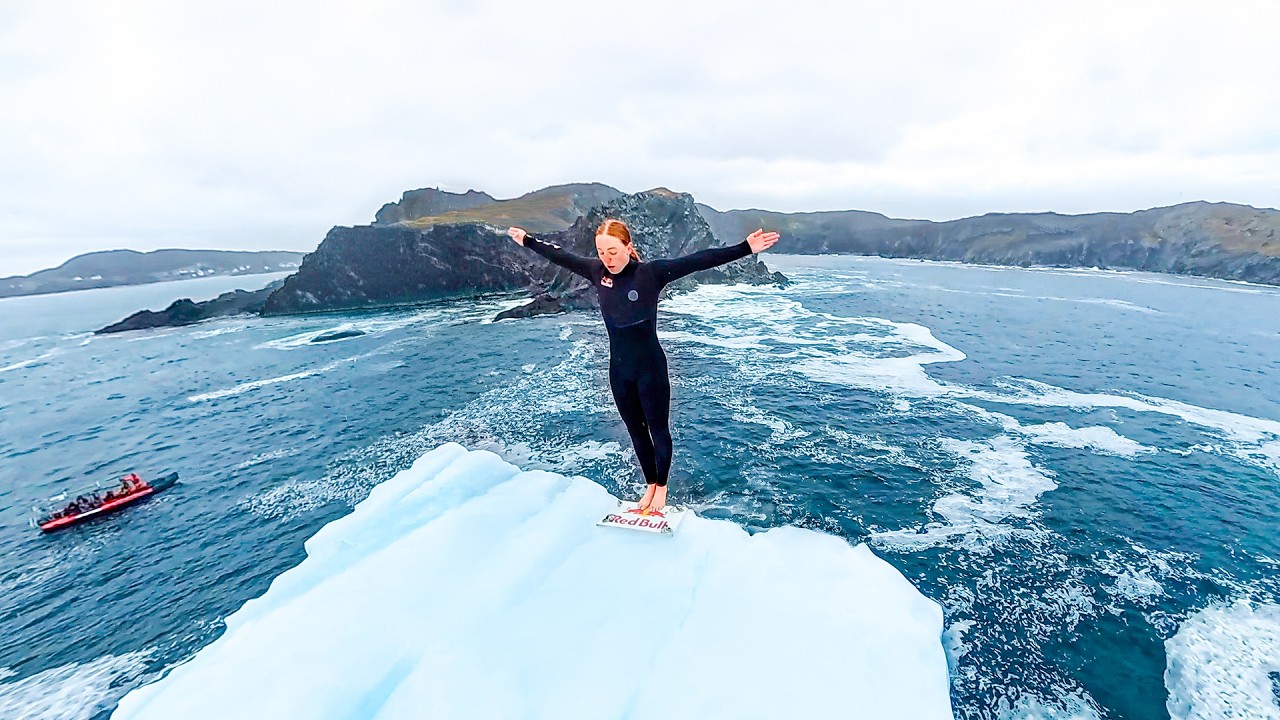
Molly Carlson stood barefoot on the summit of a drifting iceberg off the coast of Newfoundland, crampon straps unclipped, harness buckles popped open, staring down at water that was one degree Celsius. The professional cliff diver had spent weeks training for this moment, and every single person on the surrounding rescue boats had a job that existed solely because what she was about to do could kill her. What makes this more than a Red Bull extreme sports stunt is what it cost her to get there: the fear, the aborted attempts, and the quiet confession that she was not sure she even wanted to do it.
The plan was straightforward on paper. Find an iceberg off the Canadian coast with a sheer climbable face, a clear takeoff point, and enough depth below for a safe entry. Climb it. Dive off. In practice, icebergs split, collapse, and roll without warning, generating forces capable of dragging anyone roped to them as deep as 50 to 75 metres underwater. The safety team scrubbed the first serious candidate, Castle, after the boat skipper grew uncomfortable with the surge and the volume of broken ice calving off the very wall Carlson planned to launch from. Minutes after the team pulled away, the back face of that iceberg collapsed entirely into the water.
Learning to move on ice before daring to move on an iceberg
Carlson brought in Will Gadd, one of the top ice climbers in the world, to train her from scratch. Gadd has climbed icebergs, Niagara Falls, ice inside mines, and ice on top of Africa, and he was frank about what she was walking into. He introduced her to STICKY, an industrial safety acronym for conditions that can kill you, and walked her through the specific version that applied here: unpredictable rolling, violent calving, and the near-impossibility of making any of it genuinely safe. ‘This is not safe,’ Gadd said plainly during the rescue system drills. ‘This is just us doing our best to make something high-hazard reasonable.’
Carlson trained on a 10-metre indoor ice wall, then proved herself on a 20-metre natural ice face in a remote canyon Gadd reached by driving two hours through rough terrain. The outdoor climb gave her something cliff diving never had: five to ten minutes of pure focus instead of three seconds of freefall. She also had to learn to dive in a wetsuit for the first time, testing mobility on a 3-metre springboard and a 15-metre indoor platform before the team flew to Newfoundland.
The iceberg that rolled over and gave them a second chance
After the Castle abort, the team’s first scouted candidate, an iceberg they called No Name, had rolled overnight and presented a completely new face. The team regrouped over dinner, agreed to pool their expertise before boarding the boat rather than each assessing silently in their own lane, and went out the next morning on the same page. No Name passed. Gadd set a hand line across the traverse rather than a rope tethered to the berg itself, because a fixed tether could drag a climber deep if the berg rolled mid-climb. The iceberg was visibly moving and turning as they worked.
Gadd climbed first and rigged the platform. Carlson followed in crampons, kicking each foot in with deliberate precision, staying low, moving sideways across the blue-veined ice while the berg groaned beneath them. At the top, she removed her boots, handed her socks to Gadd, confirmed a clear-to-dive call from the safety team below, and stood up.
The moment after the backflip
Gadd, watching from the summit as she launched a slow, clean backflip into the Arctic water below.
Carlson surfaced. The boats moved fast. Gadd descended and was pulled aboard, and the team cleared the iceberg immediately. In the boat, still processing, Carlson said it was the coolest day of her life. Gadd, who has spent his career in consequence environments, put it simply: ‘There’s a lot of messed up stuff in the world, and that’s just something beautiful.’
The water was one degree Celsius. She dove in bare hands, bare feet, and a wetsuit she had never worn before this project, off an iceberg that had been moving the entire time she stood on it.
 Wake up to Only Happy News!