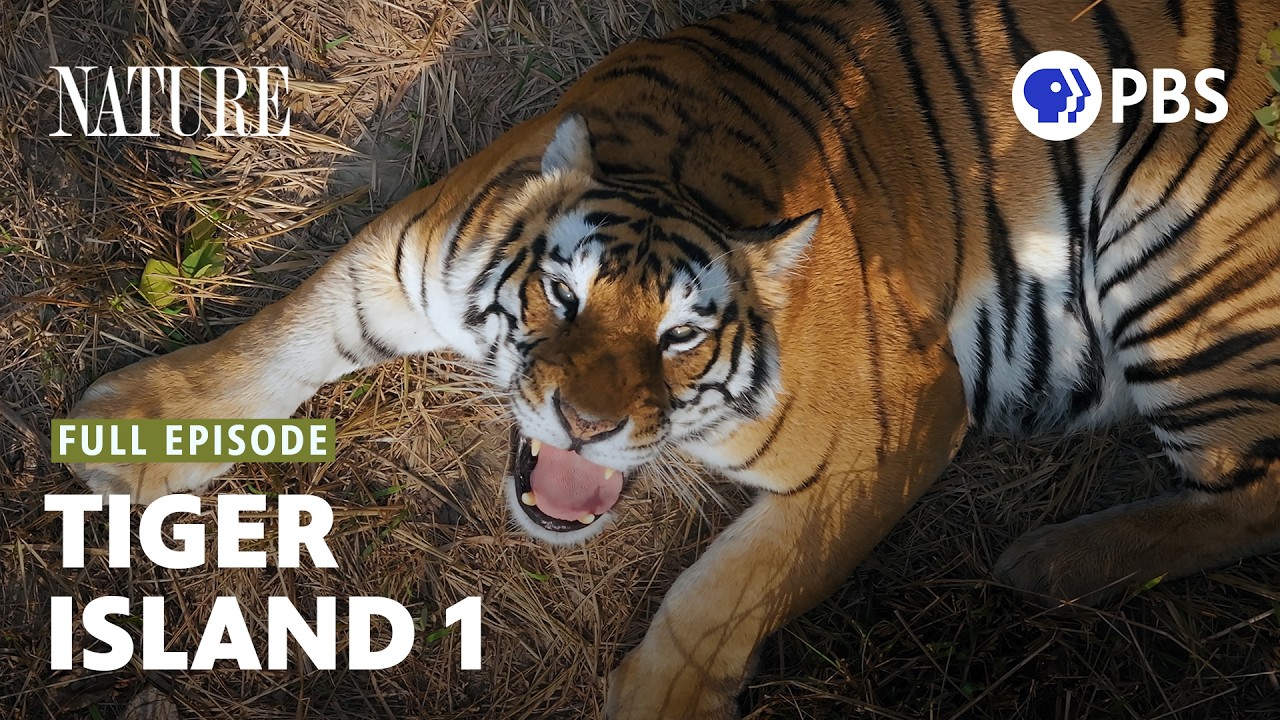
In the monsoon forests of western Nepal, a river has carved out a stretch of land that holds more Bengal tigers per square mile than almost anywhere else on earth. Tiger Island is not a place most people will ever stand on, but what unfolded there this past February is the kind of thing that rewrites what scientists thought they knew about one of the planet’s most studied predators. At the center of it all are three tigresses, each raising cubs in overlapping territories, each facing threats that test the limits of what a mother can endure.
Walking into territory where the tigers know you are there
Wildlife guide Sushila ran the safety briefing before anyone set foot on the island. Flares, she explained, won’t harm a tiger but should scare one off. That detail matters, because big-cat biologist Dan had barely absorbed it before he was standing on a dirt road with an adult female tigress moving directly toward him.
The tigress was Goma, an experienced mother with two cubs, and she crossed the road close enough for Dan to hear her breathing. ‘There’s something really strange about being on foot with a tiger,’ he said afterward, still processing it. What struck him most was not the fear but its absence in her. She did not see the team as prey. She simply wanted to live her life, and she walked past them to do it.
Goma’s territory borders several villages, and locals bring livestock in to graze alongside the wildlife. Her daughter Mala, now 4 years old and fully independent, lives in the neighboring territory to the west, raising her first litter of cubs. At 3 months old, Mala’s cubs were still nursing, still tumbling over each other in the grass, still carrying around what appeared to be a deer tail as a toy. Cinematographer Anna, tracking them on foot with Sushila’s sister Manju, watched one cub drag the fluffy object around and noted it had clearly developed a taste for meat already, even if the tail was still more plaything than meal.
The night the male arrived and changed everything
Remote cameras caught an unknown adult male moving through Goma’s territory. Male tigers kill cubs that are not their own, and this one was tracking the scent of Mala’s cubs with focused intent. Anna stayed with the encounter as the male closed to within a couple of hundred meters of the cubs. Then Mala appeared.
The confrontation lasted several hours. Mala pinned herself flat to the ground, ears back, posture entirely changed from anything the crew had seen before. The male stood over her, enormous against her slimmer frame. She held her position between him and her cubs. He eventually moved off, but he now knew exactly where she and her cubs lived.
By morning, two of her three cubs were dead. The drone crew found the male with them. For four days, there was no sign of the third cub and no certainty that Mala herself had survived. Then, on the other side of the island, a drone caught her crossing the water with one surviving cub pressed close to her side, nursing constantly, the pair of them heading somewhere safer.
Back in Goma’s territory, a hunt finally went right. With deer roughly 15 meters ahead of her and the drone hovering silently above, Goma closed the distance through tall grass, crouched nearly flat, and took a large deer cleanly. Both cubs fed properly for the first time in days.
Then the drone count came back wrong. Goma had two cubs. The screen showed four. Then five.
A third tigress, Jugini, believed to be another of Goma’s adult daughters, had left her own three cubs with Goma while she fed. One adult female was watching five cubs. The other was hunting. ‘No one’s ever seen tigers do this before,’ Dan said, standing 50 yards from the scene. ‘I was about to say tigers are solitary big cats. Are they? I don’t know anymore.’
The cub with the deer tail
Mala’s surviving cub, scrawny but apparently healthy, was still nursing hard when the crew last saw it, kneading milk out of an exhausted mother on the far side of the island.
Goma’s two cubs were full and resting beside her in the tall grass, the confident one and the shy one side by side, their personalities already distinct enough to track. Somewhere between the textbooks and this river-cut island, tigers had done something the science had not prepared anyone to see.
 Wake up to Only Happy News!