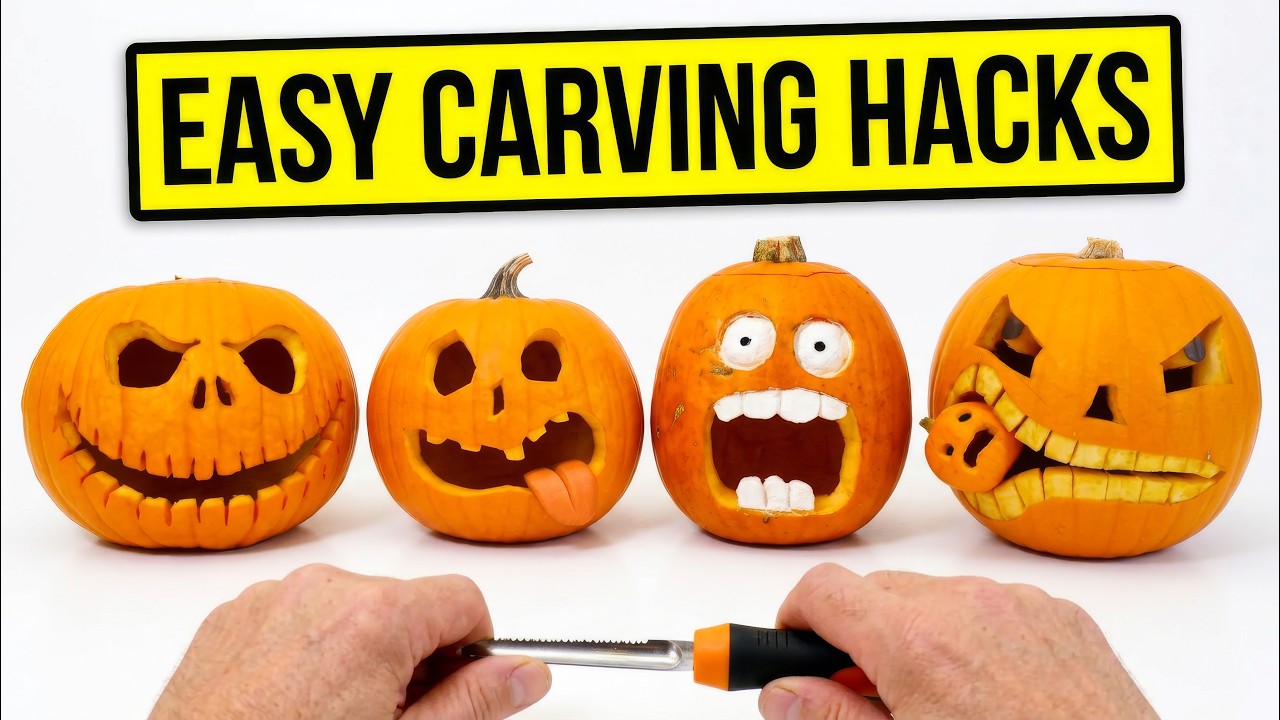
The mini pumpkin sat wedged between the carved teeth of a much larger one, its shocked little face staring out at anyone who walked past, apparently frozen mid-scream as the bigger pumpkin appeared ready to crunch down. DaveHax, the British DIY creator, had spent an afternoon working through a stack of printed pumpkin designs pulled from an online search, and the question driving the whole session was a simple one: could the pictures actually be recreated in real life, in time for a Halloween party? The answer, it turned out, was mostly yes, with a few honest wobbles along the way.
From blank pumpkin to spooky face, one careful cut at a time
The process started with a two-tool carving set that separated the rougher work from the finer detail, a serrated scoop for gutting the insides and a fine-toothed saw for the actual design work. One practical tip appeared early and stuck: thin down the walls after scooping to make the flesh useful for cooking rather than binning it. A water-based coloring pen went on first before any cutting began, because mistakes could be wiped away with a wet sponge and dried with a paper towel, then redrawn until the lines sat right. ‘You don’t need to worry if you’re not exactly on the lines,’ DaveHax noted, working through the first classic angry-faced pumpkin. ‘You can get away with so much when you’re carving a pumpkin. They’re very forgiving.’
The second design, a grinning pumpkin with a hanging tongue, required a different kind of problem-solving. The tongue itself was not a separate piece of material but the offcut left behind from cutting the mouth opening. That scrap of pumpkin flesh was trimmed with the saw to remove the carved teeth, shaved thinner with a knife, and slid back into place inside the mouth. It was not perfect. The left eye came out slightly wrong, and the teeth could have been cleaner, but propped next to the first finished pumpkin it read exactly as intended.
The terrified pumpkin needed paint, and the big-eating-small needed a second pumpkin entirely
A smaller pumpkin handled the third design, a wide-mouthed screaming face with bright white eyeballs and black pupils. Getting the eyeballs right meant carefully slicing away the outer skin to expose two bare circular patches of flesh, then scratching the surface with a carving tool to define each round eyeball shape. White acrylic paint went directly onto the exposed flesh, and once it dried, black paint added the pupils. A carving tool also scratched definition lines between the teeth across both the top and the bottom row.
The fourth design was the one DaveHax called a personal favorite, originally made years earlier. A large pumpkin was carved with a wide open mouth and square, aggressive eyes. A teardrop-shaped opening at the mouth was sized deliberately to grip a mini pumpkin. The mini pumpkin received its own sad, shocked expression, was emptied through its mouth rather than the top, and was wedged into the teeth of the large one. A couple of additional mini pumpkins were placed alongside it as if waiting their turn.
The tongue that came from the mouth itself
All four finished pumpkins were lit with tealight candles for the final comparison, the carved faces glowing from the inside against whatever surface they were placed on. The offcut-turned-tongue on the second pumpkin remained the most unexpected construction detail of the afternoon: a piece of pumpkin that was nearly discarded ended up being the finishing touch that made the whole design work.
The mini pumpkin, wedged and frozen in the larger one’s teeth, stared out with its carved shocked expression, waiting for a Halloween party that was still a few days away.
 Wake up to Only Happy News!