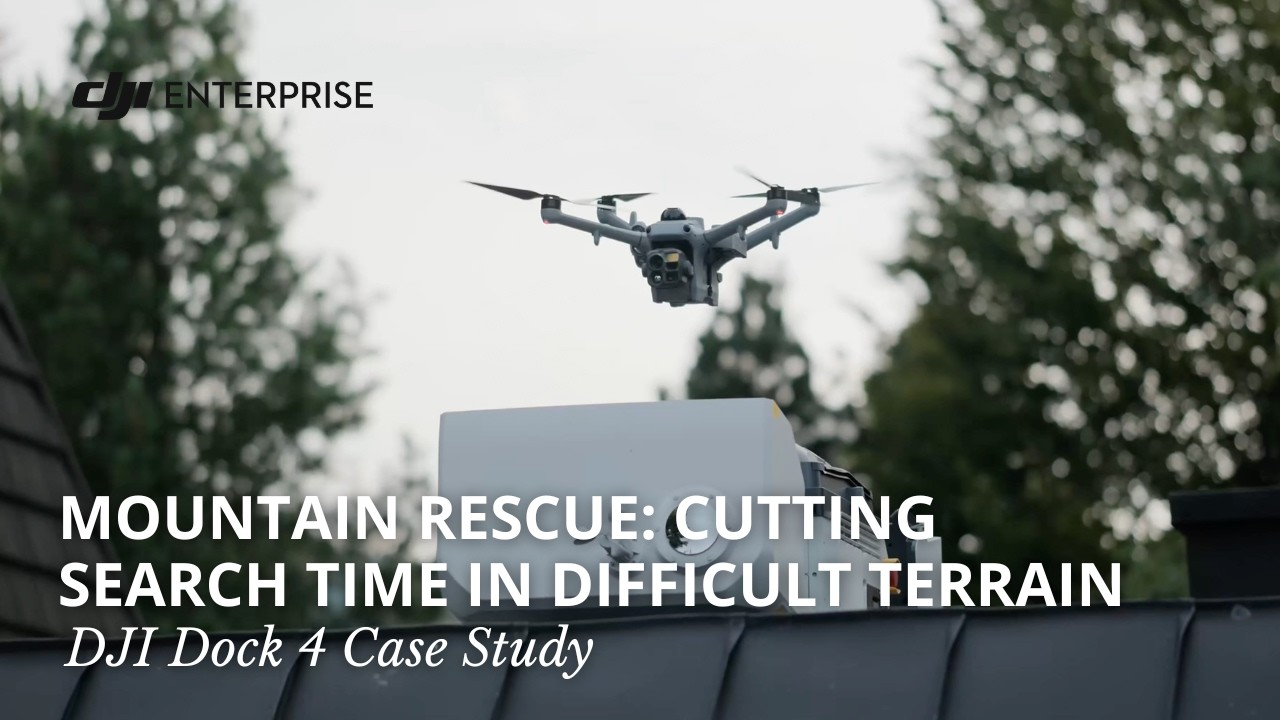
Marcin Jozefowicz has spent more than 30 years pulling people off mountains. As a TOPR rescue operative and head of the Cybertech section leading pilots and instructors working with unmanned aerial systems, he knows exactly what the difference between a fast response and a slow one costs in the high alpine. Now the drone sitting in its dock on a mountainside can be airborne, searching, and back down for a fresh battery in a matter of seconds, and that gap is closing faster than anyone expected.
Why mountain terrain makes every minute count
Mountain rescue is defined by a single reality: not every location can be reached by car, snowcat, or snowmobile. Helicopters are expensive, slow to mobilize, and weather-dependent. Foot teams burn time just getting oriented. That dead time between a distress call and the first reliable information about a person’s location is where outcomes are decided.
The DJI Dock 4, paired with the Matrice platform, changes that calculation at the reconnaissance stage. Before a helicopter lifts or a ground team laces up, a drone can already be overhead the reported coordinates, sending back thermal and RGB imagery and beginning AI-assisted human detection. Jozefowicz put it directly: ‘Drones help primarily by shortening time. They give us the ability to get oriented before we begin operating, whether by helicopter or on foot.’
The system can also open a rudimentary dialogue with a lost person. A drone dispatched from the dock will fly over and broadcast a question asking whether help is needed. The person on the ground responds with physical signals, yes or no, a simple protocol that confirms a live casualty and communicates urgency without requiring the missing person to have phone signal or working equipment.
Thermal, RGB, and the search that works after dark
The Matrice carries a camera array that combines upgraded thermal resolution with MSX image overlay and a picture-in-picture mode that fuses the thermal feed with the RGB image simultaneously. That combination matters at night, when a hiker’s headlamp appears as a point of light on the thermal layer while the RGB overlay adds the terrain detail that keeps the drone flying safely through complex mountain geography. The AI-driven human recognition layer runs across both feeds, flagging heat signatures that match a human outline even when the person is sheltering or partially obscured.
The dock ecosystem extends that reach further through O4 stations positioned across the terrain. One station sits at the dock itself, handling the local communication handoff, while additional O4 units relay the drone’s control signal into neighboring valleys that the mountain ridge would otherwise block entirely.
Beyond active rescue, the same setup handles ongoing hazard assessment: monitoring trail conditions, tracking snowpack volume, and running what the TOPR team calls ‘threat recognition.’ The drone’s assigned tasks are reconnaissance, search, situation analysis, and hazard assessment, a full operational cycle running continuously, not only when someone is already missing.
The battery swap and relaunch happens in only a few seconds after landing, a turnaround Jozefowicz noted leaves no room for a pilot to step away for a coffee break.
The dock that launched into a neighboring valley
During one of the team’s operational tests, a relay of O4 stations allowed the Matrice to fly entirely out of line-of-sight from the base dock and cross into an adjacent valley without losing control integrity. The moment registered as remarkable even to a crew accustomed to extreme terrain.
A single dock, charging silently at a mountain station, now holds a coverage radius that earlier required a coordinated helicopter deployment to match. The valley on the other side of the ridge is no longer automatically beyond reach.
For Jozefowicz and the TOPR pilots, the architecture of the Dock 4 system reflects a shift in how mountain rescue is structured, not replacing the climbers and medics, but ensuring that by the time boots hit the slope, someone has already seen exactly where to go.
 Wake up to Only Happy News!