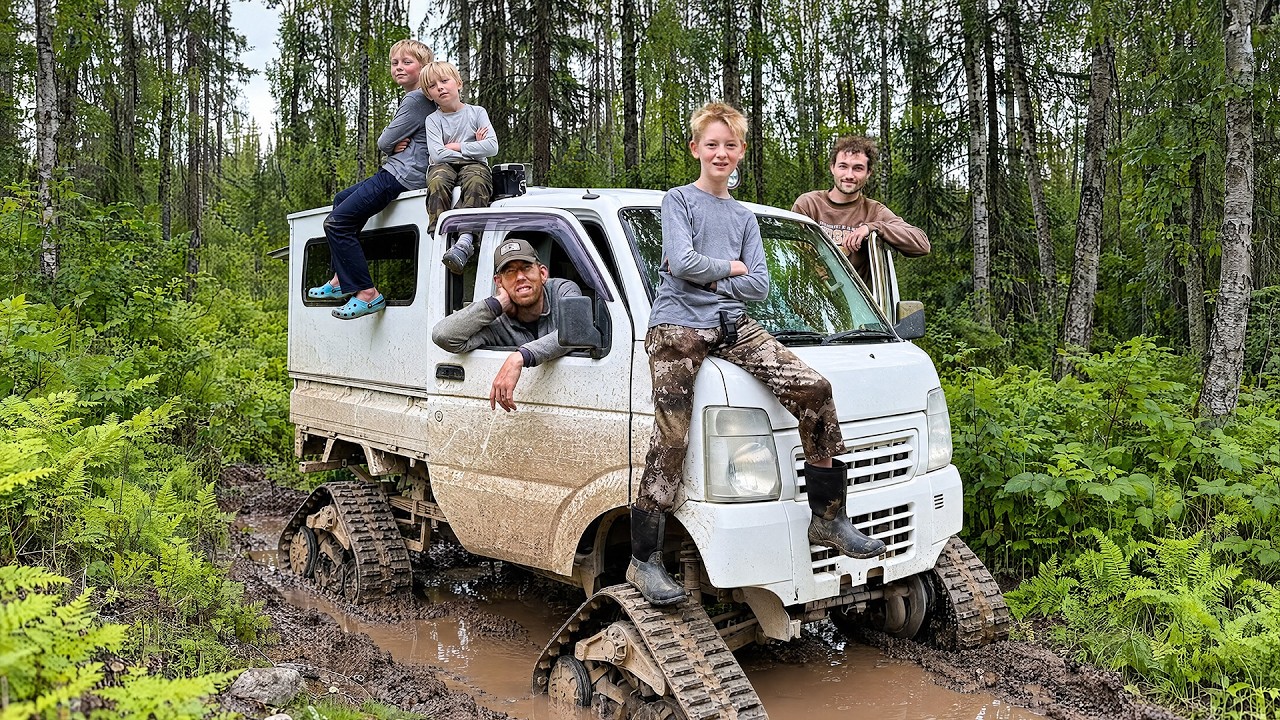
Inside a glacier cave at the center of the Alaska Range, the ice walls press in close enough to touch, and the silence is the kind that makes you aware of your own breathing. For three weeks, the crew from Traveler’s Tale pushed through some of the most remote terrain in North America, chasing salmon, scrambling onto icebergs without a safety net, and crawling inside structures that probably should have been left alone. What they found was not a postcard version of Alaska but the real one: cold, inconvenient, genuinely dangerous, and completely unforgettable.
Icebergs, quicksand, and a glacier that wants you gone
The iceberg lagoon was the kind of place that resets your sense of scale. Every single berg floating in that water had calved off one massive glacier face, and even the one they chose for lunch was, as the crew noted, probably not in the top hundred biggest in the lagoon. Getting onto it required borrowed crampons from Luke and the Nicholls family, a method that involved one person boosting another through a hole in the ice, and a clear disclaimer that none of it was recommended. The white, airy surface ice was easier to walk on than the slicker blue ice below, a detail that mattered when the water underneath was cold enough to be a one-way trip. A drone launched from a small shelf on the berg confirmed what the naked eye could barely process: the glacial face feeding the entire lagoon stretched far beyond what felt comprehensible from the water line.
Later, a wrong turn on the Richardson Highway led to an accidental discovery. After roughly 60 miles in the wrong direction, the crew committed to a glacier cave spotted by drone on the far side of a debris-covered ice field. The approach was as treacherous as it looked: loose scree sitting on top of ice, boulders suspended overhead, and a descent where any slip could trigger a flow. Inside the cave, the floor turned out to be glacial silt quicksand. ‘If you sink in there,’ the crew observed plainly, ‘they’re not going to find you till global warming hits this part of Alaska.’ They found a safe line out and kept moving.
A World War II base, an abandoned boat with fish living inside it, and salmon that bite back
Cordova delivered one of the trip’s strangest finds: a derelict wooden boat, oak or cedar planked, listing hard to one side, with small spruce trees growing from its upper deck and fish swimming in the water pooled inside the hull. The zinc had a little life left in it. The fuse box was still mounted. The bunk beds were still recognizable. The floor was not trusted for a moment. ‘I’ve explored a lot of cool abandoned stuff,’ the narrator said afterward, ‘mills, ghost towns. Boats though, that’s something pretty unique.’
Near Seward, a water taxi dropped the crew at a location in Resurrection Bay called Caines Head, home to a completely abandoned World War II military base. Inside a munitions storage bunker, the acoustics were remarkable and a bat was audible somewhere in the dark. The hike out passed mushrooms large enough that the crew wished Aaron, who had left for Texas to take care of family, had been there to photograph them.
The fishing ran through all of it: silver salmon identified by their ocean color before the species question got settled, chum with teeth that drew genuine alarm, sockeye spotted spawning in a lake-fed stream from a moldy national forest cabin above the tree line, and a bear-dragged carcass found far from the water’s edge as a reminder that the crew was not the only thing hunting. A hook accident that took one salmon’s eye made the decision about keeping it easy.
The fish that stayed in the water anyway
At one small lake, a hand-tied ginger bunny fly that had caught a rainbow trout the previous week snagged on a submerged branch and stayed there. The sockeye watched it happen and kept moving. The fly tier noted it philosophically and moved on to the next cast.
By the time fall arrived, the snow line had already dropped visibly on the surrounding peaks and daytime temperatures had settled into the low 40s. The glacier cave that started the whole trip, the one where an ice wall could have come down at any minute, felt like a long time ago and also like yesterday. The Alaska Range does not really let you go.
 Wake up to Only Happy News!