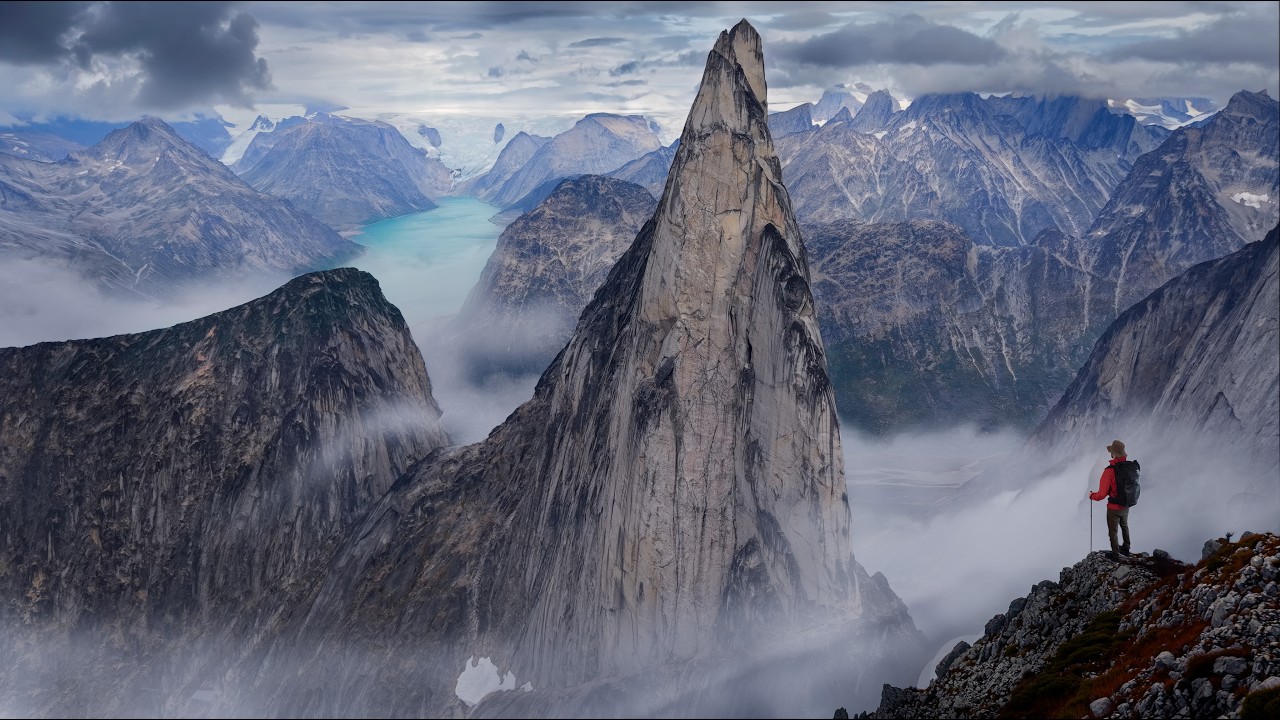
Maxim Budnick had fallen asleep on a flight from Toronto to Europe, exhausted, when he randomly woke up at 35,000 feet and looked down through a break in the clouds. Below him stretched a world of endless white, rows of massive black spires pushing upward, ice breaking across their slopes like waves. The clouds closed again before he could fully process what he’d seen. He didn’t know how and he didn’t know when, but he knew he had to go there. More than a year of planning later, he and his Xander Budnick brother were standing on the deck of a boat in southern Greenland, watching humpback whales surface in a fjord flanked by peaks more jagged than anything either of them had ever seen.
The 17-day route through the fjords of southern Greenland was, by their own admission, the most complicated trip they had ever attempted. Nine bags checked at the airport. Two of them, both canoes, went missing on arrival in Qaqortoq, forcing a two-day delay at the start. When the canoes finally appeared on the next incoming flight, Maxim described the relief as palpable. Serrano Boat Tours then carried them south to Nanortalik, a town whose name in Greenlandic translates to ‘place where the polar bears meet’, positioned at the mouth of the Tasermiut Fjord.
Into the fjord with a borrowed gun and no fresh water
Dropped off by boat into the Tasermiut Fjord, the brothers quickly discovered their first miscalculation: the glacial stream beside their intended campsite turned out to be brackish, seawater pushing in from the rising tide. They had to hike 2.5 km to reach a massive waterfall and fill their bottles. That night, sitting around a fire, Maxim casually glanced over his right shoulder and spent three full seconds deciding whether he was looking at a rock or an animal staring back at him. It was an animal. It walked straight through camp.
The wider terrain came with a borrowed firearm, a practical necessity in a place where polar bears move through the same valleys. In Greenland, Maxim noted, you can be 12 years old and legally purchase a gun, and they are available in grocery stores. The brothers kept one with them throughout the overland sections, carrying it less as a weapon than as a margin.
The interior stretch covered 60 to 70 kilometers of backcountry terrain with no trail, heavy packs, and packrafts strapped on top. One afternoon Maxim climbed alone to a saddle around 500 meters between two peaks, Xander staying in camp with a knee that couldn’t risk the mileage before a multi-day traverse. From the ridge, Maxim described the scale of the place as ‘cartoonish,’ then corrected himself: ‘Cartoonish isn’t the word because it’s like magical and mystical.’
A tent pitched inside a thousand-year-old farmhouse
The route passed through the ruins of both Norse and Inuit settlements at nearly every camp. In one valley, Maxim set up his tent and only later consulted his notes on archaeological sites to realize he had pitched it inside the footprint of a Viking homestead. He sat among the moss-covered stone walls and listened to the wind move through the fjord, turning over the story of Ivar Bardarson, the man sent by the king of Norway in 1340 to investigate why the Western Settlement had stopped paying taxes. Bardarson arrived to find empty farmhouses and livestock wandering in open pastures. No signs of struggle. No recent burials. The settlement had simply ceased to exist, and nobody has ever established where the people went.
The brothers eventually reached the Qinngua Valley, Greenland’s only natural forest, and became, as far as they know, the first people to descend its river by packraft. The packrafts made distance in 30 minutes that had taken half a day on foot. When the river forced portages, they shouldered the inflated rafts over boulder fields in the rain.
The final phase put them in canoes among icebergs that Maxim could not stop circling. He mentioned at one point, after drifting too close, that they both knew better and did it anyway. The air bubbles trapped inside those bergs, he said, were between 10,000 and 150,000 years old.
The flat iceberg that came from nowhere near here
While camped near the coast, Maxim noticed two icebergs side by side and pointed out something the locals had told him: a rounded berg calves from a nearby glacier, but any flat-topped iceberg comes from the northern ice sheet, drifts hundreds or thousands of miles around the southern tip of Greenland, and rides the tide into whatever fjord it happens to enter. The flat one in front of them had made a journey that long.
A storm chased them off the water a day earlier than planned. They packed the canoes, dried their gear on the rocks, and were picked up by boat. That evening at Minik’s house, a local contact who had helped coordinate the logistics through Sarfaq Ittuk Tours, they sat down to lamb.
‘That is so good,’ Maxim said, and meant it as a complete sentence.
Somewhere back in those fjords, pushed partly underground by centuries of permafrost, sits the stone outline of a Viking room where someone once laid hay down for a bed and listened to the door creak in the wind.
 Wake up to Only Happy News!