The yellow school bus that started its journey in Colorado rolled to a stop at the edge of a crater that has been on fire for 56 years, and the heat radiating off the Darwaza Crater hit harder than the 107-degree desert air that had been punishing the crew all day. Turkmenistan receives an estimated 8,000 to 15,000 tourists per year, which makes it the least visited country in all of Asia, and almost nothing about it works the way a traveler expects. Kara and Nate arrived on Day 30 of the Mongol Rally, stumbling off a ferry crossing that stretched to 74 hours instead of the scheduled 17, cleared customs through the night, and drove two more hours to Balkanabat before collapsing into a hotel at 4:00 a.m.
White marble, camel traffic, and the cheapest gas on earth
The first morning started before the heat peaked. The crew piled into 4x4s and spent three hours on a road so rough and fast that the drivers, completely unfazed, had to slam the brakes every few minutes for camels wandering directly into the path. Their guide called the camels traffic police. Out in the canyons, a formation locals call the dragon’s mouth rose from the landscape in shades of pale clay, and somewhere between the dry air and the cold cup of camel milk a local family offered, the trip started to feel genuinely unlike anything before it.
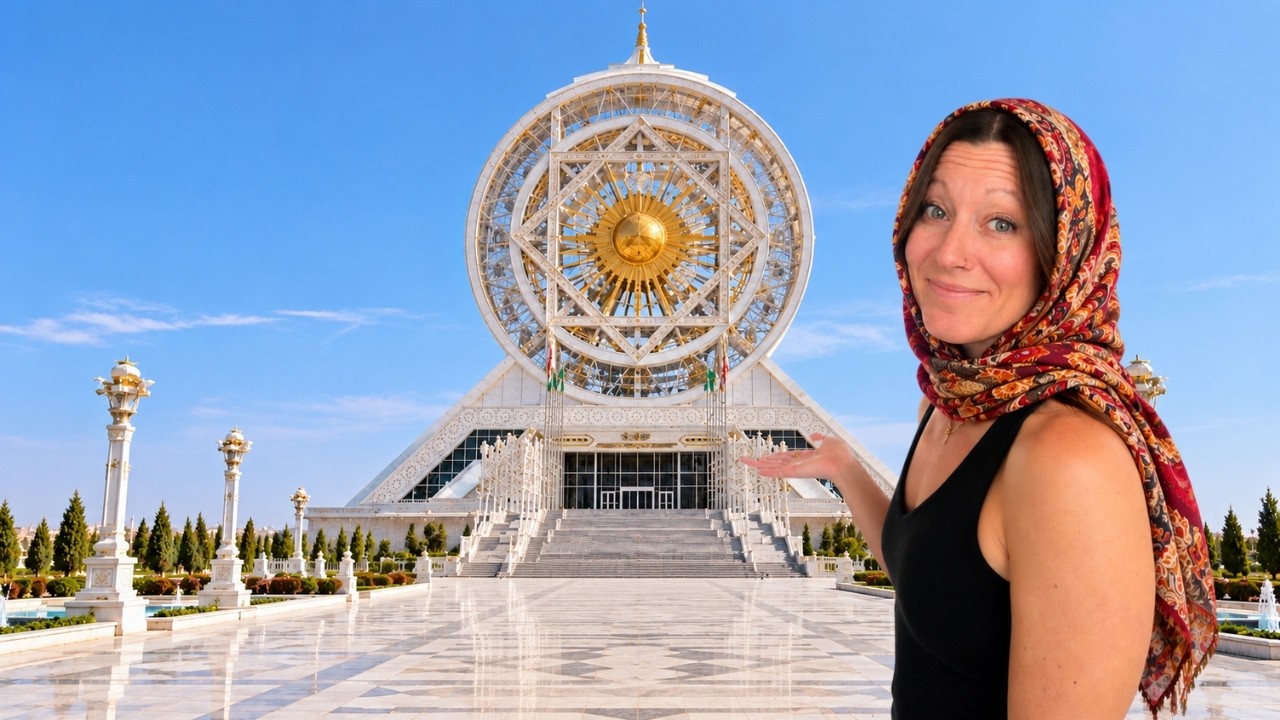
The capital, Ashgabat, delivered its own version of surreal. Because only white vehicles are permitted inside the city limits, the yellow bus had to park at the outskirts while the group transferred to a van at 2:15 in the morning. By daylight, the city revealed itself as something between a film set and a civic dream: over 500 buildings faced in white marble, a Guinness World Record for the highest white marble concentration in the world, traffic lights in white, and flags on poles engineered with a special motor to wave even when there is no wind. A 60-seat tour bus, also white, ferried the group to every major monument without once competing for a parking space. At the world’s largest indoor Ferris wheel, 450 manat bought nine tickets, under 40 US dollars, and the entire building was empty except for them.
At the Russian Bazaar, a vendor who had worked his stall for 25 years pressed slices of melon on every member of the group. One variety, which he called a Turkmen Snickers, stopped conversation. Kara described it plainly: ‘That might be one of the best things I’ve ever put in my mouth, and to know that it’s just melon.’ When the group tried to tip him, he gave them a whole free melon instead. A few stalls over, a woman selling Caspian caviar at 250 manat for 500 grams, roughly 15 US dollars, turned down a tip with a heart sign and waved them off.
Gas cost $5.80 to fill the entire tank on the last Turkmenistan fill-up. An earlier stop worked out to about $0.34 a gallon. The country’s oil is government-subsidized, and so is most of daily life: education is free, mortgages for long-serving workers carry zero interest, and gas, water, and electricity are free for residents through at least 2030, according to their guide Geldi.
The gate to hell and a night no one slept through
The two-day desert leg began with a broken AC knob, a collector’s edition Jack Daniels box repurposed as an egg carrier to protect 24 eggs across 500 kilometers of road, and a wait at the last gas station before the dunes while a diesel truck was called in to refill the pumps. When the bus finally reached the Darwaza Crater after dark, the reaction from nine people in a yellow school bus needed no narration. The crater burned in a wide circle below them, exactly as it has since Soviet drillers accidentally collapsed a rig into a natural gas pocket in 1971 and lit the leak to stop it. Geldi mentioned the fire is slowly getting smaller over the years as wind and rain smother more of the flame.
The night’s accommodation was a cluster of dome tents carpeted in thick traditional rugs with no windows. With outside temperatures still above 100 degrees, the interiors were hotter than the open air. When the generator switched off in the night, the single small ceiling fan stopped, and half the group eventually moved their bedding outside to sleep on the ground.
One thing left behind
At the Darwaza Crater’s rim, a small separate flame burns off to the right side of the main crater, low and steady against two scorched rocks.
By 6:00 a.m. the group was back on the road, pointing toward the Uzbek border with 10 hours of what Geldi called the worst road conditions of the entire route still ahead. The bus’s AC knob had broken again overnight.
 Wake up to Only Happy News!