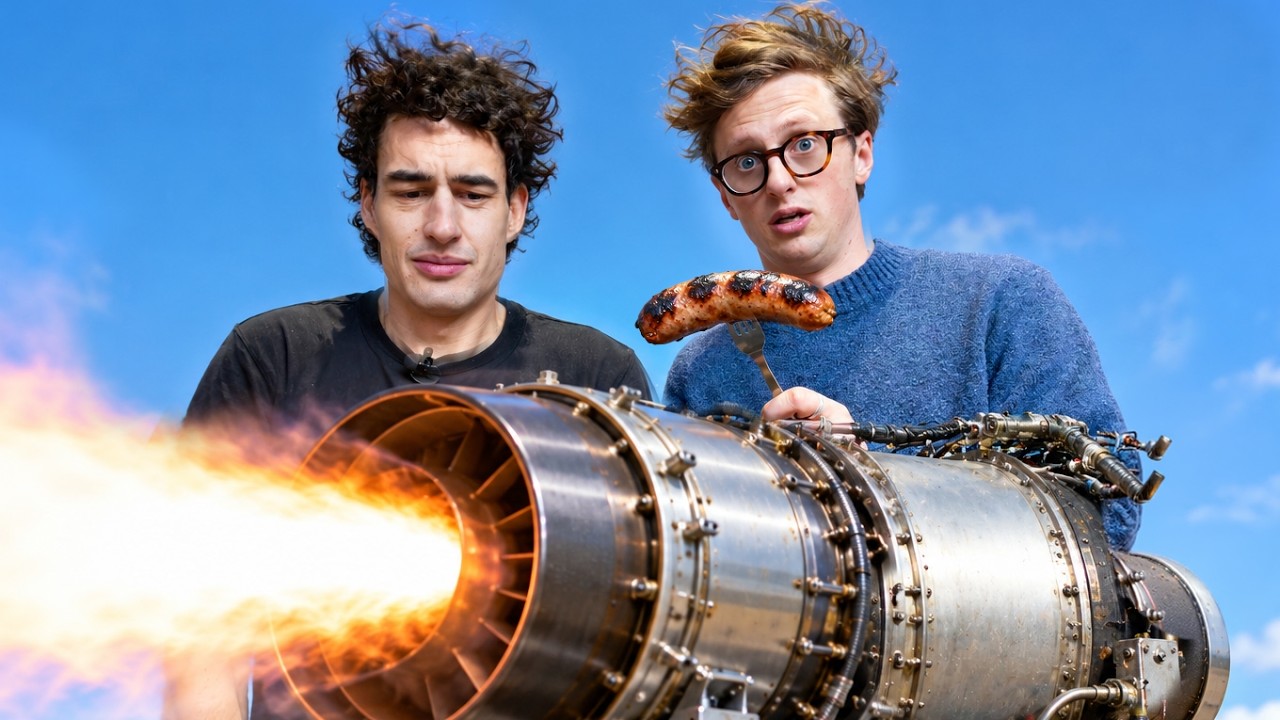
Max Fosh stood at the intake of a homemade jet engine and pushed a Cumberland sausage directly into it. Not as a stunt. As the opening move of what he genuinely believed could become a functioning barbecue. The premise sounds absurd because it is, but the engineering challenge underneath it was real, the timeline was brutal, and a small crowd of hungry Australians was already on its way. Fosh had teamed up with Alex, an Australian creator known for building things that are, by his own admission, mostly illegal, and together they had a couple of hours to turn a decommissioned death trap into the world’s first jet engine sausage sizzle.
A workshop full of things that could end you
Alex’s workshop set the tone immediately. A machete ceiling fan hung overhead. A drawer held a collection of ears. Something on the bench was described only as definitely not a gun or a bomb. And in the middle of it all sat the jet engine, a loud, fire-breathing drum that the local police had already forbidden Alex from running in his own suburb. The machine had a history; it also had a future, if Fosh and Alex could figure out what to bolt onto it.
The plan had two steps: design the barbecue, then build it. Step one produced two ideas. The first was a set of Wolverine-style claws that could hold sausages directly in front of the flame. The second was a grill mounted over the hot chamber. Step one-and-a-half, which emerged immediately after, was for Fosh to learn how to weld. Alex’s safety briefing covered the essentials: ‘If you do it wrong, you can die. But you won’t.’ Fosh welded the wiener rods together, missed at least once, and then handed the torch back. Alex finished the build in bare feet.
While Alex and a collaborator from the BoyBoy channel completed the frame, Fosh drove to the supermarket and bought every variety of sausage in stock, reasoning that since no one in human history had run this experiment before, there was no data on which type would perform best.
Thirty-two seconds to perfection
Testing moved to a friend’s remote industrial workshop, out of earshot of the police if not quite out of earshot of everyone else. A neighbor appeared almost immediately. ‘We heard it. It was pretty loud.’ Earplugs were sourced.
The Wolverine claws failed first: not enough heat. The grill failed second: same problem. Then a sausage was attached to a wire and simply thrown into the drum, which produced something technically cooked but practically destroyed. The final method, inserting sausages on a long rod directly into the engine’s core, worked in exactly 32 seconds. Four sausages came out charred on the outside and, as Fosh confirmed with some surprise, ‘actually really nice on the inside.’
Alex, characteristically understated, called it ‘a charred if not delightful sausage.’
Word spread from the noise alone. Australians arrived at the industrial park ready for a feed. Earplugs were handed out at the entrance of what Fosh announced as ‘a very modern restaurant.’ One sausage launched itself backward out of the engine and narrowly missed the cook. The rest went to the queue, free of charge, cooked by supersonic combustion, and eaten without hesitation.
The sausage that came back out
One of the bangers did not make it to a plate. It exited the engine at speed, reversed course, and returned to the chef at velocity. No one was harmed. No one was entirely surprised.
By the end of the evening Fosh and Alex had served sausages to a genuine crowd of strangers who had simply followed the sound of an engine running at full throttle in a suburban industrial estate on a weeknight. That is either the best or the most Australian restaurant opening in recorded history, and the distinction may not matter.
 Wake up to Only Happy News!