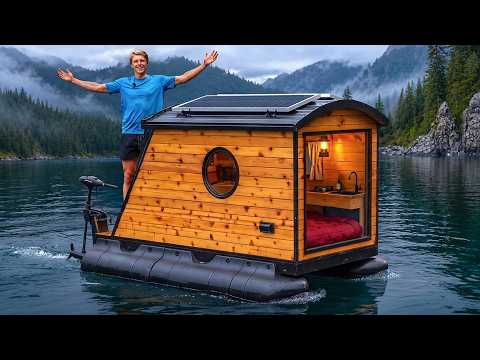
The Tiny Tanic is eight feet long, 28 square feet of floating floor space, and it is currently gliding through a sheer-walled canyon in the northeast corner of Washington state with a sirloin steak chilling in a fridge the size of a carry-on bag. David Rule built the world’s smallest houseboat from scratch in a rented farm in Central Oregon, and then he took it down 12 miles of wilderness river to reach a waterfall only accessible by boat. The question that drove the whole thing was deceptively simple: could a structure smaller than a parking space actually be lived in, cooked in, slept in, and navigated under solar power through genuine backcountry wilderness?
Building something that had no right to float
To claim the title of world’s smallest houseboat, Rule first had to find the current record holder. That search led him to Zack Bauer, the Season 3 winner of Alone turned YouTuber, whose tiny lobster-fishing houseboat built under an old rowboat hull measured 35 square feet inside, 10 feet long, 3.5 feet wide, and 4 feet tall. Rule called him directly. Bauer’s full advice: ‘Wear a life jacket and don’t sink.’
Rather than copy Bauer’s tippy single-hull approach, Rule went pontoon-style, assembling robotics-grade 18-inch diameter foam float segments like oversized Legos, three on each side, creating a platform eight feet long and 3.5 feet wide: 28 square feet total, just under the record. Cedar 2x4s formed the deck frame, six-inch Timberlok screws locked the corners, and marine-grade spar varnish sealed the whole base against river water.
The cabin itself rose from 1×2 cedar framing cut into triangular patterns for rigidity without weight. Cedar tongue-and-groove siding, finished with Penofin stain and sealer for its amber tone and deep wood penetration, wrapped the exterior. Two 15-inch round porthole windows went into the sides. A polycarbonate sheet, scored and snapped to size, filled the oversized square front window. Black satin trim tied everything together. The curved roof got a layer of quarter-inch plywood, liquid rubber membrane, and aluminum roofing panels held down with rubber-gasketed screws.
Inside the 42-inch-tall cabin: a bed the full six-foot length of the sleeping space, a 12-inch-wide countertop cabinet housing a 100-amp-hour lithium marine battery, a solar charge controller fed by two 100-watt rooftop panels, a tiny 12-volt fridge, a butane stove, and an electric water purifier that pulled lake water directly through the hull and made it drinkable at the tap. Six recessed puck lights ran across the stained cedar ceiling. A 12-volt RV fan kept the interior from becoming, as Rule put it, a sauna. The rear opening sealed with a zipper door salvaged from a canopy tent. A 30-pound-thrust Minn Kota electric motor clamped to the stern connected straight to the battery, making the Tiny Tanic effectively solar-powered.
Three days on the Pend Oreille
Rule launched at Metaline Falls on the Pend Oreille River and immediately discovered the boat was level, stable, and genuinely motorable. A fellow boater pulled alongside, looked the vessel over, and said: ‘That is cool.’ Rule spent the first four miles learning to steer while cliff faces dropped straight to the water on both sides. He made Ledbetter Cove by late afternoon, where a boat-in campsite came stocked with bear boxes, fire pits, and a standalone outerior toilet with toilet paper already loaded.
Day two brought fishing, a cliff jump, a passing rainstorm that lasted barely long enough to justify hunkering down, and a growing battery problem. The solar panels could not recharge fast enough under overcast Pacific Northwest skies, so Rule cut the motor whenever current and wind would carry the Tiny Tanic forward on their own. That evening he filleted two bass caught along the way and fried them in butter on the tiny butane stove with the cabin lens steaming up mid-cook. His verdict: ‘Long John Silver’s could never.’
On the third morning the river had risen significantly overnight from the downstream hydroelectric dam cycling the water level up and down, and the stump he had tied off to the night before was nearly submerged. The final canyon run brought the best fishing of the trip, an embarrassment of catch-and-release bass that had been nowhere the day before, and then the river opened up.
Pee Wee Falls appears around the last bend
The waterfall came into view around the final corner of the canyon after 12 miles and three days on the water.
Pee Wee Falls drops 233 feet. Rule had not expected its scale. Standing on the eight-foot deck of the world’s smallest houseboat at the base of a 233-foot waterfall, the ratio was difficult to argue with.
 Wake up to Only Happy News!