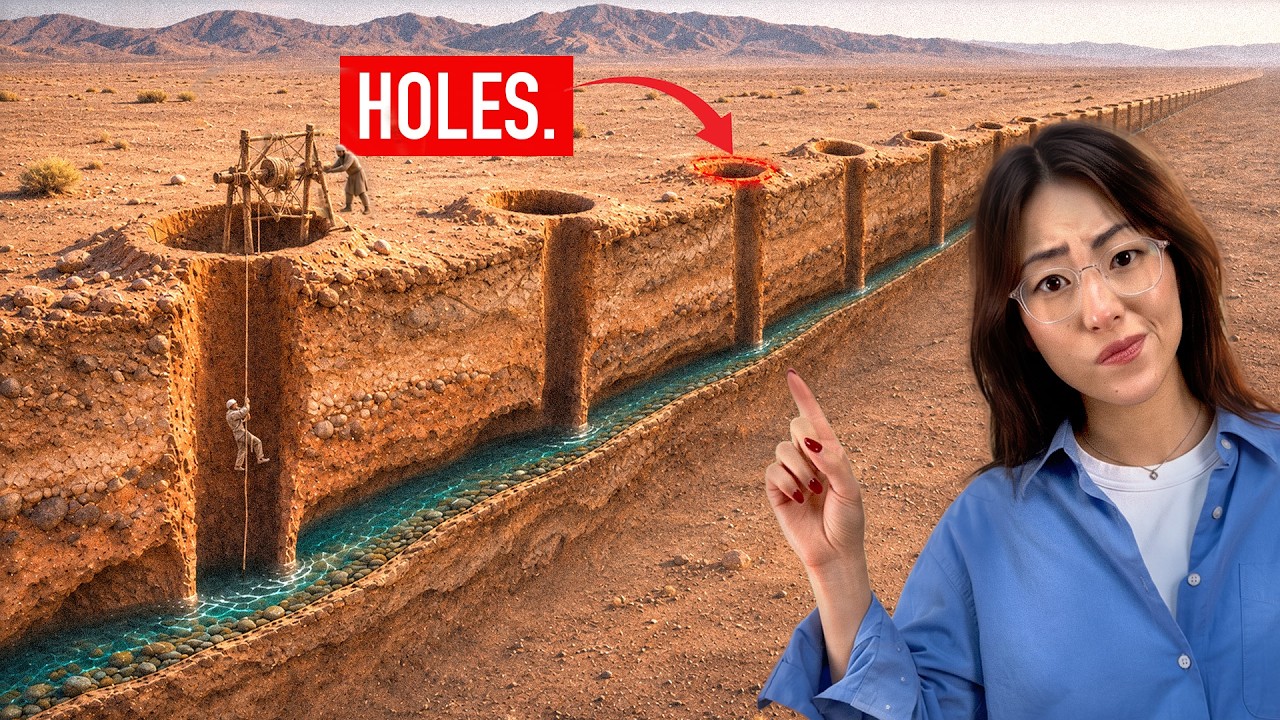
An Iranian architect arrived at a meeting last year carrying sheets of paper covered in holes. Hundreds of thousands of holes. What looked like bomb-site maps turned out to be something far older and far stranger: half a million vertical shafts sunk into the desert across the Iranian plateau, each one connected to a tunnel running for miles underground, moving water through pure gravity. And threaded through every conversation DamiLee had while researching those holes was a single word that most English speakers use without thinking twice: Paradise.
How you find water under a desert
The system has a name: qanat. And before you can build one, you have to find water that never reaches the surface. The Persian mathematician Al-Karaji wrote the manual for exactly this problem. First, study what is growing. Check the color of the soil and the texture of the rock. Drop a piece of wool into a test hole and see whether it comes up damp. When one of the test wells finally fills, that is the Mother Well.
From there, the tunnel must drop roughly one meter for every kilometer, a slope of about 1 to 1,000. Any steeper and the water erodes the sediment and destroys the channel. The shafts are marked every 30 meters along the surface. Digging crews of four worked in rotation: one digger at the face, one hauler moving soil, one person hooking loads onto a pulley, and one operating a windlass above ground. In soft ground, they lined the tunnel with baked clay hoops sourced from nearby towns. And throughout all of it, they watched the oil lamps, because a dimming flame meant the air was dying. The muqanni, as the diggers were called, had their own name for the qanat: ‘The Murderer.’ Cave-ins and bad air killed more than a few of them. They said a prayer before going in.
When everything went to plan, the water reached the surface at a point the Persians called ‘Dahan-e Farhang,’ which is also the Persian word for ‘culture.’
The microclimate that kept cities alive before electricity
Where the water surfaced, a village followed. The classical layout, called Chahar Bagh or ‘Four Gardens,’ placed water channels across the middle with cypress trees along the sides for shade and fruit. The oldest confirmed example belongs to Cyrus the Great at Pasargadae, roughly 2,500 years old, and the stone channels are still there.
In 401 BC, the Greek soldier Xenophon marched through Persian territory with 10,000 mercenaries and encountered these gardens. He wrote about them obsessively for decades afterward. In one account, a Spartan general named Lysander visits a Persian prince at Sardis and is stunned to learn that the prince laid out the whole garden himself and planted some of the trees with his own hands. A prince. Gardening. The concept of a walled, watered, living landscape in the middle of a desert was simply new to a Greek mind.
The garden was only the visible part of a much larger machine. At the head of each garden stood a tower called a Badgir, a windcatcher, which pushed air down a shaft. The water evaporated and cooled that air, which then moved out through arches into the garden. In a typical courtyard house in Yazd, most built around the 1800s, the qanat fed a central pool, the windcatcher kept the house breathing, and the thick mud-brick walls delayed heat transfer by roughly six hours. Families moved through the house across the day, shaded lower rooms in the afternoon, and rooftop terraces at night. Those terrace rooms were called ‘moonlight rooms.’
The system even produced ice. A structure called a yakhchāl used a massive shading wall next to a shallow pond, fed by qanat water. In winter, with the sun sitting low, the wall kept the pond in permanent shade until it froze. The ice was broken up and stored in insulated pits with mud-brick walls up to two meters thick, then saved for summer. The 17th-century French gem dealer Tavernier documented his shock at being handed chilled wine in the desert heat by a local man who offered it with what Tavernier could only describe as ‘regional pride.’
The operating system that is now gone
The qanat was never just infrastructure. It was a governance system. Water was divided between shareholders by time, not volume, and managed by an elected water chief called a mirab. At one site, eight mirabs each ran the rotation for one day, ensuring every person received their allotted minutes. The mirabs were paid in water: 22 minutes per day they served. Surplus water moved through neighborhoods, powered watermills, reached public cisterns called ab anbar, and fed public baths. Farmers flooded fields from elevated channels. Each system was adapted entirely to its local geography.
Starting in the 1960s, motorized deep wells spread across the plateau. They are easier to drill and run on demand rather than on a water-rotation calendar. By 2016, Iran had moved from roughly 100,000 wells in the mid-1970s to over 700,000. The country now uses about 100,000,000,000 cubic meters of water per year. Even if every qanat in Iran were rebuilt and running, they could supply only around 18,000,000,000 cubic meters. The wells were never just a replacement; they drew from the same finite aquifer with no division system in place.
The ground is sinking. In places like Rafsanjan, the land is dropping more than 35 centimeters a year. One study mapped 106 sinking zones across the country. Cracks have appeared in roads, railways, and pipelines. The political scientist Elinor Ostrom, whose research on shared resource management earned her the Nobel Prize in 2009, studied places where this kind of collapse had been avoided: thousand-year-old irrigation channels in Valencia, alpine pastures in Switzerland, and an aquifer in Los Angeles that was saved in 1947 when users sat down, wrote their own rules for extraction, and cut pumping by a third within 20 years. Her finding was consistent across every case: a shared resource does not fail because it is shared. It fails when it is shared and nobody is managing it.
The qanat came with that management built in. The wells arrived without it.
The word that crossed every border
The Persian poet Hafez, writing in Shiraz in the 1300s, described a stream called Roknabad, a qanat, as a place so beautiful that heaven was the second-best option. Scholars have debated for centuries whether he meant it literally or metaphorically. The word Pairidaeza, meaning ‘a walled garden,’ passed into Greek as Paradeisos, a real royal park you could walk into. Hebrew borrowed it as an orchard. Greek translators of the Hebrew Bible needed a word for the Garden of Eden and chose Paradeisos. Latin rendered it as Paradisus. English landed on Paradise, meaning heaven itself. DamiLee put it plainly: ‘in every translation it strips out the physical infrastructure. And now Paradise could be a beach, or a garden, or a castle on a fluffy cloud. Paradise is a place you’ve never really had to build. Or maybe it’s a place you’ve forgotten how to build.’
The stone that still splits the water
At the division point along one qanat in the Pahlavanpour system, a stone sits in the channel and splits the flow. One fifth branches toward farmland. The rest continues. The stone itself has no moving parts and requires no electricity. It has been splitting water between people for centuries.
The water keeps moving downstream toward orchards and rose fields around Kashan. In Qamsar, the flowers are picked and distilled into rose water. The harvest has its own festival. The qanat is still there, underneath all of it.
 Wake up to Only Happy News!