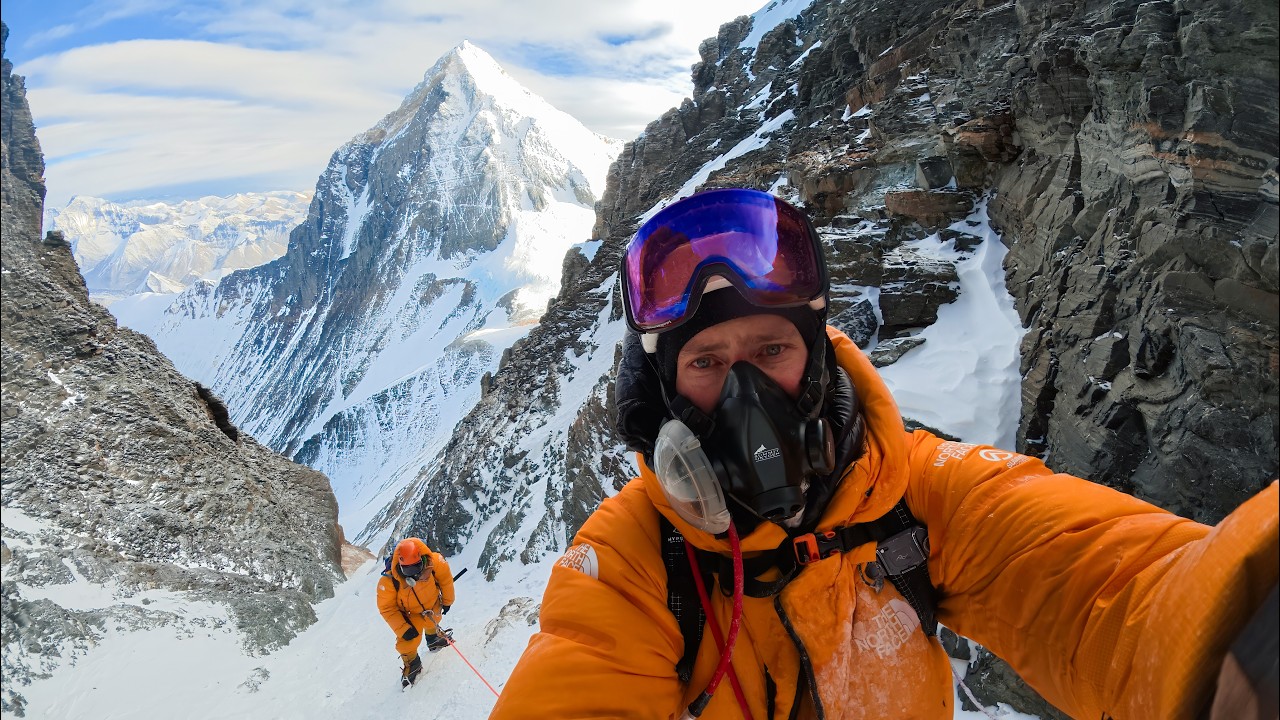
Xander Budnick stood at the top of the world and had almost nothing to say. ‘That’s it,’ he managed, voice stripped bare by altitude and exhaustion. ‘That’s the top of the world. I don’t know what to say. Got to get down.’ For anyone who had watched him pull empty vodka bottles from a drawer a few years earlier, searching for the dregs of a drinking habit that had swallowed his twenties whole, those few words carried the full weight of the climb below.
Some ascents are measured in meters. This one is measured in what had to be dismantled first.
The person who showed up at base camp
Budnick did not arrive at Everest Base Camp as a polished expedition athlete. He arrived as someone who had spent his mid-twenties deep in alcohol and drug dependency, who had checked himself into a 19-day residential treatment program, and who had spent the following years slowly reconstructing a life around the outdoors he had abandoned. The route back ran through the Annapurna Circuit, then Aconcagua at nearly 7,000 m, then Denali, five volcanoes in Ecuador, Chimborazo at roughly 6,800 m, and finally Ama Dablam. Each summit was a test to see whether the next one was worth attempting. Chimborazo passed him. Everest was next.
The team that gathered at base camp on the Khumbu Glacier at 5,300 m included Chris, a Californian who had previously climbed Manaslu, and Brett, a Canadian whom Budnick had met on Ama Dablam. Their lead guide, Gesman Tamang, carried a resume that included K2, Annapurna, and Everest. Personal guide Bire, assigned to summit day, had climbed Everest, Lhotse, Makalu, and Manaslu. The expedition also introduced a distinction that Budnick paused to explain: Sherpa is an ethnic group from the Solu-Khumbu district, their biology shaped by generations of living above 3,500 m, and the name became shorthand for all Himalayan guides. Most of Budnick’s team, including Gesman, were Tamang, from the hill districts around Kathmandu. ‘A different culture, a different history,’ Budnick noted, ‘and a team good enough to be standing at the foot of Everest.’
Sixty days is not long enough to stop worrying
The two-month window exists because Everest’s summit is only accessible for roughly two weeks in May, when the jet stream briefly lifts off the peak and before the summer monsoon closes everything down. Miss it, and the expedition is over. This season, an enormous serac hanging over the Khumbu Icefall delayed the fixed lines for weeks. When the route finally opened beneath the unresolved ice, the team moved through. Twenty minutes after Budnick and his group cleared that section, the serac collapsed. Two climbers were evacuated by helicopter. ‘That’s just pure chance,’ Budnick said afterward. ‘I don’t like that.’
Acclimatization rotations took the team up to Lobuche East at roughly 6,000 m, then across to Mera Peak by helicopter while the icefall remained closed, then up to 6,800 m or 6,900 m on the Lhotse Face before the rope-fixing team’s progress set the ceiling. At Camp Three, 7,100 m, an exhausted climber named Cole, who had just summited both Everest and Lhotse, paused long enough to attempt a world record for the highest formal dinner party before descending. Black tie, he insisted, was compulsory.
The actual summit push departed in the dark from Camp Four at 7,900 m, inside the death zone, with wind gusts forecast to hit 50 km/h and a temperature window his contact Justin Sackett pegged at roughly nine to three hours between viable and dangerous. A GPS watch near the Chinese border added a brief panic when it jumped two time zones forward and briefly convinced Budnick he had two hours less sleep than he thought.
Then daylight, and no place higher.
Afterward, Budnick, Chris, Jivan, and Bire descended and immediately turned their attention to Lhotse, the fourth-highest mountain on the planet. They summited that too.
The question George Mallory never answered
Sitting in Namche during the first acclimatization stop, Budnick returned to the question that has circled this mountain for a century. Mallory’s answer, ‘because it’s there,’ struck him as both beautiful and completely unsatisfying. His own answer arrived not as a line but as a feeling: ‘I used to smoke and drink till I couldn’t feel. The mountains, they make me want to feel alive.’
At the top of Tukla Pass, surrounded by stone cairns marking more than a hundred years of deaths on Everest, he had stood among the rock piles and noted what history keeps confirming. The mountain has claimed over 340 lives. It does not care how prepared you are.
Somewhere below the summit, still on the Lhotse Face, Budnick crossed 7,000 m, the altitude at which he surpassed Aconcagua, the highest point he had ever reached. Every step above it was new ground.
The boots he wore to keep his toes attached, the summit suit that would hold the cold back, the team of guides whose cumulative summits across the 8,000 m peaks number in the dozens: none of it resolved the original question. It just changed what it felt like to ask it.
 Wake up to Only Happy News!